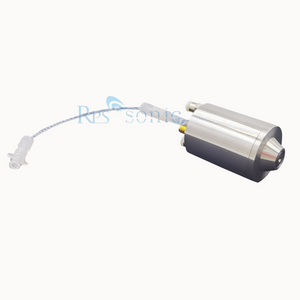
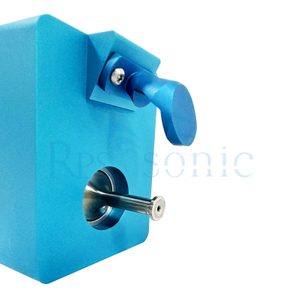
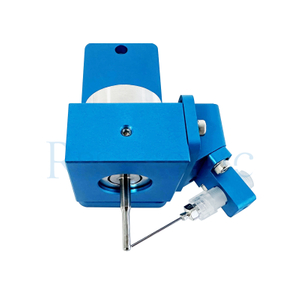
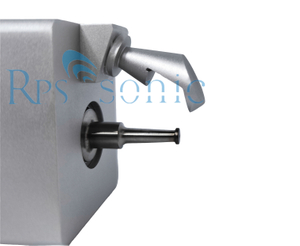
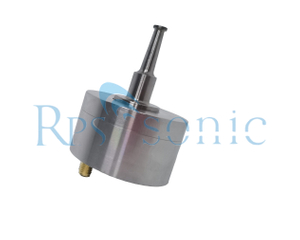
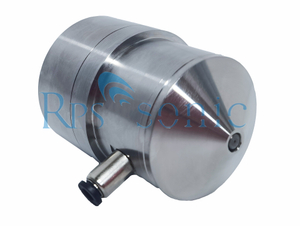
High Frequency 30khz Ultrasonic Spray Wider Nozzle Spraying Coating Machine for Slurry Coating
Description
An ultrasonic spray nozzle, also known as an ultrasonic atomizer, is a device that utilizes ultrasonic vibrations to generate a fine spray or mist of liquid droplets. It is commonly used in applications such as coating, humidification, fuel injection, and chemical reactions.
It is an advanced precision coating system designed for uniform application of slurry, suspension, and functional liquid materials. It utilizes high-frequency ultrasonic atomization technology to break liquid into fine, consistent micro-droplets, which are then evenly distributed over the target surface through a wide spray nozzle system.
Unlike conventional air-spray methods, ultrasonic spraying does not rely on high-pressure air to atomize liquids, resulting in a more controlled, efficient, and material-saving coating process. It is widely used in industries requiring high uniformity, thin film precision, and repeatable coating quality.
The system is suitable for laboratory research, pilot production, and industrial-scale coating applications, especially where slurry-based materials are involved.
Working Principle: From "High-Pressure Extrusion" to "Gentle Atomization"
Core Mechanism: A piezoelectric transducer converts electrical energy into high-frequency mechanical vibration (typically between 20kHz and 200kHz). This high-frequency vibration generates "capillary waves" on the nozzle surface, breaking up the slurry flowing across the surface into uniform micron-sized droplets.
Key Difference: Unlike traditional spraying processes that rely on high-pressure airflow or hydraulic pressure, ultrasonic spraying technology is much gentler. With the assistance of a very low-pressure carrier gas, droplets can be precisely deposited onto the substrate to form a dense, uniform coating.
Core Technological Advantages
Ultrasonic spraying is considered a key technology in lithium battery manufacturing primarily due to its significant advantages in coating quality and cost-effectiveness:
More Uniform Coating: The droplets generated by ultrasound are highly consistent in size, effectively avoiding the "coffee ring effect" and edge particle aggregation common in traditional spraying. Coating thickness uniformity can be easily controlled to over 95%, and thickness deviations can even be compressed to within ±3%, which is crucial for improving cell consistency.
Thinner Coating Capability: This technology can precisely manufacture ultra-thin coatings ranging from tens of nanometers to tens of micrometers.
Higher Utilization Rate: Due to virtually no splattering or overspray, material utilization can reach 85% to 95%, more than four times that of traditional two-fluid spraying. This is extremely beneficial for expensive precious metal catalyst layers (such as platinum) or nanomaterials.
Clog-Free Design: The slurry does not need to be squeezed through tiny nozzles under high pressure; instead, it is atomized by ultrasonic energy, physically eliminating nozzle clogging. Some advanced designs even achieve stable spraying with "no pressure, no clogging, and no residue." Better Interface Control: By adjusting spraying parameters, the pore structure of the coating can be actively designed; it also enables gradual transitions between layers such as electrodes and electrolytes, i.e., gradient coatings, optimizing interface compatibility.
More Environmentally Friendly Process: Eliminating the need for high-pressure air reduces solvent evaporation, making it greener and lower-carbon, and also reducing environmental impact and waste gas treatment costs. Broadly speaking, for those focusing on R&D or preparing small-sized samples, desktop/laboratory equipment is the starting point; for pilot-scale production or preparing larger-area samples, vertical/medium-sized equipment is more suitable; and for mass production, industrial online equipment that can be integrated into the production line is required.
Here's how an ultrasonic spray nozzle typically works:
1. Ultrasonic transducer: The core component of an ultrasonic spray nozzle is an ultrasonic transducer. It usually consists of a piezoelectric element, such as a piezoceramic disk, that can convert electrical energy into mechanical vibrations. When an alternating current (AC) voltage is applied to the piezoelectric element, it causes it to vibrate at ultrasonic frequencies,typically in the range of 1 to 100 megahertz (MHz).
2. Liquid supply: The liquid to be sprayed is supplied to the ultrasonic spray nozzle. It can be a solution, suspension, or any
other liquid that needs to be atomized into small droplets.
3. Vibrating plate: The ultrasonic transducer is coupled to a vibrating plate or diaphragm. This plate is typically made of a
thin metal or ceramic material and acts as a surface for the liquid to rest upon.
4. Cavitation and atomization: As the ultrasonic transducer vibrates, it induces high-frequency pressure waves in the liquid resting on the vibrating plate. These pressure waves create microscopic cavitation bubbles in the liquid. Cavitation is the rapid formation and collapse of bubbles in a liquid due to pressure changes. When the bubbles collapse, they generate localized shockwaves and intense energy. This energy disrupts the liquid surface, causing it to break up into small droplets.The size of the droplets can be controlled by adjusting the parameters of the ultrasonic vibrations.
5. Spray formation: The liquid droplets generated by the cavitation process are then expelled from the ultrasonic spray nozzle as
a fine mist or spray. The spray can be directed to a specific target or area as required.
Parameter:
| Item | Parameter |
| Frequency | 30Khz |
| Power | 10~100w |
| FLOW RATE (ml/min) | <120 ml/min |
| Spray width | 50-80mm |
| Solution utilization | above 98% |
Features
Uniform coating: uniformity >95%
Saving raw materials: raw material utilization rate is over 85%, 4 times that of traditional air spray nozzle
High control accuracy of coating thickness : 20 nm to tens of micron coatings can be precisely sprayed.
Non clogging
Anti-corrosion nozzle
High precision, high controllable spray.
Ultrasonic atomization provides extremely fine and uniform droplet distribution, resulting in smoother coating surfaces and improved film consistency compared to traditional spray methods.
The system significantly reduces material waste by eliminating overspray and rebound loss, making it more cost-effective and environmentally friendly.
It enables low-pressure, non-contact coating, which helps protect sensitive substrates and prevents surface damage or deformation.
The wide nozzle design increases production efficiency by covering larger areas in a single pass, reducing cycle time and improving throughput.
Compared to conventional spraying systems, it delivers better coating precision, higher repeatability, and more stable long-term performance.
Application:
Battery electrode coating (lithium-ion batteries)
Fuel cells and energy material coating
Solar cell and photovoltaic film coating
Ceramic slurry and functional coating layers
Electronic component protective coating
Medical and pharmaceutical surface coating
Thin film and nano-material deposition
Precision industrial surface treatment