Application of Ultrasonic Homogenizing Equipment in The Herbal Extraction Industry
The application of ultrasonic homogenizing equipment in the herbal extraction industry is rapidly gaining momentum, becoming an advanced technology to replace traditional high-temperature, long-duration extraction methods due to its significant advantages in high efficiency, environmental friendliness, and protection of active ingredients. It utilizes the "cavitation effect" generated by ultrasound in liquids to efficiently break down plant cell walls, allowing for the rapid release of active ingredients.
Core Technology Principle: Cavitation Effect The core of ultrasonic homogenization technology is the cavitation effect. When high-intensity ultrasound propagates in a liquid, it alternates between high and low pressure. In the low-pressure phase, tiny vacuum bubbles form in the liquid; in the subsequent high-pressure phase, these bubbles are instantly compressed until they burst.
The instant the bubbles burst releases enormous energy at a microscopic scale, creating localized high temperatures (up to several thousand degrees Celsius), high pressures (up to several thousand atmospheres), and intense shock waves and microjets. This powerful physical force effectively impacts and breaks down the tough cell walls and cell membranes of plants, allowing the active ingredients (such as flavonoids, polysaccharides, and alkaloids) originally encapsulated within the cells to be rapidly and fully released into the extraction solvent.
Key Advantages: Compared to traditional extraction methods such as boiling and reflux, ultrasonic homogenization technology offers significant advantages in herbal extraction:
1. High extraction efficiency and short time: Ultrasonic waves can instantly disrupt cell walls, greatly accelerating the dissolution rate of active ingredients. The processing time for a single sample can be reduced from 5-10 minutes using traditional methods to 2-5 minutes. A study on rosemary essential oil extraction also confirmed that this pretreatment method shows significant advantages in yield, efficiency, and chemical composition.
2. Protection of heat-sensitive active ingredients: The entire extraction process does not require high temperatures and is typically carried out at a low temperature of 40-50℃. This is crucial for protecting precious active ingredients that are heat-labile, easily hydrolyzed, or oxidized (such as certain alkaloids and flavonoids).
3. Economical and environmentally friendly: Due to its fast extraction speed and high efficiency, this method significantly saves time, energy, and solvent consumption. Furthermore, as a "green" technology, it greatly reduces the use and emissions of organic solvents, better meeting modern environmental protection requirements.
4. High Extract Purity and Activity: Mild extraction conditions better preserve the natural configuration and bioactivity of the extract. For example, studies have shown that essential oils obtained using this method exhibit higher antioxidant and antifungal activity.
5. Typical Applications and Process Flow: Ultrasonic homogenization technology is widely used in herbal extraction and is often combined with other technologies to form synergistic processes:
Synergistic Extraction Process: In the extraction of saponins from Acanthopanax senticosus, a synergistic method of "salt-assisted + homogenization + ultrasound" (SHAUE) was used. Homogenization first involves mechanical disruption, and then ultrasound further enhances cell wall disruption and mass transfer through cavitation, ultimately achieving a saponin extraction rate of 3.29% and a purity of 62.57%.
Pretreatment Enhancement Process: In the extraction of rosemary essential oil, "homogenization-ultrasound" pretreatment (HUP) is used first, followed by microwave water distillation. The synergistic effect of homogenization and ultrasound significantly promotes the separation of essential oils, ultimately achieving a eucalyptol percentage of 36.73±1.18%.
Complete Process Flow: A typical industrial application usually includes the following steps:
Raw Material Pretreatment: The herbal plants are washed, dried, and pulverized.
Mixing: The pretreated raw materials are mixed with an extraction solvent (such as water, ethanol, etc.) at a certain ratio (e.g., 1:5 to 1:10).
Ultrasonic Homogenization Extraction: Extraction is carried out in an ultrasonic homogenizer, typically for several minutes to tens of minutes.
Solid-Liquid Separation: The extract is separated from the plant residue by filtration or centrifugation.
Purification and Concentration: The extract is further purified (e.g., using macroporous adsorption resin), concentrated, and dried to obtain the final product.
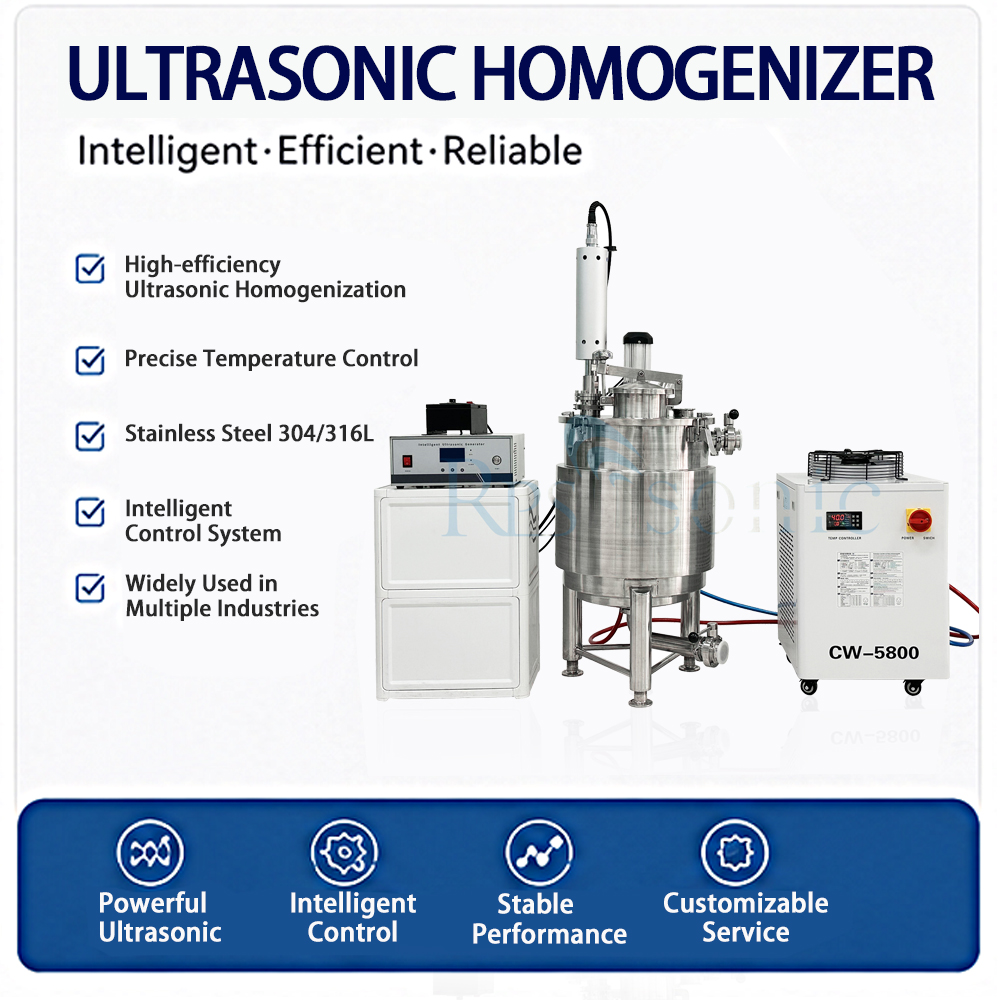
Equipment Types and Selection: RPS-SONIC offers a variety of ultrasonic equipment to suit different scenarios:
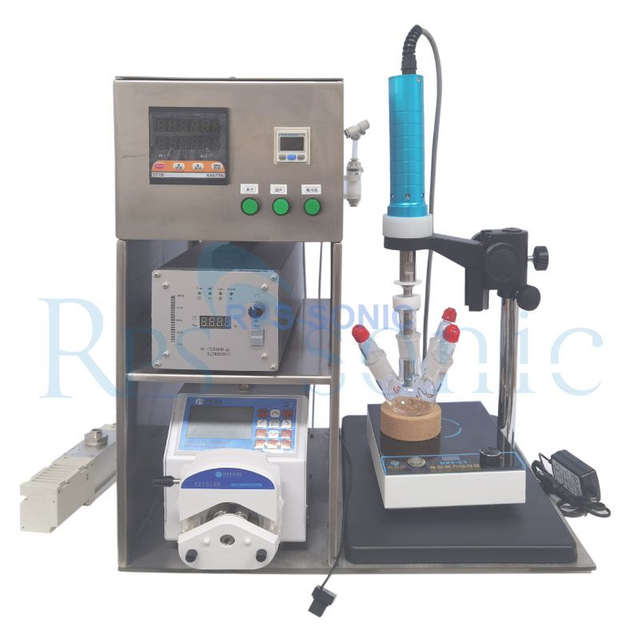
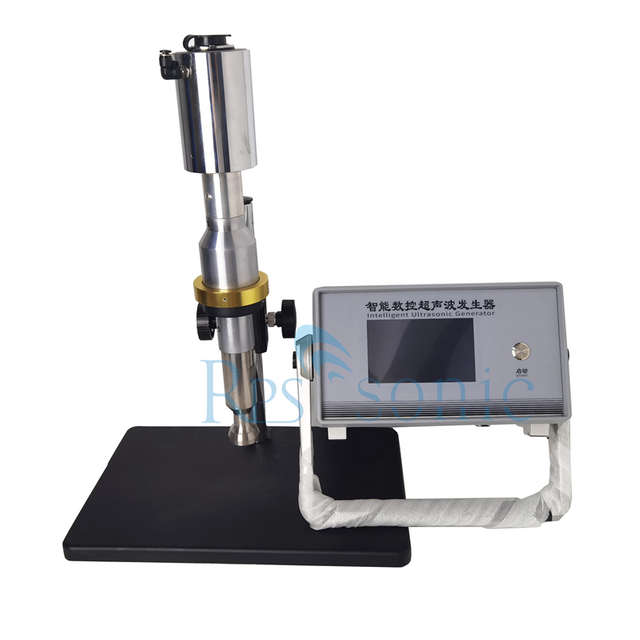
Laboratory-Grade Equipment: Primarily used for research and development and small-batch sample processing.
For example, the RPS-SONO20-1500, with a power of 1500W, a frequency of 20kHz, and a built-in touchscreen, offers comprehensive functions and is suitable for laboratory use.
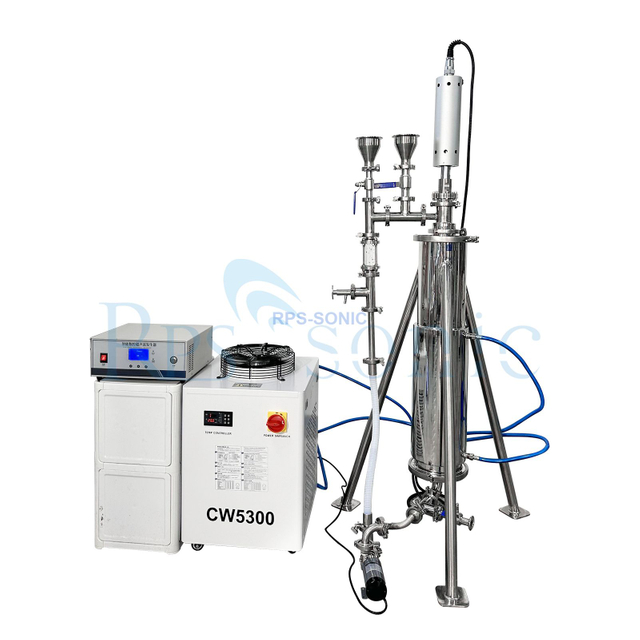
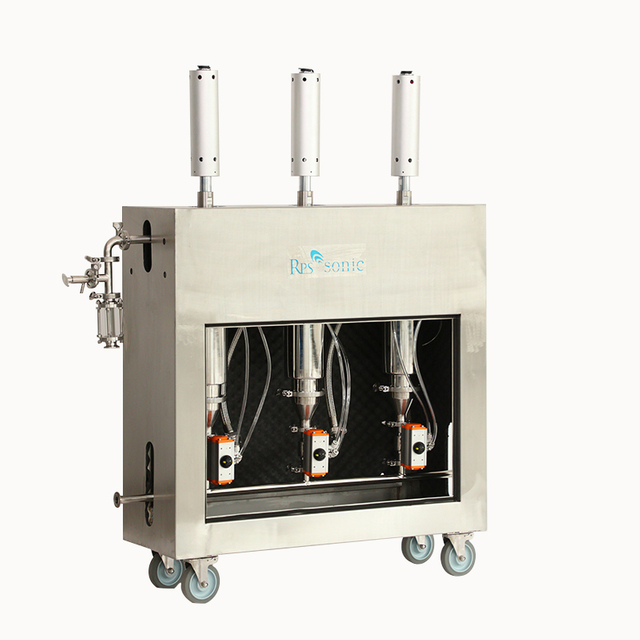
Industrial-grade equipment: Used for large-scale continuous production, with processing capacities ranging from a few liters to hundreds of liters per hour.
For example, the RPS-SONO20-50L model has a power of 3000W and a processing capacity of 50L; while the RPS-SONO20-100L model boasts a power of up to 6000W and a processing capacity of up to 100L.
Key selection parameters:
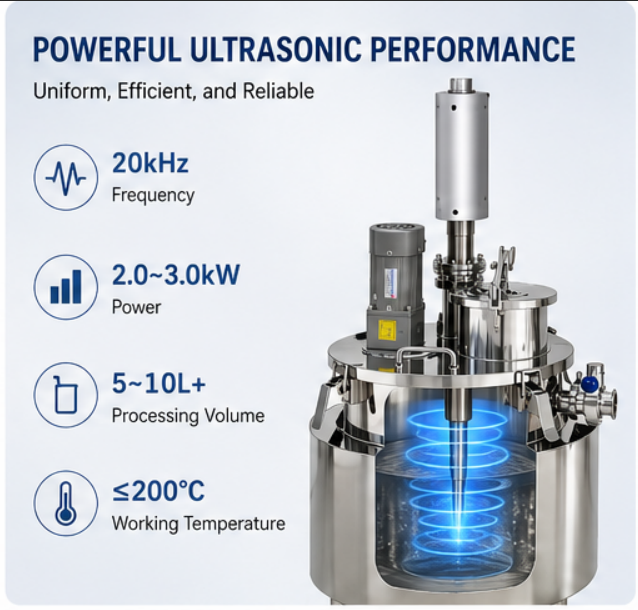
Power: Determines processing capacity and effectiveness. 1000-1500W is suitable for soft rhizomes, while 2000-3000W may be required for hard woody rhizomes.
Frequency: The commonly used frequency is 20kHz.
Amplitude transducer (probe): The component that directly contacts the sample; it is typically made of high-strength, corrosion-resistant titanium alloy.
Summary and Outlook: In conclusion, ultrasonic homogenizers, through their unique "cavitation effect," provide an efficient, green, and high-quality solution for herbal extraction. It not only significantly improves extraction efficiency and yield, but also protects precious heat-sensitive active ingredients at low temperatures, ensuring the quality of the final product.
As the plant extraction industry continues to demand higher quality and efficiency, and with ongoing technological optimization, ultrasonic homogenization technology will play a greater role in food, nutritional supplements, pharmaceuticals, and many other fields, becoming one of the key technologies driving the high-value utilization of herbal resources.