Application of ultrasonic atomization technology in the new energy industry
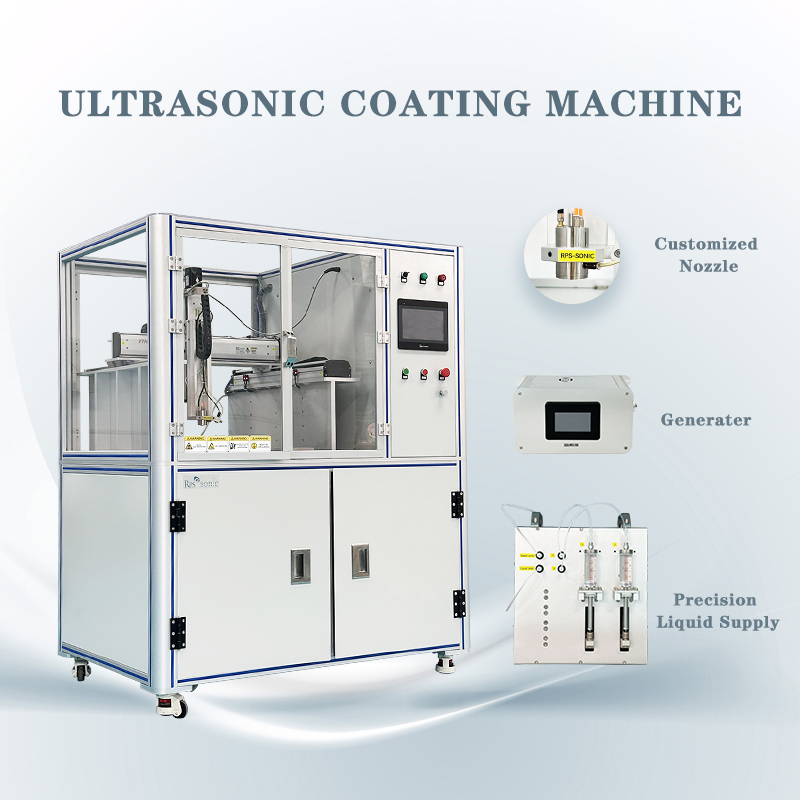
Ultrasonic atomization spraying technology, with its core advantages of high precision, high uniformity, high material utilization, and non-contact, gentle process, is becoming a key force driving the upgrading of the new energy industry. This technology uses high-frequency ultrasound to atomize liquids into uniform droplets at the micron or even nanometer scale, which are then precisely deposited onto the substrate surface using a low-pressure carrier gas. From lithium-ion batteries to hydrogen fuel cells, and to next-generation solar cells, ultrasonic atomization spraying is comprehensively empowering new energy manufacturing.
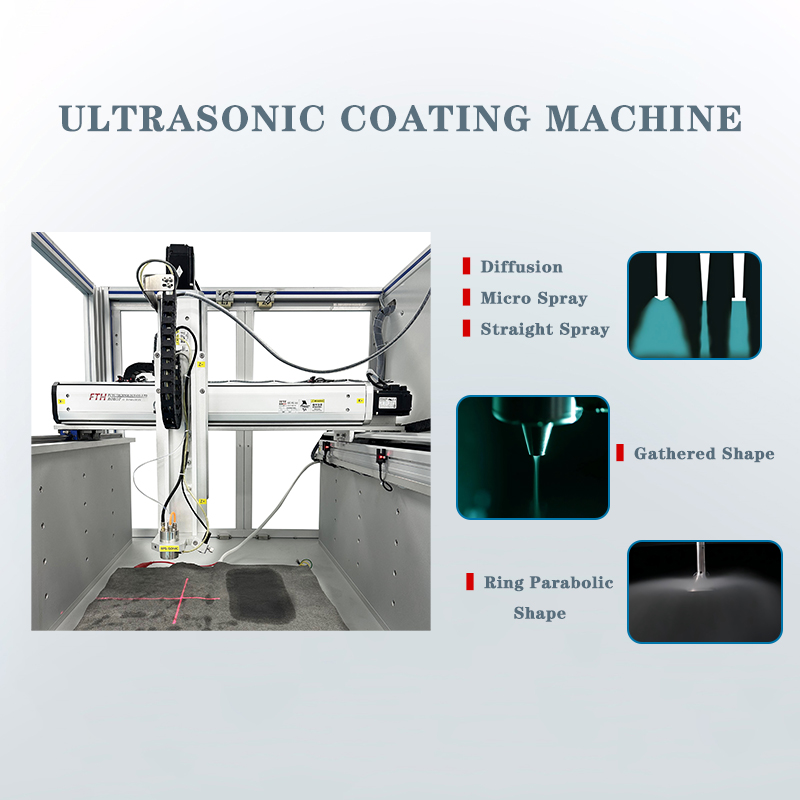
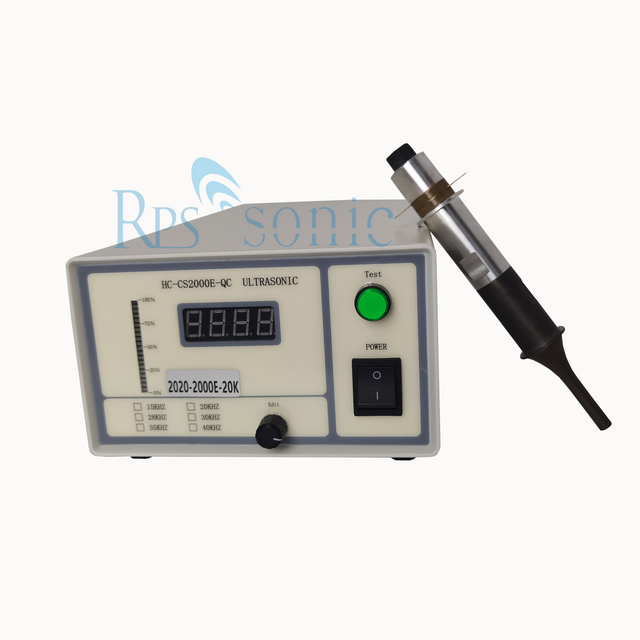
Core Technology Principle: The core of the ultrasonic atomization spraying system is the piezoelectric transducer. When a high-frequency current (typically 20kHz-120kHz) is applied to the system, the transducer generates high-frequency mechanical vibration. This vibration forms a standing wave in the liquid film at the nozzle, "breaking" the liquid into micron-sized droplets (typically 1-50μm in diameter) with a concentrated size distribution. The atomized droplets are directionally transported to the substrate surface, where they dry and solidify to form a dense and uniform functional coating. Unlike traditional spraying methods that rely on high-pressure airflow or mechanical pressure, this process requires no high pressure or violent impact, making it a non-contact precision coating process.
Core Advantages
Ultrasonic atomization spraying technology exhibits significant advantages in multiple dimensions in new energy manufacturing:
* **Excellent Coating Uniformity:** The narrow droplet size distribution allows for coating thickness deviations to be controlled within ±5%, effectively avoiding defects such as streaks, pinholes, and edge effects common in traditional processes. This is crucial for devices with extremely high consistency requirements, such as batteries and fuel cells.
* **Extremely High Material Utilization:** The atomization process eliminates high-pressure airflow dispersion, ensuring stable droplet trajectories and enabling precise point-to-point deposition. Material utilization rates can reach 85%-95%, far exceeding the 30%-50% of traditional spraying. For precious metal catalysts and high-value battery materials, this advantage directly translates into significant cost savings.
* **Ultra-Thin Coatings:** Ultrasonic spraying can easily prepare extremely thin (≤10μm or even nanometer-scale) and uniform coatings. This is particularly critical for the fabrication of functional layers such as electrolyte layers and high-performance electrodes in solid-state batteries.
Non-contact process, protecting substrates: Low-speed carrier gas delivery of droplets, without severe impact, effectively protects fragile substrates such as ultra-thin electrodes (below 6μm), flexible diaphragms, and proton exchange membranes from damage.
Green and environmentally friendly: No high-pressure air is required, reducing organic solvent evaporation by 30%-50%, aligning with the low-carbon manufacturing trend in the new energy industry.
Core Applications in the New Energy Field
I. Lithium-ion Battery Manufacturing
Ultrasonic spraying technology has been deeply applied in multiple stages of lithium-ion battery manufacturing:
1. Electrode Preparation (Positive/Negative Electrode)
A slurry containing active materials (such as lithium cobalt oxide, high-nickel ternary NCM811/NCA, graphite, silicon-carbon, etc.) mixed with conductive agents and binders is uniformly sprayed onto a metal foil current collector. Ultrasonic spraying can achieve ultra-thin and uniform electrode coatings, avoiding the "edge effect" or cracking problems common in traditional coatings, and improving the consistency of electrode thickness. For special slurries such as high-nickel positive electrodes and silicon-carbon negative electrodes, the equipment can adjust the vibration frequency to adapt to the viscosity and particle characteristics of different slurries, avoiding slurry agglomeration. Studies show that this technology can increase battery energy density by more than 15%.
2. Functional Coating of Separators
Uniformly spraying a ceramic coating (such as Al₂O₃/SiO₂ nanoparticles) or a polymer coating onto the surface of a PP/PE-based separator can significantly enhance the separator's heat resistance (ceramic coatings can withstand temperatures >200℃), electrolyte wettability, and mechanical strength. This technology can also precisely control the coating's porosity (typically >40%) and pore size distribution (<1μm), balancing ion conductivity and dendrite blocking ability. Improved coating effectively suppresses separator thermal shrinkage, prevents internal short circuits in the battery, and enhances safety.
3. Solid-State Batteries
Ultrasonic spraying is one of the few feasible processes for fabricating key components of solid-state batteries. It can be used to spray solid electrolyte layers (oxides/sulfides) to achieve submicron-level ultrathin (0.5-5μm) defect-free coatings. Its low-temperature process characteristics avoid material decomposition caused by high-temperature sintering, making it particularly suitable for the film formation of temperature-sensitive solid electrolytes. Simultaneously, spraying a buffer layer (such as LiLaZrO₃) at the electrode/electrolyte interface can effectively reduce interfacial impedance and improve the cycle stability of the entire cell.
4. Other Functional Coatings
Ultrasonic spraying can also be used for tab protection coatings (to prevent electrolyte corrosion), anti-corrosion coatings for battery casings, conductive layers for current collectors (spraying a carbon layer onto foil to reduce interfacial impedance), and precise spraying of microelectrode patterns for flexible batteries (spraying onto flexible substrates such as PET/PI to avoid mechanical damage) and microcells.
II. Fuel Cell Manufacturing
The membrane electrode assembly (MEA) is the core of a fuel cell, and its fabrication quality directly determines the battery's power density, stability, and lifespan. Ultrasonic spraying technology is triggering a precision revolution in fuel cell manufacturing:
1. Catalyst Coated Membrane (CCM) Preparation
Ultrasonic spraying can atomize catalyst slurries (such as platinum-carbon catalysts) into micron- or even nanon-sized droplets, precisely depositing them onto the surface of the proton exchange membrane or gas diffusion layer substrate to form a dense and uniform catalyst layer. 1. Narrow Droplet Size Distribution from Atomization: Atomization allows for control of catalyst layer thickness deviation within ±5%, providing a uniform three-phase reaction interface for electrochemical reactions.
2. Significantly Improved Utilization of Noble Metal Catalysts
Traditional spraying methods achieve less than 30% utilization of precious metals such as platinum. Ultrasonic spraying technology, through optimized atomization parameters and trajectory control, can increase platinum catalyst utilization to 90% while reducing material consumption by 50%. The non-clogging design of the equipment reduces maintenance frequency, ensuring continuity of experiments and production.
3. Gradientized and Three-Dimensional Structured Electrodes
Using multi-channel nozzles, ultrasonic spraying can achieve gradient electrode structures in the thickness direction—using different proportions of catalyst or ionomer near the film side and near the diffusion layer side to optimize ion transport and gas mass transfer, respectively. Precise spraying can also be performed on pre-prepared three-dimensional porous frameworks (such as carbon felt or nanofiber meshes) to maximize the active area and create electrode morphologies impossible with traditional methods.
4. Solid Oxide Fuel Cells (SOFCs)
Ultrasonic spraying technology also demonstrates significant advantages in the preparation of electrolyte and electrode layers in SOFCs. It can transform the prepared slurry into tiny, uniform droplets, which, after drying and sintering, form a dense and uniform thin film.
III. Solar Cell Manufacturing
Ultrasonic spraying technology is becoming a key means to improve efficiency and reduce costs in the field of solar cells:
1. Perovskite Solar Cells
Ultrasonic spraying can atomize the precursor solution into nanoscale droplets, achieving uniform coating at low temperatures. This technology can precisely control the active layer thickness to the submicron level, significantly improving photoelectric conversion efficiency while reducing material loss by more than 80%.
2. Thin-Film Solar Cells
Ultrasonic spraying has been proven to successfully deposit various functional coatings for thin-film solar cells, including anti-reflective layers, transparent conductive oxide (TCO) coatings, buffer layers, PEDOT coatings, and active layers. Its modular design supports multi-nozzle array integration and adapts to different sized cell substrates, providing a cost-effective solution for the large-scale production of thin-film solar cells.
3. CIGS Thin-Film Solar Cells
Ultrasonic atomization can also be applied to the fabrication of functional layers in CIGS (copper indium gallium selenide) thin-film solar cells.
In summary, ultrasonic atomization spraying technology, with its high precision, high uniformity, high material utilization, and friendliness to fragile substrates, has become an indispensable key process in the new energy manufacturing field. From electrode and separator coating in lithium-ion batteries to the precision fabrication of catalyst layers in fuel cells, and then to the deposition of functional layers in solar cells, this technology is comprehensively driving the new energy industry towards a more efficient, precise, and sustainable direction. With continuous technological iteration and further cost optimization, ultrasonic atomization spraying will play an even more important role in the global energy transition.