Ultrasonic spray coating system is a technique for forming thin films with specific functions or properties on the surface of optical glass. It utilizes ultrasonic waves to atomize liquid into fine droplets and uniformly spray them onto the surface of optical glass. This article introduces the princ
Currently, research on the extraction of antioxidants and anti-aging drugs from natural products has attracted widespread attention from domestic and foreign scholars. Considerable research results have been achieved in this field, and based on comprehensive domestic and international research repor
Ultrasonic spray coating system is a technique for forming thin films with specific functions or properties on the surface of optical glass. It utilizes ultrasonic waves to atomize liquid into fine droplets and uniformly spray them onto the surface of optical glass. This article introduces the princ
What is ultrasonic tinning?Ultrasonic tinning is a kind of welding method that does not use flux. The ultrasonic probe produces cavitation in the molten solder core through mechanical vibration at ultrasonic frequency, and removes the oxide film on the metal surface for smooth and clean tinning. Ult
The application of ultrasonic in the sewing industry mainly reflects the two major functions of ultrasonic: welding and cutting. In 2019, for masks that are popular all over the world, ultrasound is a household name for applying these two functions to the fullest. The cutting and welding of velvet c
Currently, research on the extraction of antioxidants and anti-aging drugs from natural products has attracted widespread attention from domestic and foreign scholars. Considerable research results have been achieved in this field, and based on comprehensive domestic and international research repor
The application of ultrasonic in the sewing industry mainly reflects the two major functions of ultrasonic: welding and cutting. In 2019, for masks that are popular all over the world, ultrasound is a household name for applying these two functions to the fullest. The cutting and welding of velvet c
What is ultrasonic tinning?Ultrasonic tinning is a kind of welding method that does not use flux. The ultrasonic probe produces cavitation in the molten solder core through mechanical vibration at ultrasonic frequency, and removes the oxide film on the metal surface for smooth and clean tinning. Ult
Currently, research on the extraction of antioxidants and anti-aging drugs from natural products has attracted widespread attention from domestic and foreign scholars. Considerable research results have been achieved in this field, and based on comprehensive domestic and international research repor
What's the Principle and theory of ultrasonic plastic welding machine? The principle of ultrasonic plastic welding machine? How does ultrasonic welding work? what's the composition and function of ultrasonic plastic welding machine What's the core parts in ultrasonic plastic welding machine Ultrasonic plastic welding machine models and specifications? What's the Advantages of ultrasonic welding?
Currently, research on the extraction of antioxidants and anti-aging drugs from natural products has attracted widespread attention from domestic and foreign scholars. Considerable research results have been achieved in this field, and based on comprehensive domestic and international research repor
Ultrasonic spray coating system is a technique for forming thin films with specific functions or properties on the surface of optical glass. It utilizes ultrasonic waves to atomize liquid into fine droplets and uniformly spray them onto the surface of optical glass. This article introduces the princ
The application of ultrasonic in the sewing industry mainly reflects the two major functions of ultrasonic: welding and cutting. In 2019, for masks that are popular all over the world, ultrasound is a household name for applying these two functions to the fullest. The cutting and welding of velvet c
Currently, research on the extraction of antioxidants and anti-aging drugs from natural products has attracted widespread attention from domestic and foreign scholars. Considerable research results have been achieved in this field, and based on comprehensive domestic and international research repor
| Spray Flow: | |
|---|---|
| Spraying Width: | |
| Spray Height: | |
| Atomized Particles: | |
| Frequency: | |
| Suitable for Liquid Viscosity: | |
| Diversion Air Pressure: | |
| Availability: | |
| Quantity: | |
RPS-S40
RPS-SONIC
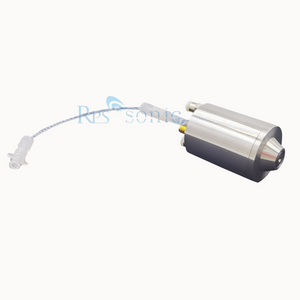
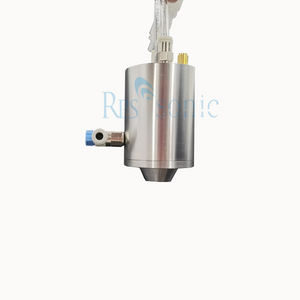
40K Ultrasonic Spray Coating Nozzle for Micron Atomization in Energy Industry
Description
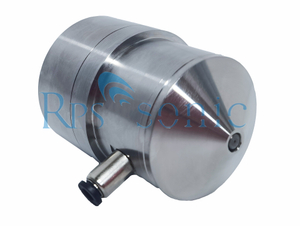
The 40kHz Ultrasonic Spray Coating Nozzle is a precision atomization system designed for micron-level liquid dispersion and functional coating in energy-related industries. It uses high-frequency ultrasonic vibration to convert liquid slurries into fine, uniform droplets, enabling highly controlled deposition on complex surfaces.
Unlike conventional air-atomizing or high-pressure spray systems, this ultrasonic nozzle produces a soft, low-velocity spray with narrow droplet size distribution, ensuring better coating uniformity, higher material utilization, and significantly reduced overspray. It is especially suitable for energy materials that require precise layer control and stable electrochemical performance.
Core Technology Principle: The core of ultrasonic atomization spraying lies in its unique atomization method. The system converts high-frequency electrical energy into mechanical energy through a piezoelectric transducer, generating high-frequency longitudinal vibration. This vibrational energy forms standing waves in the liquid film on the nozzle surface, "breaking" the liquid into micron-sized droplets with a highly concentrated size distribution. Unlike spraying methods that rely on high-speed airflow or high pressure, this process is very gentle. The resulting droplets are then guided to the target substrate by a low-pressure carrier gas, thus achieving precise, controllable, and repeatable coating.
The system is equipped with a 40kHz ultrasonic atomizing nozzle, providing stable cavitation-driven droplet formation for consistent micron-scale spray output.
A key advantage is its ability to handle high-solid-content and energy-material slurries, such as battery electrode coatings and functional conductive inks, without clogging or pressure instability.
Compared with traditional spray methods, this technology delivers more uniform film thickness and improved particle distribution, which is critical for electrochemical performance in energy devices.
The non-contact, low-pressure atomization process minimizes material rebound and ensures high deposition efficiency with reduced waste of expensive active materials.
The system supports adjustable flow rate and ultrasonic power, allowing precise control of coating density, spray width, and layer consistency.
Its modular design allows integration into automated production lines for battery, fuel cell, and photovoltaic manufacturing systems.
Parameters
| Model NO. | RPS-AT40 |
| Spray Flow | <40ml/min |
| Spraying Width | 10~50mm |
| Suitable for Liquid Viscosity | <100cps |
| Suspension Particle Size | 10~40μm |
| Diversion Air Pressure | <0.05MPa |
| Communication | RS485 |
| Nozzle Material | Titanium alloy |
| Input Voltage | 220V/50Hz |
| Production Capacity | 200/Month |
Ultrasonic atomization produces uniform micron-scale droplets, improving coating consistency and functional layer stability.
It significantly increases material utilization efficiency, reducing waste of costly energy materials such as cathode and anode slurries.
Compared with conventional air spray systems, it provides better film uniformity, lower defect rates, and improved electrochemical performance.
The anti-clogging ultrasonic design ensures stable long-term operation even with high-viscosity or particle-rich liquids.
It supports continuous industrial processing, making it suitable for scalable energy manufacturing lines.
Uniform coating: uniformity >95%
Saving raw materials: raw material utilization rate is over 85%, 4 times that of traditional air spray nozzle
High control accuracy of coating thickness : 20 nm to tens of micron coatings can be precisely sprayed.
Non clogging
Anti-corrosion nozzle
High precision, high controllable spray.
Ultrasonic atomization spraying technology is playing an increasingly crucial role in the electronics industry due to its core advantages of high precision, high uniformity, and high material utilization. It provides a novel solution to many challenges that traditional spraying processes struggle with by atomizing liquid into micron-sized uniform droplets and then precisely depositing them onto the target surface. This technology is widely used in the manufacturing of numerous electronic components, from microscopic semiconductor chips to macroscopic circuit boards.
The 40kHz Ultrasonic Spray Coating Nozzle is widely used in:
Lithium-ion battery electrode coating (anode & cathode slurry)
Fuel cell catalyst layer spraying
Solar photovoltaic thin-film deposition
Energy storage material coating
Conductive ink and functional coating
Supercapacitor electrode production
Advanced energy material R&D
Precision industrial coating systems
Ms. Yvonne
sales@xingultrasonic.com
+86 571 63481280
+86 15658151051
1st Building NO.608 Road ,FuYang, Hangzhou, Zhejiang,China