Ultrasonic Tea Beverage Extraction Technology: Principles, Processes, And Industrial Applications
1. Introduction
Tea beverages have developed into one of the mainstream products in the international beverage market due to their natural, healthy, and convenient drinking characteristics. However, as a key link that affects the quality of tea beverages, the extraction process has long faced a core contradiction - although high-temperature extraction can obtain a higher extraction rate of tea components, it will also cause a large amount of volatilization of tea aroma, color change and turbidity of tea soup. Although low-temperature extraction can reduce tea soup turbidity and better preserve soup color and aroma, in order to ensure extraction efficiency, large amounts of extraction must be carried out for a long time, which does not meet the requirements of industrial production.
How to maintain the good quality of tea leaves and a high extraction rate of contained ingredients under low-temperature and short-term leaching conditions has become an urgent problem to be solved in the tea beverage production process. The emergence of ultrasound-assisted extraction technology provides an effective solution to this problem. Ultrasound has a variety of physical and sonochemical effects and has been widely used in the extraction of Chinese medicinal materials. In recent years, with the continuous deepening of research and the advancement of industrial practice, ultrasonic technology has shown broad application prospects in the field of tea beverage extraction.
2. Technical principles
The core mechanism of ultrasound-assisted extraction of active ingredients from tea mainly includes two aspects:
(1) Cavitation effect. When ultrasonic waves propagate in a liquid medium, micro-gas nuclei (cavitation nuclei) existing in the medium vibrate, grow and collapse under the action of the ultrasonic field. The moment when cavitation bubbles collapse, local high temperature and high pressure can be generated. This strong shock wave can effectively destroy the cell walls of tea plants, causing active ingredients such as tea polyphenols, amino acids, and caffeine in the cells to quickly release and dissolve into the surrounding solvent. Research shows that ultrasonic extraction utilizes the local high temperature and high pressure generated by this cavitation to enhance the ability of substances to dissolve and decompose in solvents.
(2) Mechanical effects and thermal effects. During the propagation of ultrasonic waves through media particles, their energy is continuously absorbed by the media particles and converted into heat energy, causing the system temperature to rise. At the same time, the mechanical vibration of ultrasonic waves generates microfluidic shear force, which can directly act on the cell wall to enhance the release, diffusion and dissolution of intracellular substances. The synergistic effect of mechanical effect, cavitation effect and thermal effect makes ultrasonic an extraction method with dual functions of physical wall breaking and enhanced mass transfer.
3. Technical advantages
Compared with traditional high-temperature extraction, ultrasonic-assisted extraction of tea beverages has the following significant advantages:
Low temperature extraction, excellent quality. Ultrasonic technology enables efficient extraction of tea leaves at lower temperatures (such as 20-50°C). Using the combined technology of cell disruption and ultrasonic low-temperature countercurrent extraction, under the extraction conditions of 20°C and 30 minutes, the tea juice solids yield can reach more than 90%, and the product has excellent flavor and quality. The low-temperature conditions effectively avoid the large-scale volatilization of the tea aroma and the oxidative discoloration of the tea soup, making the sensory quality of the product close to the flavor of the original tea.
It is short-term and efficient, greatly shortening the extraction time. Ultrasonic treatment makes the tea ingredients dissolve twice as fast as conventional low temperature, and the extraction time can be shortened by half. Studies have shown that when tea is extracted at a conventional low temperature of 45-50°C at an ultrasonic frequency of 40kHz, the extraction efficiency is significantly improved.
Selective extraction improves the quality of tea soup. Research shows that the leaching rate of microwave and ultrasonic waves on tea polyphenols, amino acids, and caffeine is equivalent to that of conventional extraction methods, but it has an inhibitory effect on the leaching of macromolecules such as protein and pectin. This means that ultrasonic extraction can ensure the full leaching of active ingredients while reducing the dissolution of macromolecular substances that cause the tea soup to be turbid, thereby improving the clarity and stability of the tea soup.
The content of active ingredients is higher. The content of main catechins in tea soup extracted by different extraction methods was analyzed. The results showed that the content of main catechins in tea soup extracted by ultrasonic extraction was higher than that of other extraction methods. Compared with the conventional solvent extraction method, the ultrasonic method not only significantly increases the extraction rate, but also significantly improves the quality of the extract.
Green and environmentally friendly. Ultrasonic-assisted extraction can be carried out in water or food-grade solvent systems, reducing the use of organic solvents and in line with the development direction of green processing.
4. Key process parameters
The efficiency of ultrasonic extraction of active ingredients in tea is comprehensively affected by multiple process parameters, and requires systematic optimization for different tea types and target ingredients.
4.1 Ultrasonic frequency
Ultrasonic frequency is one of the important factors affecting the extraction effect. Research shows that 20kHz is a commonly used frequency in tea beverage extraction. Low-frequency ultrasound (20-40kHz) can produce large cavitation bubbles, directly impact tea cells, and extract macromolecule nutrients such as tea polyphenols and caffeine. Research shows that the higher the frequency of ultrasound, the higher the extraction rate and eventually approaches a certain stable value.
4.2 Extraction temperature
Temperature is a key factor affecting the leaching of water-soluble substances in tea. As the temperature rises, the extraction speed accelerates, but if the temperature is too high, the water-extracted substances of the tea will oxidize faster and the quality will decrease. Therefore, 45-60°C is generally considered to be a more reasonable temperature range for ultrasonic extraction. The optimal extraction temperature for white tea is 45°C; ultrasonic low-temperature countercurrent extraction technology can achieve efficient extraction at 20°C.
4.3 Extraction time
One of the biggest advantages of ultrasonic extraction is its short time. The optimal time for ultrasonic extraction of white tea is a specific optimized time; the optimal process for ultrasonic extraction of instant tea needs to comprehensively consider extraction time, frequency and other factors. In actual production, the extraction time can usually be controlled within the range of 10-60 minutes.
4.4 Material-to-liquid ratio and raw material particle size
The material-to-liquid ratio directly affects the mass transfer efficiency and extraction cost. The optimal material-to-liquid ratio varies for different tea types and target ingredients. The particle size of tea leaves also affects the extraction efficiency - the finer the particle size, the larger the specific surface area, the more complete the contact with the solvent, and the higher the extraction rate. Some studies have divided tea leaves into different particle sizes such as 24-40 mesh and 40-60 mesh for comparative experiments. The study also found that the shorter the tea fermentation time, the higher the extraction rate.
5. Industrial application
Ultrasonic tea beverage extraction technology has moved from laboratory research to industrial production and has achieved remarkable results.
The world's first ultrasonic low-temperature countercurrent leaching production line. The Tea Research Institute of the Chinese Academy of Agricultural Sciences cooperated with Yunnan Lincang Lancangjiang Tea Co., Ltd. to achieve low-temperature and efficient preparation of fresh tea juice through the combined technology of cell disruption and ultrasonic low-temperature countercurrent extraction.
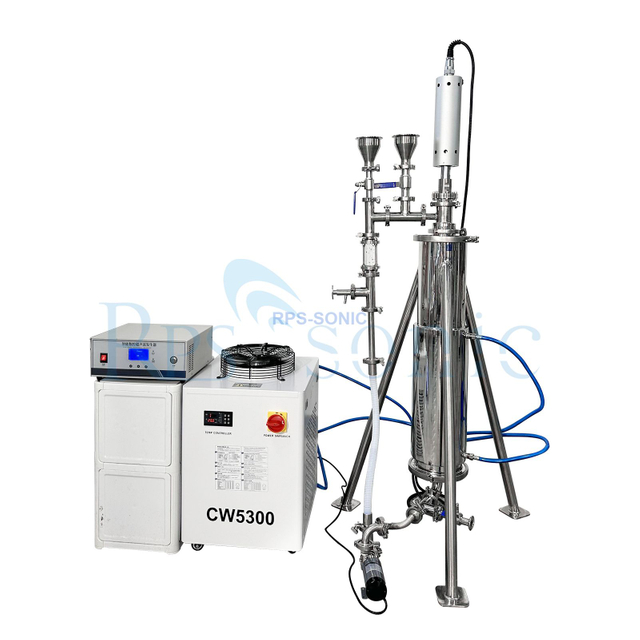
Ultrasonic multi-stage countercurrent extraction column segmented extraction. According to the leaching characteristics of the active ingredients of tea, an ultrasonic multi-stage countercurrent extraction column is used for segmented extraction. High-flavor cold-soluble instant tea is prepared in the front-end, and functional instant tea enriched in tea polyphenols (tea polyphenols content ≥65%) is prepared in the back-end to achieve efficient, high-quality and high-value utilization.
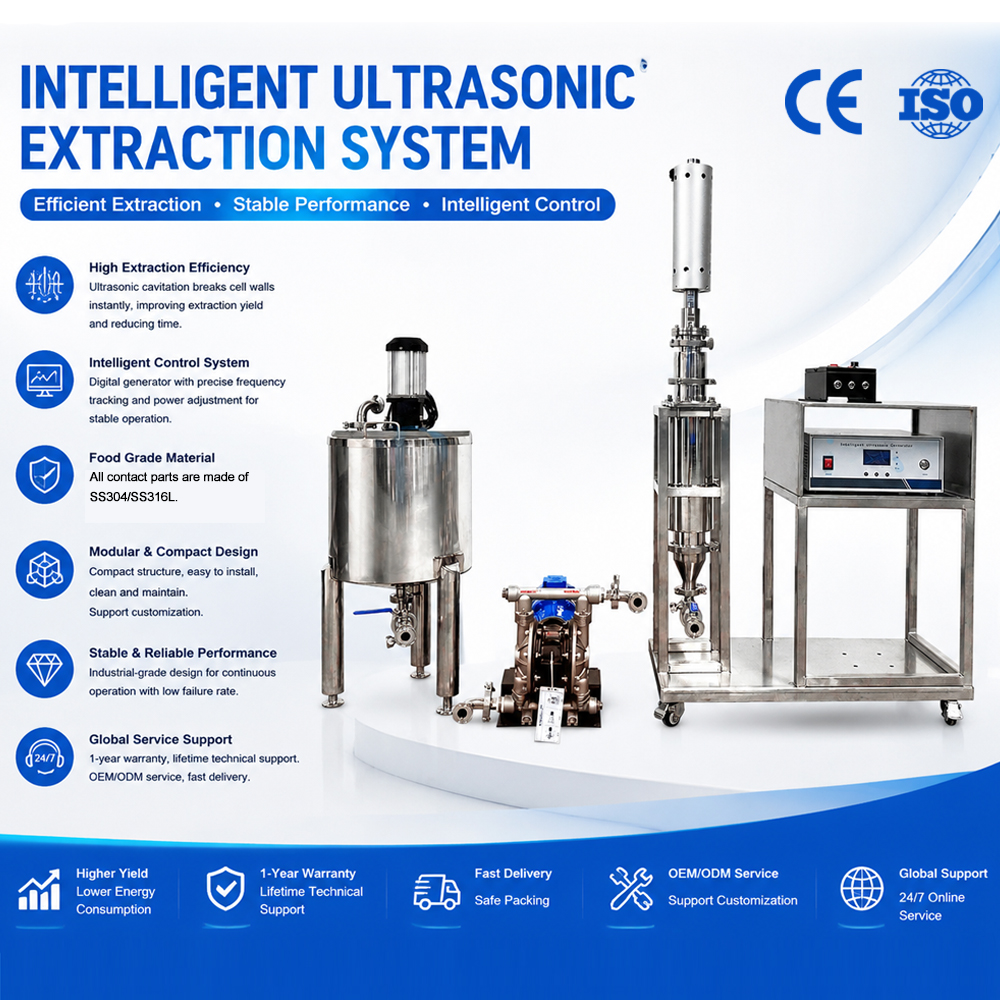
Ultrasonic dynamic low-temperature extraction production line. In recent years, a complete set of ultrasonic dynamic low-temperature extraction production lines has also been put into use, with a production capacity of up to 500L/batch, low-temperature control throughout the process (extraction/filtration/concentration stage ≤55°C), and the use of "ultrasonic dynamic extraction + multi-stage purification + membrane concentration + vacuum freeze-drying" process to retain active ingredients and original aromas such as tea polyphenols and theanine
Conclusion
Ultrasonic-assisted extraction technology relies on the synergistic effect of cavitation, mechanical and thermal effects to achieve low-temperature, short-time, and efficient extraction of active ingredients in tea. It is an effective way to solve the contradiction between the quality and efficiency of traditional tea beverage extraction processes. From laboratory research to an industrial production line with an annual output of 100,000 tons, ultrasonic tea beverage extraction technology has gone through a complete process from theory to practice, from exploration to maturity. With the continuous advancement of technology and the continuous deepening of industrial application, ultrasonic extraction technology will provide solid technical support for the quality improvement and green development of the tea beverage industry.