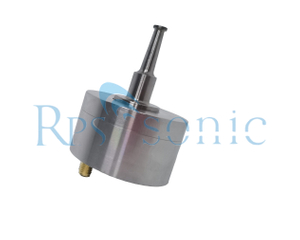
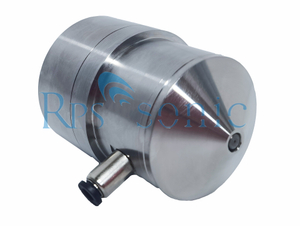
Automatic 40kHz-100kHz Ultrasonic Spray Coating Machine Spray Nozzle for Battery Slurry Atomization
Description
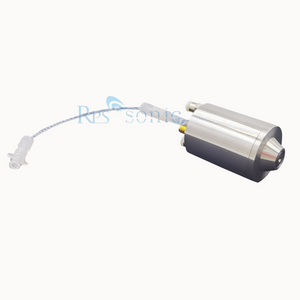
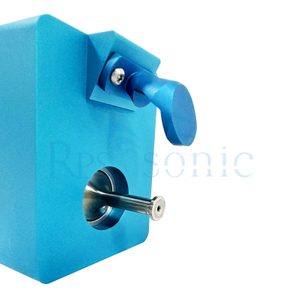
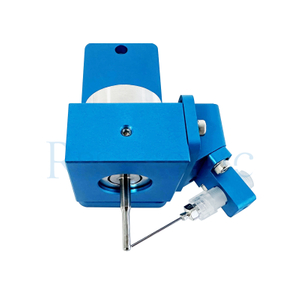
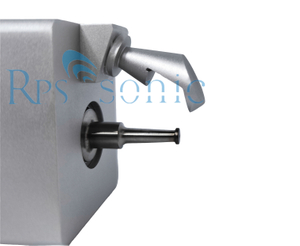
The Automatic 40kHz–100kHz Ultrasonic Spray Coating Machine is a high-precision coating system designed for advanced battery slurry atomization and functional material deposition. It utilizes adjustable high-frequency ultrasonic energy to atomize liquid slurry into uniform micro- and nano-sized droplets, ensuring extremely consistent coating quality and superior film uniformity.
This system is specially engineered for energy storage applications such as lithium-ion batteries, fuel cells, and advanced electronic materials, where precise coating thickness and material distribution are critical. The wide frequency range of 40kHz to 100kHz allows flexible optimization for different slurry viscosities and coating requirements.
Here's how an ultrasonic spray nozzle typically works:
1. Ultrasonic transducer: The core component of an ultrasonic spray nozzle is an ultrasonic transducer. It usually consists of a piezoelectric element, such as a piezoceramic disk, that can convert electrical energy into mechanical vibrations. When an alternating current (AC) voltage is applied to the piezoelectric element, it causes it to vibrate at ultrasonic frequencies,typically in the range of 1 to 100 megahertz (MHz).
2. Liquid supply: The liquid to be sprayed is supplied to the ultrasonic spray nozzle. It can be a solution, suspension, or any
other liquid that needs to be atomized into small droplets.
3. Vibrating plate: The ultrasonic transducer is coupled to a vibrating plate or diaphragm. This plate is typically made of a
thin metal or ceramic material and acts as a surface for the liquid to rest upon.
4. Cavitation and atomization: As the ultrasonic transducer vibrates, it induces high-frequency pressure waves in the liquid resting on the vibrating plate. These pressure waves create microscopic cavitation bubbles in the liquid. Cavitation is the rapid formation and collapse of bubbles in a liquid due to pressure changes. When the bubbles collapse, they generate localized shockwaves and intense energy. This energy disrupts the liquid surface, causing it to break up into small droplets.The size of the droplets can be controlled by adjusting the parameters of the ultrasonic vibrations.
5. Spray formation: The liquid droplets generated by the cavitation process are then expelled from the ultrasonic spray nozzle as
a fine mist or spray. The spray can be directed to a specific target or area as required.
Parameter:
| Item | Parameter |
| Frequency | 40Khz-100khz |
| Power | 10~100w |
| Spray area | 20*20-30*30cm |
| Spray width | 5~25mm |
| Solution utilization | above 98% |
Key Features
The machine is equipped with an advanced ultrasonic spray nozzle capable of operating within a 40kHz–100kHz adjustable frequency range, enabling precise control over droplet size and spray characteristics.
It supports stable atomization of high-viscosity battery slurries, ensuring uniform dispersion without clogging or uneven particle distribution.
The system offers programmable control of flow rate, spray width, and ultrasonic power, allowing accurate adjustment for different coating thicknesses and substrate types.
A high-precision automatic motion platform ensures consistent coating paths, improving repeatability and production efficiency.
Constructed with corrosion-resistant materials and industrial-grade ultrasonic components, the system guarantees long-term stability and reliable continuous operation.
A PLC touchscreen control interface provides real-time monitoring and easy parameter configuration for fully automated coating processes.
Features
Uniform coating: uniformity >95%
Saving raw materials: raw material utilization rate is over 85%, 4 times that of traditional air spray nozzle
High control accuracy of coating thickness : 20 nm to tens of micron coatings can be precisely sprayed.
Non clogging
Anti-corrosion nozzle
High precision, high controllable spray.
Advantages
Ultrasonic atomization produces extremely fine and uniform droplets, significantly improving coating homogeneity and film consistency compared to traditional spray systems.
The wide frequency adjustability allows optimization for different slurry formulations, enhancing flexibility across multiple battery and material applications.
It reduces material waste by minimizing overspray and ensures higher deposition efficiency, making it more cost-effective for industrial production.
The non-contact spraying process protects sensitive substrates and prevents surface damage or structural deformation.
Compared to conventional air spray or high-pressure coating methods, it delivers superior precision, better repeatability, and improved energy efficiency.
Application:
Lithium-ion battery electrode coating
Solid-state battery material deposition
Fuel cell catalyst layer coating
Solar cell thin-film coating
Electronic functional material coating
Ceramic slurry and advanced material deposition
Nano-coating and precision surface treatment
Research and industrial pilot production