Application of Ultrasonic Aging Technology: Utilizing Ultrasound To Accelerate The Aging And Flavor Maturation of Alcoholic Beverages
The traditional aging of alcoholic beverages typically requires a long period. During storage, the alcohols, acids, esters, phenols, and other flavor compounds within the liquid undergo slow processes—such as oxidation, esterification, condensation, extraction, and volatilization—that gradually soften the body of the spirit and harmonize its aroma.
However, prolonged storage entails higher costs, significant capital tie-up, and extended production cycles.
With the advancement of ultrasonic technology, **Ultrasonic Aging Technology** has emerged as a promising method for process intensification in the field of alcoholic beverage processing.
Acoustic cavitation, generated by high-intensity ultrasound, intensifies micro-scale mass transfer, mixing, and interfacial interactions within the liquid, thereby influencing physicochemical processes associated with maturation and flavor development.
Ultrasound does not merely "shake" the liquor; rather, through the application of specific acoustic energy, it serves as a controllable, supplementary technique to the traditional aging process.
What is ultrasonic-assisted aging?
Ultrasonic-assisted aging involves applying high-intensity ultrasound to the liquid (such as wine or spirits) to induce acoustic cavitation, acoustic streaming, and micro-scale disturbances, thereby accelerating or intensifying physicochemical processes associated with maturation.
When ultrasound enters the liquid, it generates a large number of tiny cavitation bubbles.
These bubbles undergo a cycle of:
Formation → Growth → Rapid collapse
During collapse, localized, transient high-energy environments and intense micro-scale liquid disturbances are created.
These effects can promote:
·Intermolecular contact
·Mass transfer
·Dissolution and extraction
·Oxidation-related processes
·Esterification and other reactions
·Release of aroma compounds
·Homogenization of the liquid
Therefore, the core of ultrasonic-assisted aging is not simply raising the temperature, but rather intensifying mass transfer and reaction processes within the liquid through acoustic cavitation and sonochemical effects.
Why can ultrasound influence the aging of alcoholic beverages?
Traditional aging is a highly complex process.
Taking wine as an example, the following may occur during storage:
·Changes in phenolic compounds
·Tannin polymerization
·Pigment changes
·Ester formation
·Reactions between alcohols and acids
·Release and transformation of aroma compounds
·Micro-oxidation processes
These processes typically require a long time to occur gradually.
Ultrasound can increase micro-scale movement within the liquid through cavitation and acoustic streaming, thereby altering mass transfer and the reaction environment.
Ultrasound can have a particularly pronounced effect on processes involving liquid-liquid, liquid-solid, and liquid-gas interfaces.
Consequently, ultrasonic-assisted aging is generally understood as a form of process intensification technology.
Key mechanisms of ultrasonic-assisted aging
1. Acoustic cavitation
Acoustic cavitation is one of the most important mechanisms in ultrasonic-assisted aging.
The formation and collapse of cavitation bubbles can generate localized, high-speed micro-jets and intense disturbances.
These effects facilitate micro-scale mixing and mass transfer within the liquid.
2. Enhanced mass transfer
The various components within the liquid are not static.
Acoustic streaming generated by ultrasound enhances mass transfer within the liquid, allowing substances in different regions to come into more thorough contact. This effect is particularly important for processes involving extraction, dissolution, or interfacial mass transfer.
3. Accelerating the extraction of wood components
During the aging process in oak barrels, the liquid gradually extracts the following from the oak:
· Tannins
· Lignin-related compounds
· Vanillin
· Furan compounds
· Phenolic substances
When using oak chips, blocks, or other wood media, ultrasound enhances the contact and mass transfer between the liquid and the wood.
Consequently, ultrasound-assisted oak extraction is a key application area within accelerated aging technologies.
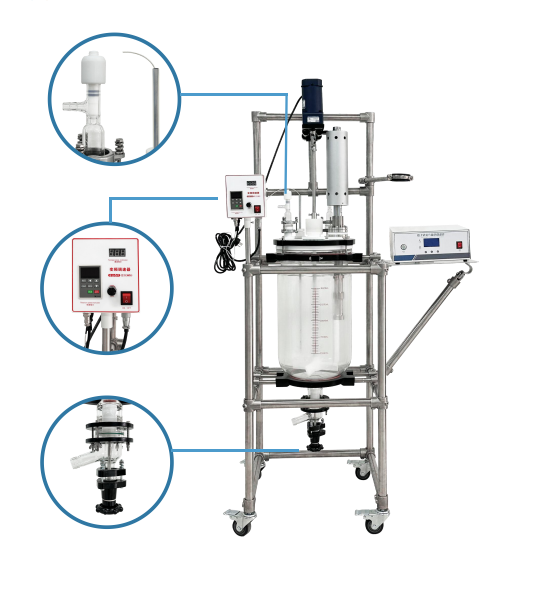
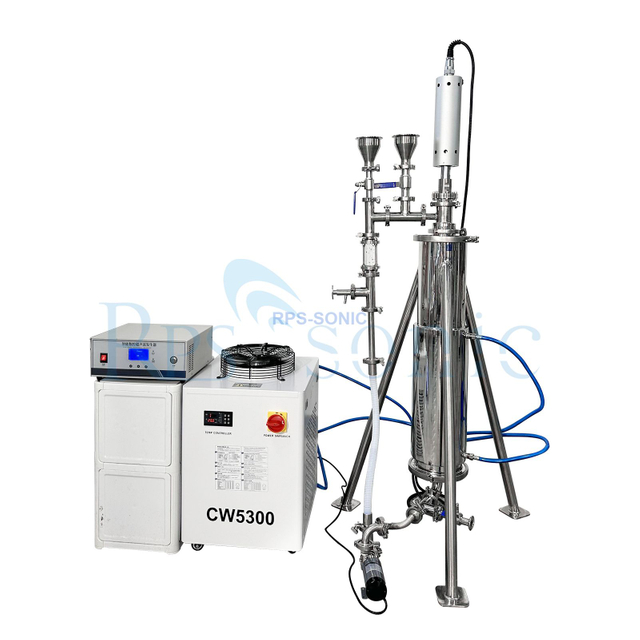
Ultrasonic accelerated aging circulation system
For industrial-scale applications, rather than installing numerous ultrasonic probes directly inside large storage tanks, a circulation-based configuration can be employed.
Typical system:
Liquid storage tank
↓
Sanitary circulation pump
↓
Ultrasonic aging reactor
↓
Temperature control system
↓
Return to storage tank
Through circulation, the liquid continuously passes through the high-intensity ultrasonic treatment zone.
This design offers the following advantages:
· Concentrated ultrasonic treatment zone
· Easy control of ultrasonic energy
· Convenient flow rate control
· Simplified temperature control
· Enables multiple circulation cycles
· Better suited for pilot-scale and industrial scale-up
For food and beverage production, wetted parts made of SS304 or SS316L and sanitary piping connections can be used to meet specific hygiene requirements.
What parameters need to be controlled for ultrasonic accelerated aging?
Ultrasonic accelerated aging involves more than simply setting an ultrasonic power level.
The following parameters are crucial:
Ultrasonic frequency
High-intensity industrial liquid processing typically employs ultrasonic systems operating at approximately 20 kHz.
Different frequencies produce distinct acoustic cavitation characteristics; therefore, the frequency must be selected based on the specific application.
Ultrasonic power
Power determines the amount of ultrasonic energy delivered to the liquid.
However, excessive power can lead to:
· Rapid temperature rise
· Increased liquid evaporation
· Higher energy consumption
· Unintended changes in flavor profile
Optimization based on the specific liquid being processed is therefore necessary.
Amplitude
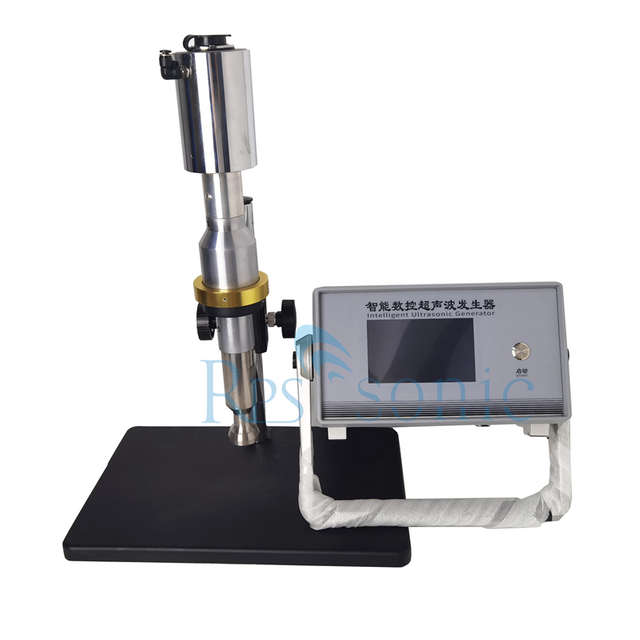
Amplitude directly affects the intensity of the ultrasonic probe's mechanical vibration.
Treatment intensity can generally be controlled by adjusting the amplitude. **Processing Time**
Different types of alcoholic beverages require different processing times.
Therefore, it is recommended to determine the optimal processing time through small-scale trials before proceeding to pilot-scale scale-up.
Temperature
Temperature is a critical parameter in the ultrasonic aging process.
Heat is generated during ultrasonic operation.
If the beverage requires processing at lower temperatures, the following can be added to achieve temperature control:
Cooling water circulation + heat exchanger + temperature sensor.
Future Applications of Ultrasonic Aging Technology
As alcohol production moves toward shorter cycles, higher efficiency, controllability, and automation, ultrasonic aging technology holds significant potential for further research and industrial application.
Future development may focus on:
· Ultrasonic-assisted wine aging
· Ultrasonic aging of *Baijiu* (Chinese white spirit)
· Ultrasonic rapid oak extraction for whisky
· Ultrasonic maturation of brandy
· Ultrasonic treatment of fruit wines
· Ultrasonic extraction from oak media
· Continuous-flow ultrasonic aging
· Combined ultrasonic and temperature-controlled aging
· Combined ultrasonic and micro-oxygenation processes
Among these, the Continuous Flow Ultrasonic Aging System is particularly suitable for alcohol enterprises requiring industrial-scale and automated production.
**Conclusion**
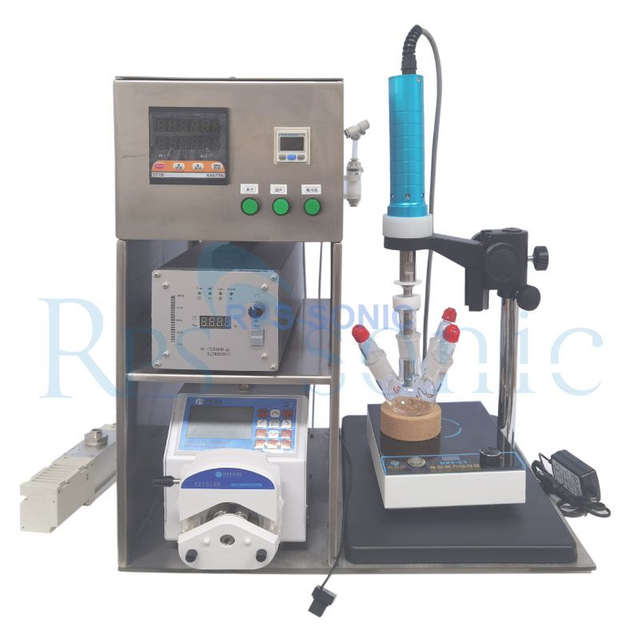
Ultrasonic aging is a process-intensification technology that utilizes acoustic cavitation and ultrasonic-enhanced mass transfer to facilitate the maturation of alcoholic beverages.
It can be applied to the research and production of various spirits and wines—such as wine, *Baijiu*, whisky, brandy, rum, and fruit wines—and can be integrated with oak chips, oak blocks, circulation systems, and temperature control systems.
For industrial production, the primary advantages of ultrasonic aging over traditional static aging are process controllability and adjustable treatment intensity; furthermore, continuous and automated processing can be achieved using circulating ultrasonic reaction chambers.
However, alcohol aging is a complex process, and ultrasonic treatment parameters must be optimized based on the specific type of beverage, formulation, and desired flavor profile. Final process parameters for industrial application should be determined through small-scale trials, pilot-scale tests, and validation via sensory and physicochemical analysis, rather than simply relying on ultrasonic power levels to gauge aging effectiveness.