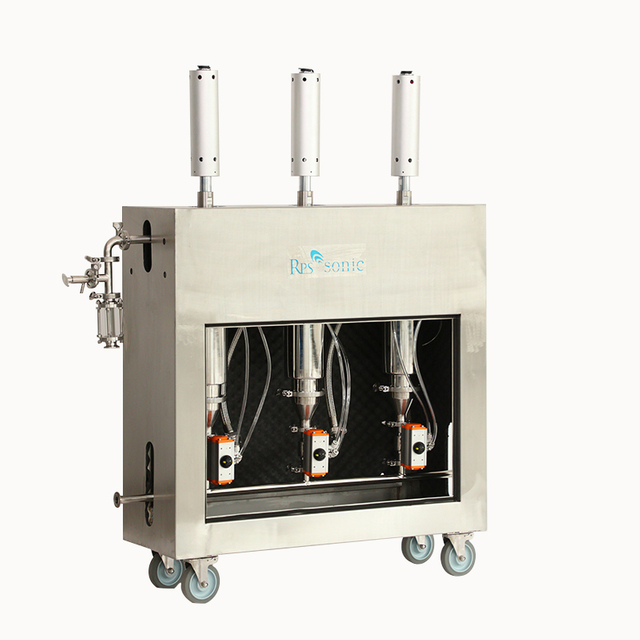
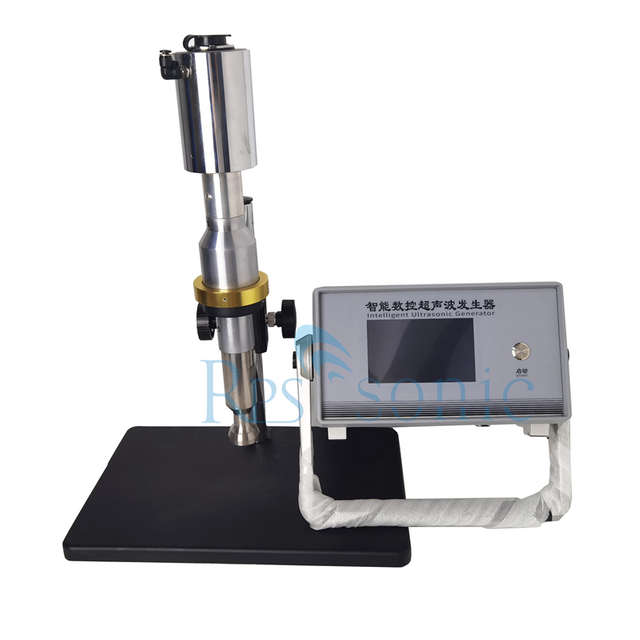
Application of Ultrasonic Equipment in the Processing of Jams, Sauces, and Baby Food Purées
In the modern food processing industry, products such as jams, sauces, and baby food purees—while distinct from one another—all demand high standards regarding particle fineness, uniformity, stability, mouthfeel, and product consistency.
While traditional equipment—such as high-speed mixers, colloid mills, and mechanical homogenizers—can meet basic production needs, challenges often persist when processing high-viscosity materials, fine particles, oil-water mixtures, or foods containing natural fibers; these issues include uneven particle distribution, phase separation, excessive air bubbles, and inconsistent quality between batches.
Ultrasonic technology leverages high-frequency mechanical vibration and cavitation effects to further enhance processes such as particle dispersion, emulsification, homogenization, and degassing within liquid systems.
Consequently, ultrasonic processing technology is increasingly being adopted as a method to enhance processing capabilities in the production of jams, sauces, baby food, and other high-value-added food products.
I. Why is ultrasonic processing needed in food processing?
Food slurries are typically not simple, homogeneous liquids.
For example:
Jams may contain fruit pulp, peel, pectin, and natural fibers;
Ketchup, chili sauce, and salad dressings may contain plant particles, oils, an aqueous phase, and various flavoring ingredients;
Baby food purees usually require a finer, more uniform texture, alongside controlled particle size and product stability.
Traditional mechanical stirring relies primarily on impellers to generate shear and circulation.
In contrast, ultrasound generates a vast number of tiny cavitation bubbles within the liquid. As these bubbles form, expand, and rapidly collapse, they create localized high-speed micro-jets, shear forces, and intense liquid agitation.
These effects help to:
·Disperse food particles
·Break down large agglomerates
·Improve oil-water mixing
·Enhance solid-liquid mass transfer
·Reduce localized agglomeration
·Improve product uniformity
·Reduce some entrapped air
Consequently, ultrasound serves as an intensification step for mechanical stirring, homogenization, and emulsification processes.
II. Ultrasonic processing of jam: Improving smoothness and uniformity
Jam is typically composed of ingredients such as fruit, sugar, water, and pectin.
During production, the dispersion state of fruit pulp and plant fibers directly affects the final product's:
·Mouthfeel
·Appearance
·Stability
·Spreadability
·Product consistency
With traditional stirring, insufficient shear can lead to large fruit particles or fiber agglomerates.
Ultrasonic processing can further enhance particle dispersion.
1. Improving fruit particle dispersion
The mechanical action generated by ultrasound reduces particle agglomeration, allowing fruit pulp and fibers to disperse more uniformly throughout the jam matrix.
Process testing based on specific product formulations can be conducted for fruit bases such as strawberry, blueberry, mango, peach, and apple.
2. Enhancing pectin dispersion
Pectin is a crucial structural component in many jam products.
If pectin is not adequately dispersed, localized agglomeration may occur.
Ultrasound improves mixing and dispersion within the liquid, thereby helping pectin distribute more evenly. 3. Improving Product Texture
For jam products requiring a finer, more uniform texture, ultrasound can serve as an intensification process following traditional mixing or homogenization.
The final outcome depends on factors such as fruit type, particle size, solids content, viscosity, and ultrasonic processing parameters.
III. Ultrasonic Processing of Sauces: Emulsification, Dispersion, and Stability
Sauces represent a highly promising application for ultrasonic food processing.
Products such as ketchup, chili sauce, salad dressing, mayonnaise, barbecue sauce, dressings, and various compound sauces typically contain ingredients with diverse properties.
For example:
Water + Oil + Plant particles + Spices + Proteins + Thickeners
These different components are prone to separation, sedimentation, or agglomeration.
Ultrasound enhances shear forces and turbulence within the liquid, thereby improving the dispersion of the various components.
1. Ultrasonic Emulsification
In oil-water systems, ultrasound can break down large droplets into much finer ones.
Reducing droplet size allows the oil phase to disperse more uniformly within the continuous phase.
Consequently, ultrasound can assist in the emulsification of products such as:
·Salad dressings
·Mayonnaise
·Emulsified dressings
·Oil-based chili sauces
·Compound sauces
It should be noted that emulsification efficiency depends not only on ultrasonic power but also on factors such as the emulsifier used, the oil-to-water ratio, viscosity, temperature, and the specific formulation.
2. Dispersion of Spices and Plant Particles
Many sauces contain ingredients such as:
·Chili peppers
·Garlic
·Onion
·Ginger
·Herbs
·Spices
·Plant fibers
If these solid particles are not adequately dispersed, they tend to settle or create localized concentration gradients.
The fluid agitation generated by ultrasound helps distribute these particles more evenly throughout the sauce.
3. Reducing the Risk of Separation
For food systems prone to phase separation, ultrasound can improve the uniformity of emulsions and suspensions.
Therefore, it can serve as a supplementary process to traditional high-speed mixing and mechanical homogenization equipment. IV. Application of Ultrasound in Infant Purées
Infant purées generally have stricter requirements regarding product texture and uniformity compared to ordinary foods.
Consumers typically expect products to be:
Fine, uniform, and smooth, without noticeable coarse particles.
Therefore, the potential for ultrasonic treatment can be explored for purées made from apples, bananas, pumpkins, carrots, vegetables, and meat, as well as composite purées.
1. Improving Purée Uniformity
Raw fruit and vegetable materials typically contain:
· Plant cells
· Fibers
· Pectin
· Starch
· Moisture
Even after traditional grinding, particle and fiber agglomerates may persist.
Ultrasound can further enhance particle dispersion within the liquid phase, resulting in a more uniform system.
2. Improving Mouthfeel
For infant foods requiring a very fine texture, ultrasound can serve as a post-processing step following grinding, shearing, and homogenization.
By precisely controlling ultrasonic amplitude, treatment time, and temperature, product texture can be tailored to specific raw materials.
However, it is important to emphasize:
For infant food, "higher ultrasonic power" is not necessarily better.
Excessive treatment may affect the product structure and certain sensitive ingredients; therefore, process validation based on the specific formulation is required.
3. Reducing Air Entrainment
High-speed mechanical mixing tends to introduce air into the food slurry.
Air entrapment can lead to:
· Foaming
· Oxidation
· Changes in appearance
· Filling difficulties
Proper ultrasonic processing can be combined with vacuum or degassing systems to mitigate issues with air bubbles in the food slurry.
Consequently, for high-end infant purée production lines, one might consider:
A combined process of Mixing + Homogenization + Ultrasonic Processing + Vacuum Deaeration.
What should be prioritized for food-grade ultrasonic equipment?
When ultrasonic equipment is used directly for food processing, its design and materials are critical.
Food-contact components
Suitable food-contact materials must be selected based on product requirements, such as:
SS304 / SS316L
For probes and high-intensity ultrasonic components, appropriate titanium alloys can be selected based on process requirements. Sanitary Design
Food processing equipment must minimize:
·Dead legs
·Product residue
·Hard-to-clean areas
·Material accumulation
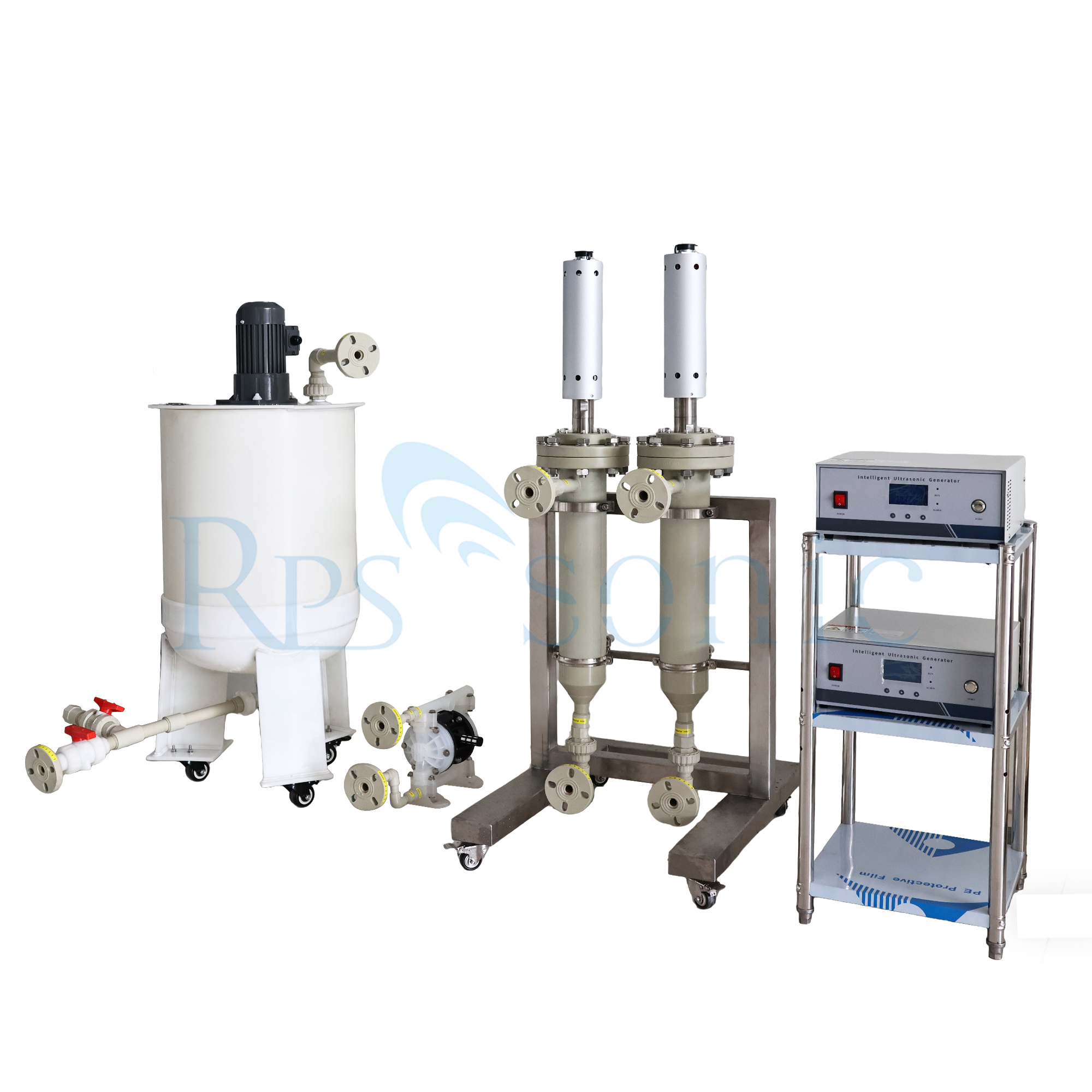
Consequently, flow-through ultrasonic systems must fully account for:
CIP cleaning, sanitary connections, and drainability.
Temperature Control
A portion of ultrasonic energy is inevitably converted into heat.
Temperature control is critical for products such as jams, sauces, and baby food.
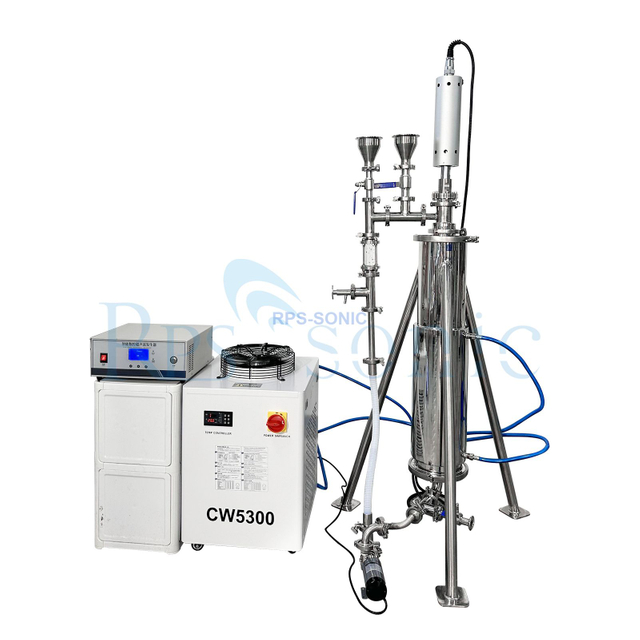
Equipment can incorporate the following to regulate processing temperatures:
·Temperature sensors
·Cooling jackets
·Heat exchangers
·Chillers
From fruit jams, tomato sauces, chili sauces, and salad dressings to baby food purees (fruit, vegetable, and mixed blends), food processing faces a common challenge:
How to achieve uniform dispersion of ingredients and obtain a stable, smooth, and consistent product texture.
Ultrasonic equipment leverages cavitation, mechanical vibration, and micro-streaming to effectively enhance particle dispersion, emulsification, homogenization, and mass transfer within food systems.
For food manufacturers, adopting ultrasound does not necessarily mean completely replacing existing production lines.
A more practical approach is:
Integrating ultrasound as an enhancement module for existing mixing, homogenization, emulsification, and degassing processes.
Through laboratory validation and industrial scale-up, ultrasonic processing systems can be customized based on the specific viscosity, particle size, solids content, and temperature requirements of different food products.
From jams and sauces to baby food and plant-based products, ultrasound is bringing more precise process control solutions to food manufacturing.