Ultrasonic Extraction for Herbal Alcohol Tinctures And Oils
Herbal tinctures and oil-based botanical extracts have been used for centuries to concentrate valuable compounds from leaves, roots, flowers, seeds, bark, and other plant materials.
However, conventional maceration and soaking processes can require hours or even days to achieve sufficient extraction. For commercial producers, this can mean long processing cycles, large extraction tanks, high solvent consumption, and inconsistent extraction performance.
Ultrasonic-assisted extraction (UAE) offers a modern way to intensify botanical extraction by using high-frequency ultrasonic energy to improve solvent penetration, disrupt plant structures, and accelerate mass transfer.
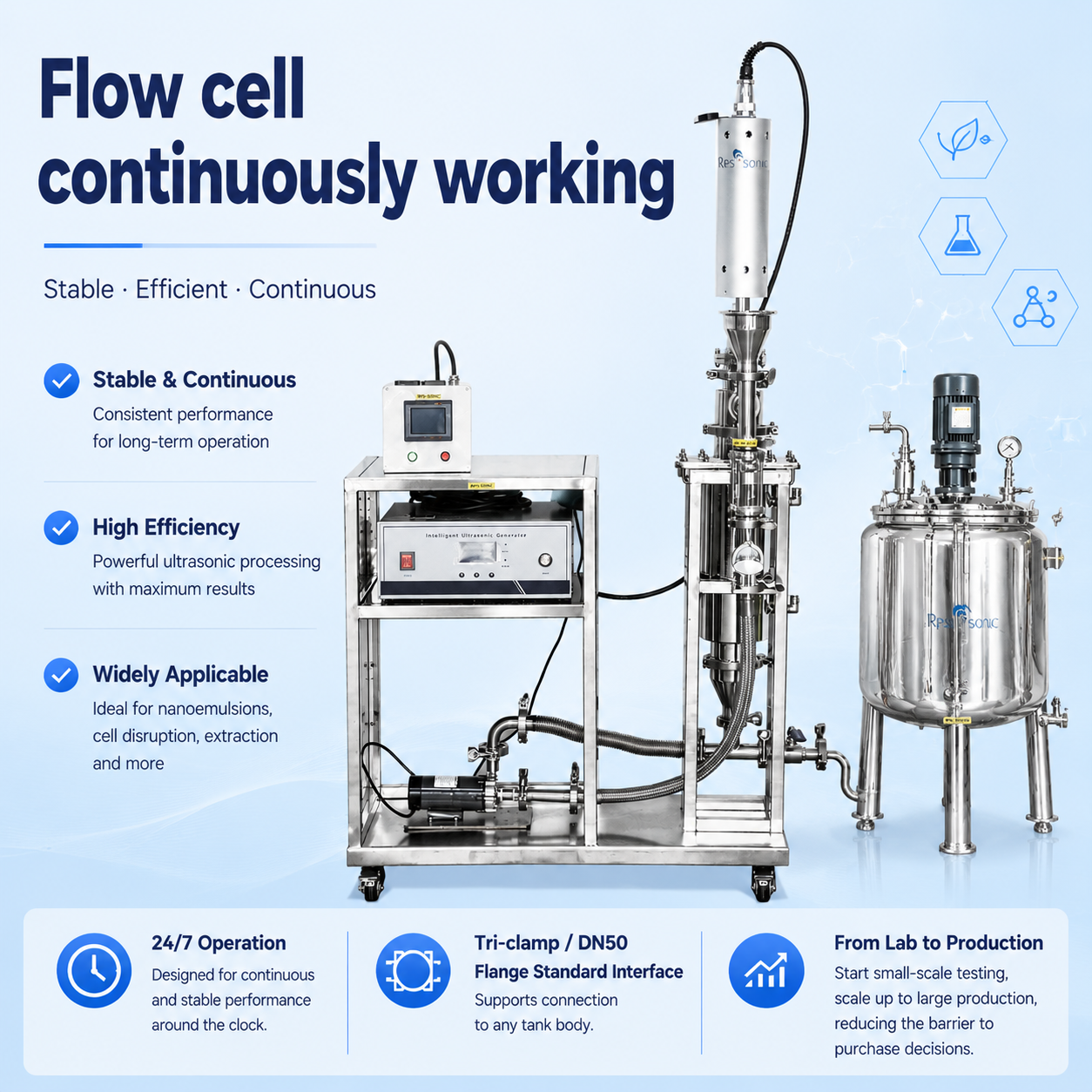
From small-batch herbal tinctures to larger-scale botanical oil extraction, ultrasonic processing can be integrated into existing extraction workflows or designed as a continuous-flow system.
How Does Ultrasonic Extraction Work?
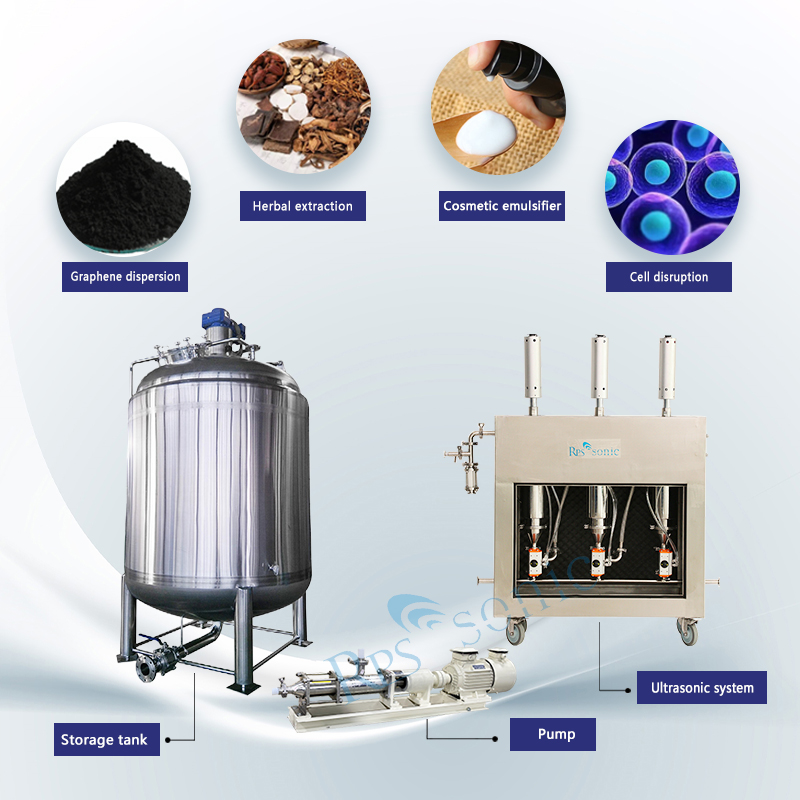
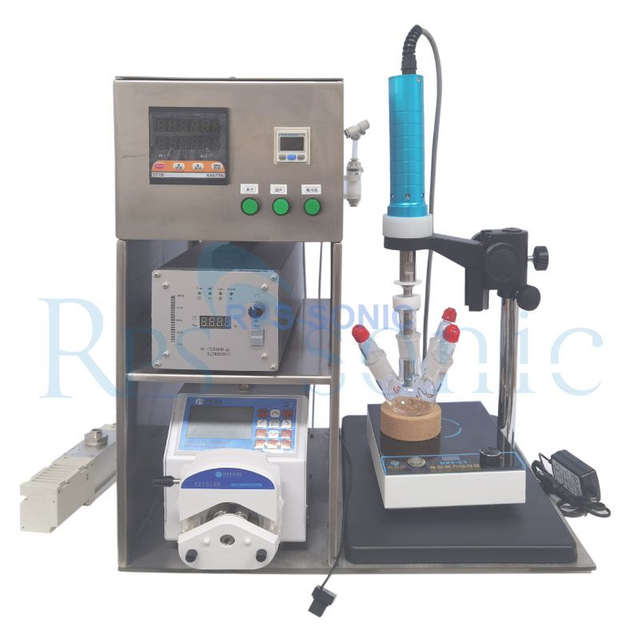
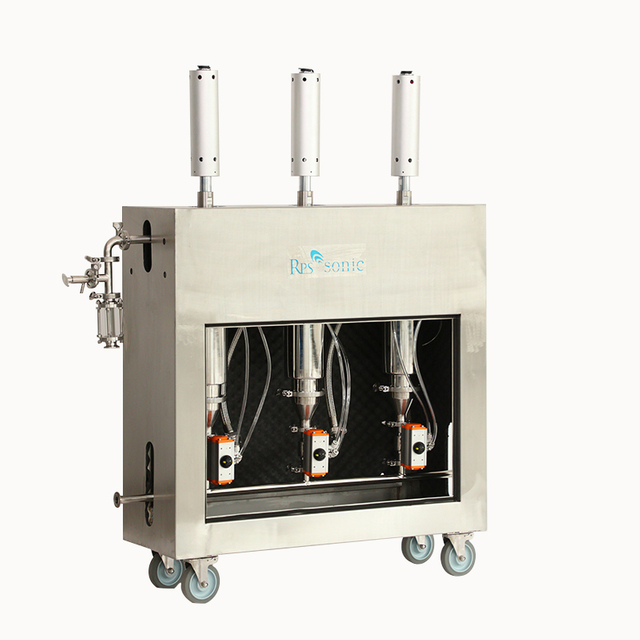
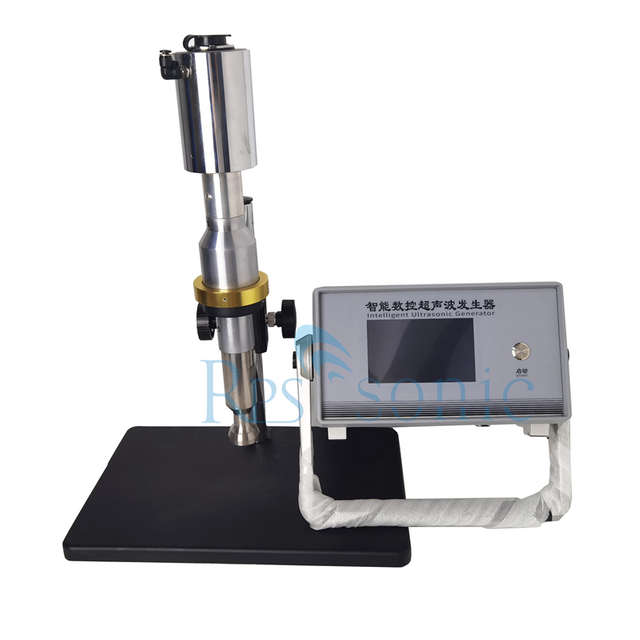
An industrial ultrasonic extraction system typically consists of:
Ultrasonic Generator + Transducer + Sonotrode/Horn + Extraction Vessel or Flow Cell
The ultrasonic generator converts electrical energy into a high-frequency signal. The transducer converts this signal into mechanical vibration, while the sonotrode transfers the ultrasonic energy directly into the extraction medium.
When ultrasound propagates through a liquid, it can generate microscopic cavitation bubbles. Their formation, growth, and collapse create intense local fluid movement, microstreaming, and shear forces.
These effects can help:
· Improve solvent penetration into plant material
· Disrupt or weaken plant cell structures
· Increase contact between the solvent and botanical material
· Reduce boundary-layer resistance
· Enhance mass transfer
· Accelerate the release of soluble target compounds
As a result, ultrasonic treatment can significantly intensify the extraction process compared with passive soaking alone.
Ultrasonic Extraction of Herbal Alcohol Tinctures
Alcohol-based tinctures commonly use ethanol, water, or ethanol-water mixtures as extraction media.
The choice of solvent depends on the botanical material and the target compounds.
During conventional maceration, the solvent gradually penetrates the plant structure and dissolves soluble compounds. The process is largely dependent on diffusion, particle size, temperature, solvent composition, and extraction time.
Ultrasonic treatment introduces an additional mechanism.
Enhanced Solvent Penetration
Ultrasonic cavitation and acoustic streaming continuously disturb the liquid around plant particles.
This can improve the contact between the extraction solvent and the plant surface, helping the solvent reach areas that may otherwise be less accessible.
Improved Cell Disruption
The mechanical effects generated by ultrasound can weaken plant cell structures and promote the release of intracellular compounds.
For finely milled botanical materials, ultrasonic treatment can be particularly useful as a process-intensification step.
Faster Mass Transfer
Once compounds are released from the plant matrix, they must migrate into the surrounding solvent.
Ultrasonic agitation can reduce concentration gradients and improve liquid movement around particles, helping accelerate this mass-transfer stage.
Ultrasonic Extraction for Herbal Oils
Oil-based botanical extraction presents different challenges from alcohol tincture production.
Many plant compounds have limited solubility in water but can be extracted into suitable edible or cosmetic oils.
Examples include oil-based extracts made from:
· Herbs
· Spices
· Seeds
· Flowers
· Leaves
· Roots
· Botanical powders
The objective is generally to transfer desirable oil-soluble or partially oil-soluble compounds from the plant matrix into the carrier oil.
Ultrasonic processing can enhance the interaction between the plant material and oil by improving wetting, dispersion, and mass transfer.
Better Plant–Oil Contact
Ultrasonic energy promotes fluid movement around solid particles and can help disperse botanical material throughout the oil phase.
This increases the effective contact area between the plant material and extraction medium.
Improved Extraction Efficiency
By intensifying mass transfer, ultrasound can help shorten the time required for certain oil-based extraction processes.
The actual improvement depends on the botanical material, particle size, oil type, temperature, ultrasonic amplitude, treatment time, and solids concentration.
Controlled Processing Conditions
Many botanical compounds are sensitive to excessive heat.
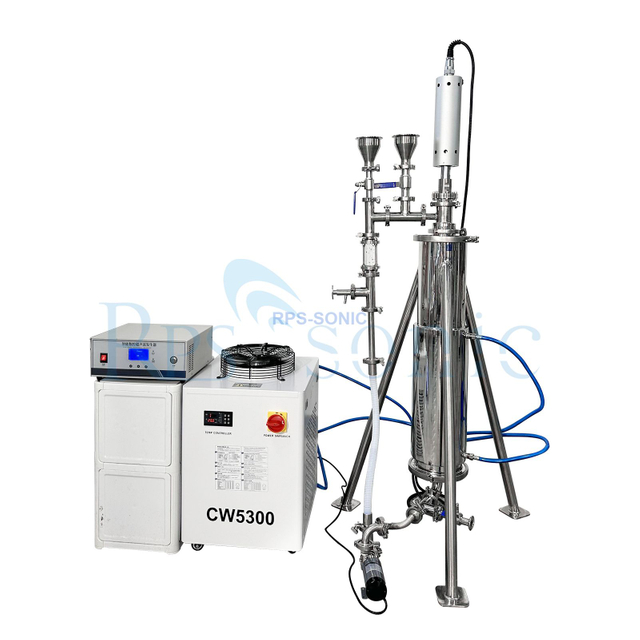
Ultrasonic extraction can be combined with temperature monitoring and cooling to maintain a controlled processing temperature.
This is especially useful when processing heat-sensitive botanical ingredients.
Key Factors Affecting Ultrasonic Herbal Extraction
There is no single ultrasonic setting that works for every herb.
The optimum process should be developed according to the raw material and desired extract.
1. Ultrasonic Frequency
Low-frequency, high-power ultrasound is commonly used for industrial extraction applications.
A typical industrial system may operate around 20 kHz, providing strong mechanical and cavitation effects.
2. Ultrasonic Amplitude
Amplitude strongly affects the intensity of ultrasonic treatment.
Higher amplitude can generate stronger cavitation, but excessive intensity may increase temperature or negatively affect certain sensitive compounds.
The optimum amplitude should therefore be determined through process testing.
3. Extraction Temperature
Temperature influences both extraction kinetics and compound stability.
A controlled-temperature system can combine ultrasonic processing with:
· Cooling jackets
· Heat exchangers
· Chillers
· Temperature sensors
to maintain the desired process temperature.
4. Particle Size
Reducing plant material to an appropriate particle size increases the available surface area.
However, extremely fine particles may create filtration, pumping, or separation problems.
The optimum particle size should balance extraction performance with downstream processing requirements.
5. Solvent-to-Solid Ratio
The ratio between botanical material and extraction medium affects both extraction efficiency and operating cost.
Ultrasonic processing may allow the process to be optimized without simply increasing solvent consumption.
6. Processing Time
One of the major advantages of ultrasonic extraction is the potential to reduce extraction time.
However, longer treatment is not always better. Excessive processing can increase energy consumption and may affect certain compounds.