Why Is 20kHz Often Chosen for Ultrasonic Emulsification?
In the industrial fields of ultrasonic emulsification, nanodispersion, and sonochemical reaction, the vast majority of mass production equipment and laboratory R&D equipment use a uniform operating frequency of 20kHz. High-frequency bands such as 40kHz and 60kHz are rarely used, and low-frequency bands below 15kHz are rarely used. This is not an accidental choice of industry practice, but a comprehensive optimal solution based on the physical principles of ultrasonic cavitation, material handling characteristics, equipment mechanical stability, and suitability for industrial mass production. This article will deeply analyze the underlying logic of 20kHz becoming the golden frequency band of ultrasonic emulsification from the four dimensions of core principles, frequency band comparison, process adaptation, and equipment performance.
I. The Core of Ultrasonic Emulsification: Cavitation Effect Determines Emulsification Effectiveness
The core advantage of ultrasonic emulsification, distinguishing it from traditional stirring and homogenizing emulsification, lies in its reliance on the ultrasonic cavitation effect to achieve microscopic emulsification. High-frequency propagation of ultrasound in a liquid medium creates periodic alternating positive and negative pressures, prompting the formation of numerous tiny cavitation bubbles. These bubbles continuously grow and expand before collapsing rapidly, generating instantaneous temperatures of 5000K and pressures exceeding 1000 atmospheres in the microscopic region, accompanied by high-speed microjets, strong turbulent shear forces, and shock waves.
This extreme microscopic physical action can powerfully tear apart the oil-water interface, break up large-diameter droplets, and disrupt powder agglomeration structures, allowing immiscible liquids to form uniformly sized, highly stable nanoscale emulsions. Simply put, the strength of the emulsification effect depends entirely on the intensity and energy density of ultrasonic cavitation, and the core parameter influencing the cavitation effect is the ultrasonic frequency.
II. The Underlying Physical Logic of Frequency and Cavitation Intensity The frequency of an ultrasonic wave directly determines the size, collapse energy, and shear force of cavitation bubbles; the two are inversely proportional: the lower the frequency, the larger the cavitation bubble volume, and the stronger the instantaneous energy and shear impact force released during collapse; the higher the frequency, the finer the cavitation bubbles, and the weaker the impact energy and shear force. The performance differences between different frequency bands directly determine their emulsification adaptability.
1. High-Frequency Band (40kHz and above): High precision, but insufficient power. High-frequency ultrasound, such as 40kHz, 60kHz, and 80kHz, produces small, uniformly distributed cavitation bubbles, resulting in gentler cavitation and lower noise. However, its core weakness is extremely obvious: the shear force and impact force released during bubble collapse are significantly reduced, making it unable to break the interfacial tension of high-viscosity materials and difficult to break up large droplets and agglomerated powders.
1. **High-frequency bands:** These high-frequency bands are only suitable for fine homogenization of low-viscosity, thin materials, such as mild emulsification of ordinary skincare products and dilute aqueous solutions. They are completely unsuitable for the process requirements of high-solids slurries, high-viscosity oil-water systems, nanomaterial dispersion, and deep emulsification in industrial settings. They result in low emulsification efficiency, large particle size in the finished emulsion, and poor stability.
2. **Low-frequency bands (15kHz and below):** Excessive energy, extremely poor stability. Low-frequency ultrasound below 15kHz produces excessively large cavitation bubbles and excessively high vibration amplitudes, resulting in extremely strong instantaneous impact energy. While seemingly providing stronger emulsification capabilities, this has fatal flaws. Excessively low frequencies lead to violent liquid surface oscillations, material splashing, and extremely unstable process conditions. Simultaneously, the ultra-large amplitude exacerbates cavitation losses in titanium alloy probes and transducers, significantly accelerating equipment fatigue and aging, resulting in high failure rates and short service life. This makes them completely unsuitable for routine production and precise process control.
3. **20kHz band:** A perfect balance between cavitation intensity and stability. 20kHz, as the industry's golden frequency band, precisely strikes the balance between cavitation effect and equipment stability. The cavitation bubbles generated in this frequency band are of moderate size and have sufficient energy density. The strong shear force and microjets generated during collapse are sufficient to tear apart the interfaces of various high and low viscosity materials, achieving deep nano-emulsification, powder deagglomeration, and fine homogenization. Simultaneously, the vibration amplitude is controllable, and the operation is stable, without problems such as violent splashing or excessive cavitation, making it perfectly suitable for most industrial and laboratory emulsification scenarios.
III. Core Advantages of 20kHz for Industrial Production
Besides its cavitation principle advantages, the core reason why 20kHz has become an industry standard is its adaptability to all scenarios and its ability to be mass-produced on a large scale—advantages that other frequency bands cannot replace.
1. Strong Amplitude and Power Capacity
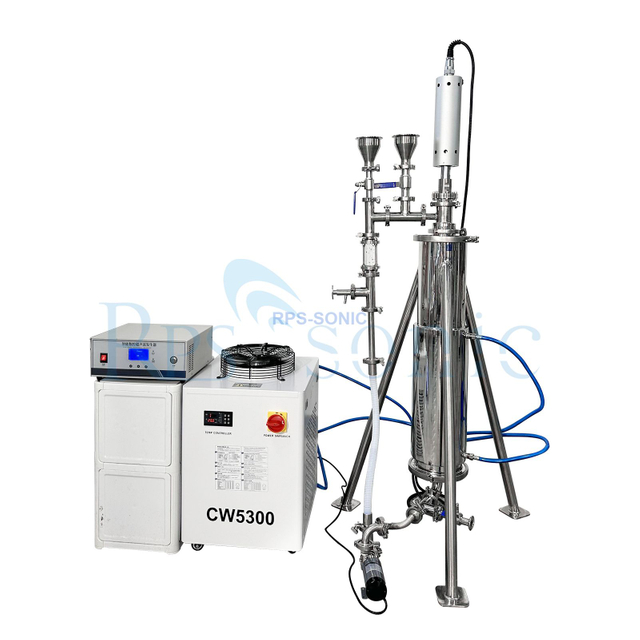
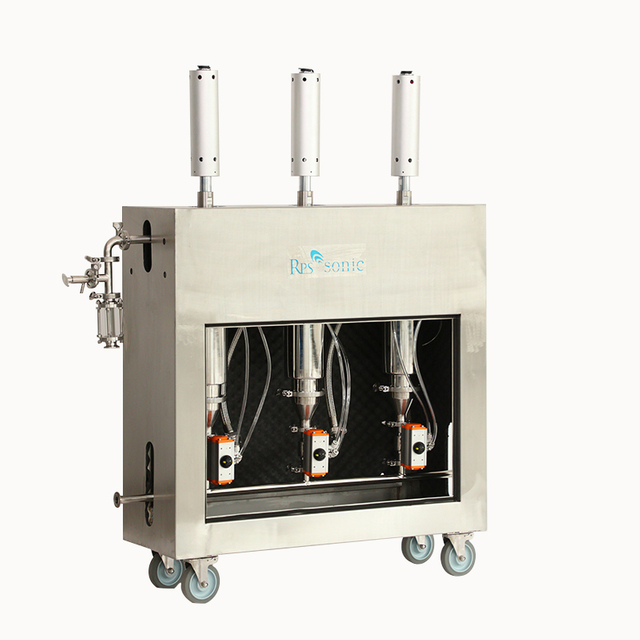
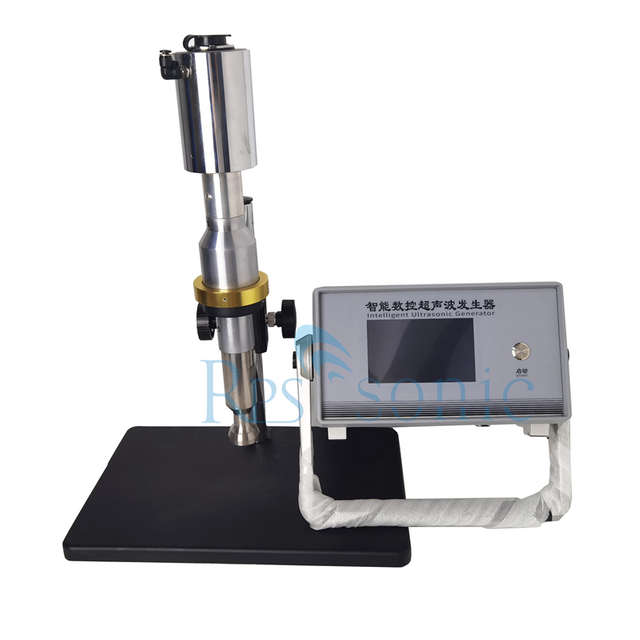
The core driving force of ultrasonic emulsification is mechanical amplitude; insufficient amplitude cannot trigger effective cavitation. The 20kHz transducer can achieve stable output with large amplitude and supports high-power upgrades from 500W to tens of kilowatts, meeting the needs of small-scale laboratory research and development as well as pilot-scale and continuous industrial production lines. High-frequency transducers struggle to achieve large amplitude and high power output, are prone to overheating and performance degradation under high-power conditions, and are prohibitively expensive, hindering industrial application.
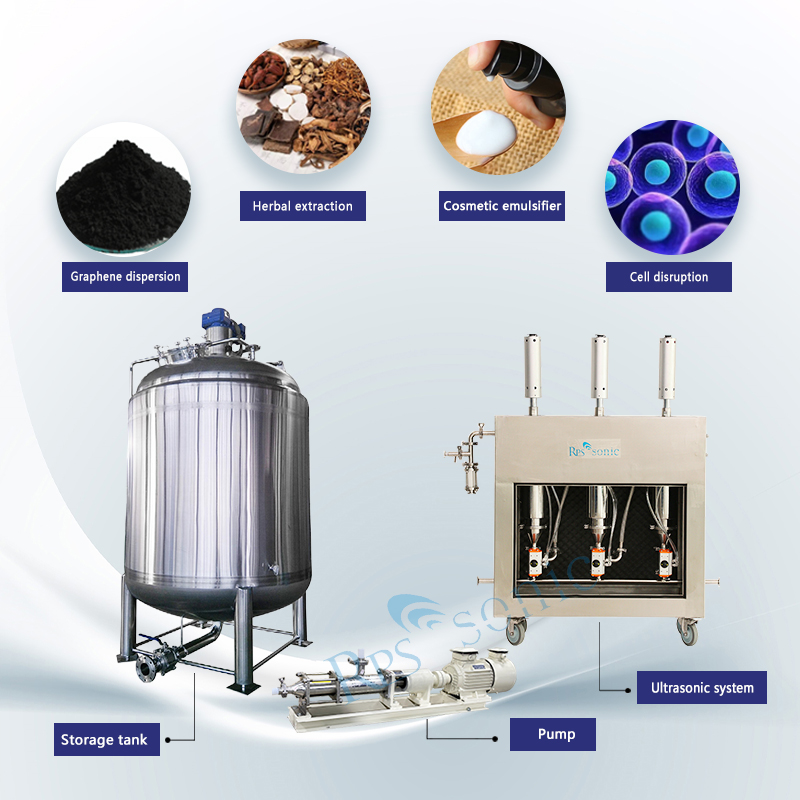
2. Comprehensive Process Compatibility: The 20kHz ultrasonic emulsification process boasts exceptional adaptability, compatible with most scenarios including oil-water emulsification, plant extraction, nanomaterial dispersion, lithium battery slurry treatment, traditional Chinese medicine extraction, cosmetic homogenization, and ultrasonic degassing. Whether dealing with low-viscosity solutions or high-viscosity, high-solids materials, it achieves stable and efficient processing results, far exceeding the versatility of high-frequency equipment.
3. Linear Scale-Up Without Scale-Up Effect: A critical pain point in industrial production is process scale-up failure. The 20kHz equipment employs unified amplitude control logic, allowing emulsification parameters and formulation effects from laboratory trials to be directly and linearly scaled up to industrial mass production equipment. This eliminates the issue of successful trials failing to meet mass production standards, significantly reducing R&D and mass production costs for enterprises.
IV. Common Misconceptions Explained: Why Not Pursue High-Frequency Quiet Operation? Many users wonder: High-frequency ultrasound above 40kHz is almost inaudible to the human ear, offering a better user experience, so why isn't it widely used in industry? The core answer is: noise is a secondary issue; emulsification effect is the core standard.
The trade-off for high-frequency silence is a significant reduction in cavitation intensity, directly leading to incomplete emulsification, poor emulsion stability, and uneven powder dispersion, failing to meet the quality requirements of industrial products. The noise problem of 20kHz equipment can be easily solved by adding soundproof enclosures and closed cavity structures; it is a secondary issue that can be optimized and does not affect the core process effect at all.
V. Conclusion Ultrasonic emulsification is best performed in the 20kHz frequency band, representing the optimal choice in terms of physical principles, process effect, equipment performance, and industrial adaptability. It solves the shortcomings of high-frequency bands (insufficient intensity and inability to deeply emulsify) and avoids the defects of low-frequency bands (equipment vulnerability and process instability). With its core advantages of high cavitation intensity, wide applicability, scalable power, and easy process amplification, it has become the universal standard frequency band in the global sonochemistry and ultrasonic emulsification industries.
20kHz is the universal golden frequency band for emulsification, covering more than 95% of industrial scenarios; only a few special scenarios may use 30-40kHz high frequency for fine homogenization, but this is only used as an auxiliary process and cannot replace the deep emulsification and dispersion capabilities of 20kHz.