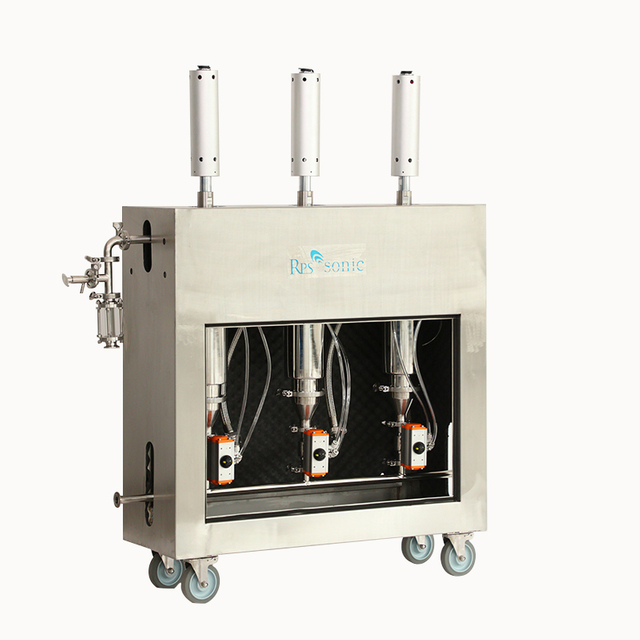
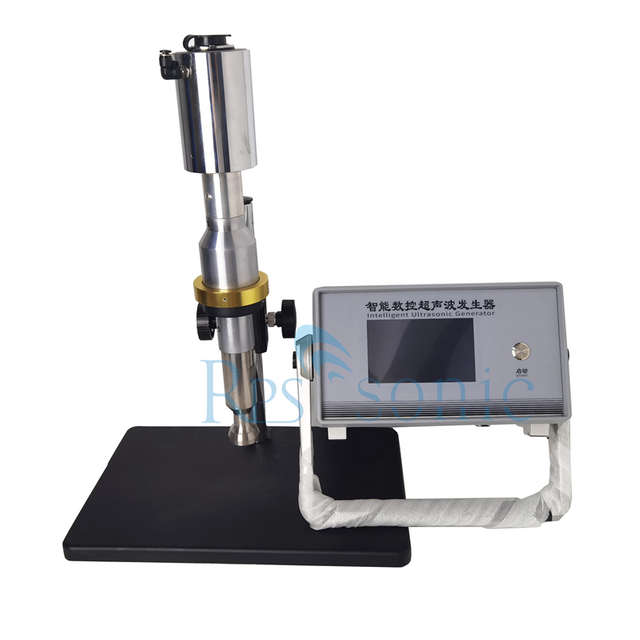
What Is Continuous-Flow Ultrasonic Extraction?
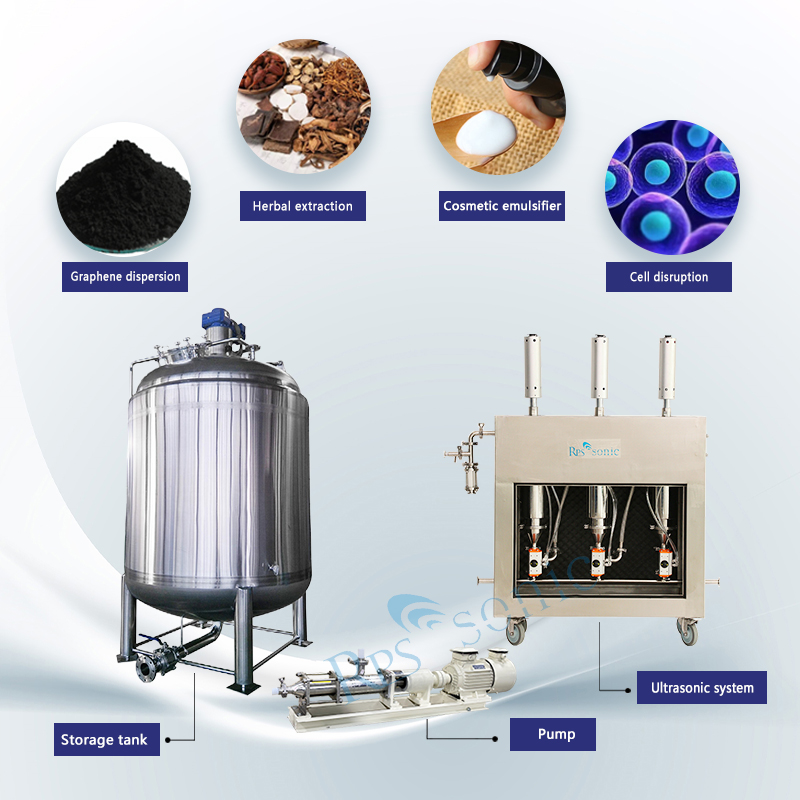
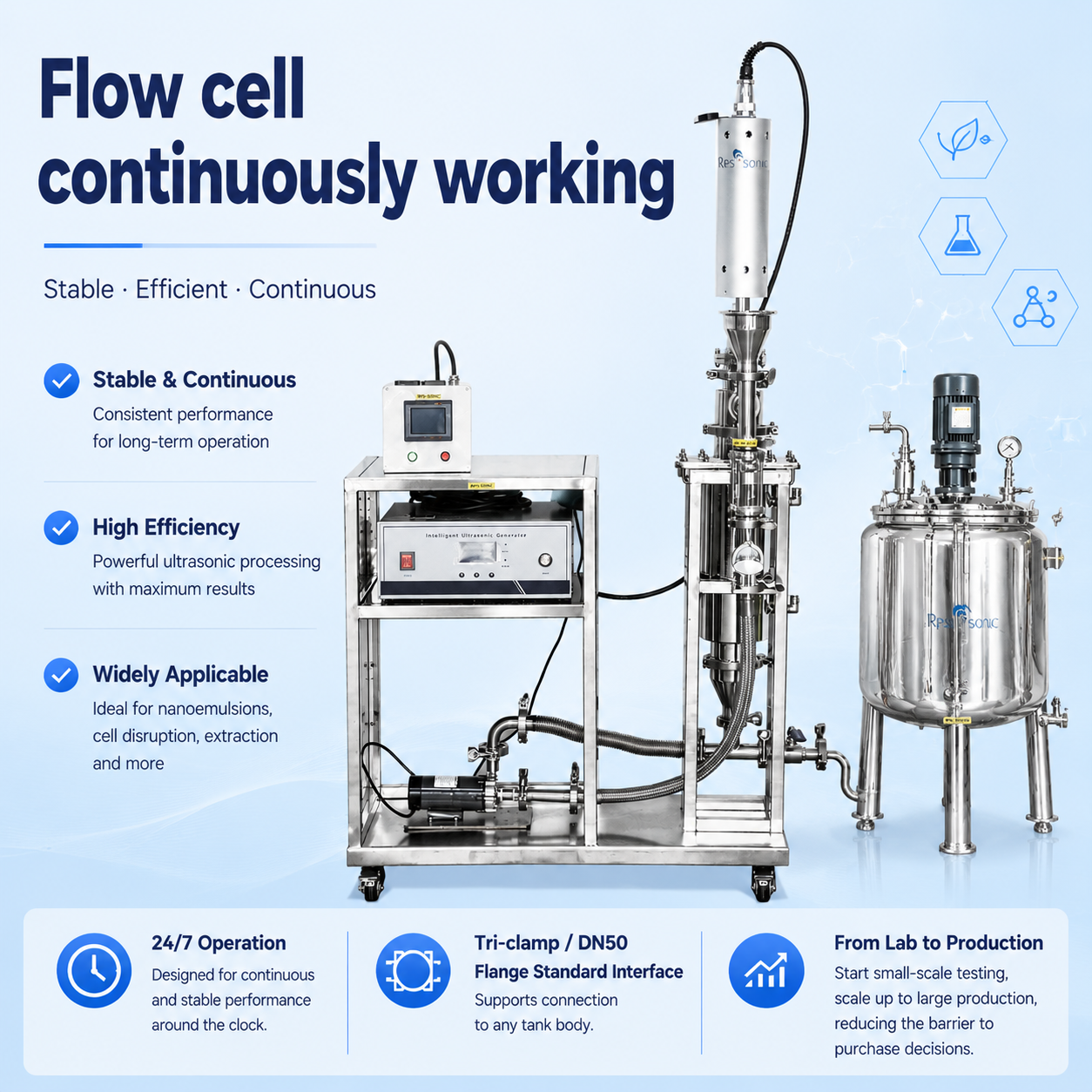
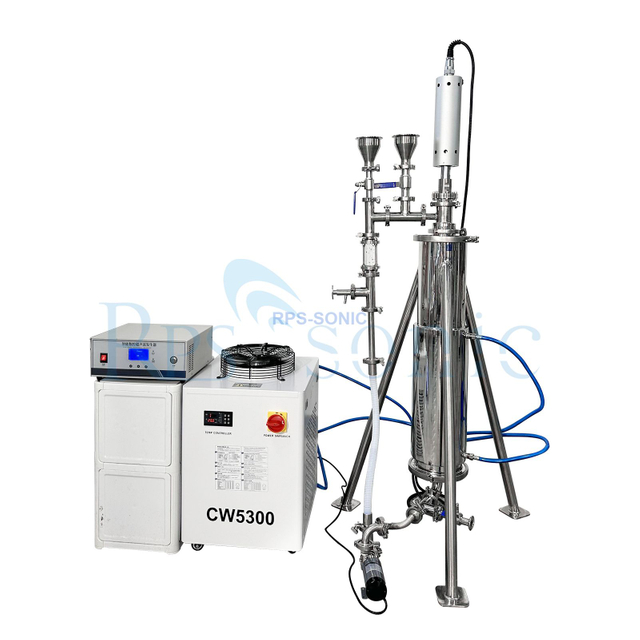
For industrial production, continuous-flow ultrasonic extraction can provide a more scalable process configuration.
A typical system can be designed as:
Feed Tank → Pump → Ultrasonic Flow Cell → Holding Tank → Filtration → Collection
The botanical slurry or extraction liquid passes continuously through an ultrasonic treatment chamber.
The process can be controlled by adjusting:
· Flow rate
· Ultrasonic power
· Amplitude
· Number of ultrasonic transducers
· Treatment volume
· Temperature
This approach is suitable for manufacturers looking to move from laboratory extraction to continuous production.
Ultrasonic Equipment for High-Viscosity Herbal Extracts
Some herbal extraction systems contain significant amounts of plant solids and can become highly viscous during processing.
In these applications, equipment selection becomes particularly important.
The system should consider:
Pumpability + Particle Size + Solids Content + Viscosity + Temperature + Ultrasonic Energy Density
For example, a high-solids botanical slurry may require a positive-displacement pump and a larger-diameter flow path to maintain stable material transfer.
The ultrasonic chamber should also be designed to minimize dead zones and prevent excessive accumulation of plant material.
Food, Nutraceutical and Cosmetic Applications
Ultrasonic herbal extraction can be considered for a wide range of botanical processing applications, including:
Food & Beverage
· Herbal extracts
· Botanical flavor ingredients
· Spice extracts
· Natural color ingredients
· Functional beverage ingredients
· Botanical-infused oils
Nutraceuticals
· Plant extracts
· Botanical concentrates
· Herbal tinctures
· Functional ingredients
· Natural antioxidant extracts
Cosmetics
· Botanical oil extracts
· Herbal active ingredients
· Plant-derived cosmetic ingredients
· Natural skin-care formulations
For food, nutraceutical, and cosmetic applications, all product-contact materials and processing conditions should be selected according to the applicable regulations and the final product requirements.
Customized Ultrasonic Extraction Equipment
Different botanical extraction projects have different requirements.
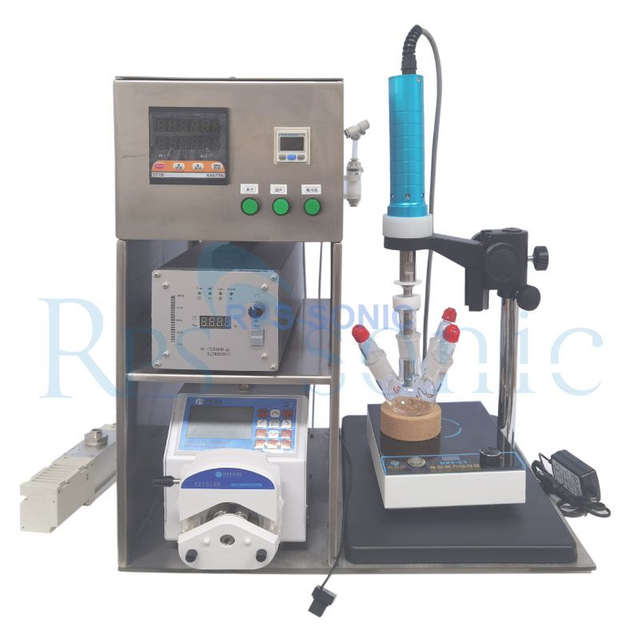
A laboratory researcher may need a small ultrasonic probe system for process development, while an industrial manufacturer may require a complete skid-mounted extraction line.
Ultrasonic equipment can be customized according to:
· Extraction volume
· Botanical solids concentration
· Viscosity
· Particle size
· Solvent type
· Processing temperature
· Required flow rate
· Target extraction time
· Batch or continuous operation
The ultrasonic horn can also be customized in terms of diameter, length, geometry, and installation configuration.
For industrial systems, titanium alloy sonotrodes are commonly considered because of their mechanical strength, corrosion resistance, and suitability for high-intensity ultrasonic operation.
From Laboratory Trials to Industrial Production
Successful ultrasonic extraction projects typically follow a step-by-step development process:
Step 1 — Raw Material Testing
Evaluate the botanical material, moisture content, particle size, and target compounds.
Step 2 — Solvent Screening
Compare suitable alcohol, water-alcohol, oil, or other extraction media.
Step 3 — Ultrasonic Parameter Optimization
Test frequency, amplitude, processing time, temperature, and solid-to-liquid ratio.
Step 4 — Pilot Testing
Verify extraction performance at a larger scale.
Step 5 — Industrial Scale-Up
Design the appropriate batch or continuous-flow ultrasonic extraction system.
This approach helps prevent simply scaling up ultrasonic power without understanding the actual process requirements.
Conclusion
Herbal alcohol tinctures and oil-based botanical extracts require efficient contact between the extraction medium and plant material.
Ultrasonic-assisted extraction provides a powerful process-intensification technology by combining cavitation, acoustic streaming, mechanical vibration, and enhanced mass transfer.
For herbal tinctures, ultrasound can improve solvent penetration and facilitate the release of compounds from plant structures.
For oil-based botanical extraction, it can improve plant–oil contact, dispersion, and mass transfer while allowing the process to be operated under controlled temperature conditions.
From laboratory-scale botanical research to industrial production, ultrasonic systems can be designed as batch extraction systems or continuous-flow processing units.
For manufacturers working with herbs, spices, medicinal botanicals, plant powders, or oil-based extracts, ultrasonic technology offers a flexible pathway toward faster, more controllable, and more scalable extraction processes.