Applications of Ultrasonic Aging Equipment in Wine Processing: From Aroma Extraction To Accelerated Aging
A bottle of wine, from grapes to a finished product with complex aromas and a full-bodied taste, often requires fermentation, maceration, oak barrel aging, and a long maturation period.
Traditional wine aging typically takes months or even years.
For wineries, time means cost; but for consumers, the real value lies in the final aromas, colors, textures, and flavor profiles of the wine.
So, is there a technology that can shorten some of the maturation and aging processes while preserving as much of the wine's original quality as possible?
Ultrasonic wine processing is emerging as a promising solution.
Through the cavitation effect, mechanical vibration, and microjets generated by powerful ultrasound, the release of flavor compounds from the grapes can be promoted, and the mass transfer process between the wine and the oak barrels can be enhanced, thereby aiding in the wine's maturation and flavor development.
I. Why Can Ultrasound Affect Wine?
When ultrasound acts on a liquid, it generates numerous tiny bubbles.
These bubbles continuously form, expand, and rapidly collapse, creating strong localized mechanical forces within the liquid.
In winemaking, these effects manifest primarily as: cavitation, microjets, localized shear forces, turbulence and micromixing, enhanced mass transfer, and disruption of cell structure.
These effects don't simply "alter the wine," but rather accelerate mass transfer and extraction processes that would otherwise take a considerable amount of time.
II. Extracting More Aromatic Compounds and Phenolic Compounds from Grapes
Grape skins, seeds, and pulp contain numerous components related to wine quality, such as: phenolic compounds, tannins, anthocyanins, aromatic compounds, pigments, and various plant-based active substances.
During traditional maceration, these substances primarily diffuse into the grape juice or wine naturally.
The problem is: The structure of the grape tissue limits the rate of mass transfer.
Ultrasound can alter this process.
How does ultrasonic cavitation aid extraction? When ultrasound enters a system composed of grape juice and solid grape material, the rapid collapse of cavitation bubbles generates microjets and shear forces.
These mechanical effects can:
disrupt or weaken plant cell structure
promote solvent penetration into grape tissue
enhance the migration of intracellular substances into the liquid phase
accelerate the release of phenols, pigments, and some aromatic compounds.
Simultaneously, the mechanical effects of ultrasound may further refine solid particles, thereby increasing the effective contact area between the solid and liquid phases.
Therefore, the entire process can be understood as:
Cell structure disruption + enhanced mass transfer + increased contact area = more efficient component extraction
III. Ultrasound can help enhance the color of wine
The color of red wine is closely related to anthocyanins and other phenolic substances in grape skins.
In traditional winemaking, a relatively long maceration and fermentation process is required for the pigments in the grape skins to gradually enter the wine.
Ultrasound-assisted treatment can enhance the contact and mass transfer between grape skins and the wine.
Therefore, for certain red wine processes, the application of ultrasound in:
pigment release, polyphenol extraction, and maceration enhancement can be explored.
The ultimate goal is to help achieve a more pronounced and stable color expression.
Of course, the actual effect is closely related to factors such as grape variety, ripeness, ultrasonic power, processing time, and temperature. Therefore, industrial production usually requires small-scale trials to determine the optimal parameters.
IV. Ultrasonic-Assisted Aroma Release in Wine
The aroma of wine is a very complex system.
Some aromas come from the grapes themselves, while others come from the fermentation and aging processes.
Grape tissue contains several aromatic precursors and volatile related components.
Ultrasound can promote the migration of these components into the liquid phase by enhancing tissue disruption and mass transfer.
Therefore, ultrasound can be used to study and optimize:
Grape Raw Material Stage
Promotes:
Aromatic precursor release, extraction of grape skin components, migration of aroma-related substances
Fermentation Stage
Promotes:
Solid-liquid mass transfer, contact between grape skins and wine, release of some flavor components
Aging Stage
Promotes:
Contact between wine and oak materials, migration of wood components, fusion of flavor substances
This means that the application of ultrasound is not limited to so-called "accelerated aging."
It can actually be used throughout multiple stages of wine processing.
Therefore, a more accurate definition of ultrasonic aging equipment should be:
Ultrasonic-Assisted Wine Aging
that is, ultrasonic-assisted wine maturation/aging
rather than simply being a "rapid aging device".
What are the advantages of ultrasonic aging equipment?
① Reduced processing time
Traditional aging relies on natural diffusion and long-term storage.
Ultrasonic waves can enhance mass transfer, thus potentially shortening the time required for some process steps.
② Improved grape raw material utilization
By enhancing cell structure disruption and solid-liquid mass transfer, it can help:
polyphenols, pigments, and aroma-related components in grapes to more fully enter the liquid phase.
③ Enhanced oak component extraction
For aging materials such as oak chips and blocks, ultrasound can increase the effective contact and mass transfer between the wine and the wood.
④ Controllable process parameters
Compared to simply relying on long-term natural aging, ultrasonic treatment can be optimized by adjusting:
ultrasonic power, amplitude, processing time, temperature, and circulation flow rate. ⑤ Easy to integrate with existing equipment
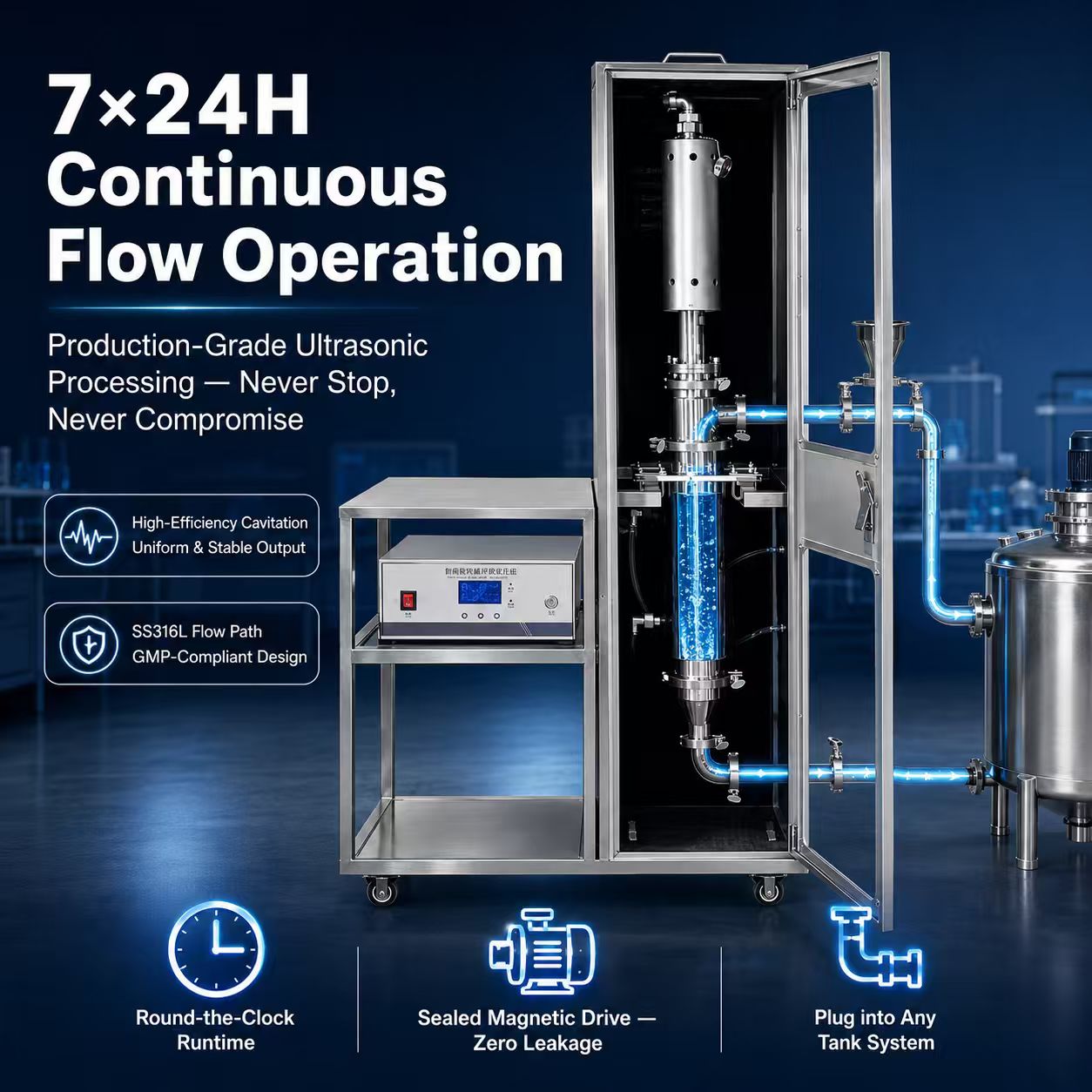
The ultrasonic system can be designed as:
Storage tank + circulation pump + ultrasonic flow tank
forming a circulating treatment system.
For example:
Wine storage tank
↓ Circulation pump
↓ Ultrasonic treatment unit
↓ Return to storage tank
↓ Circulation treatment
This solution is particularly suitable for wineries that already have stainless steel storage tanks for technological upgrades.