Technical Advantages and Application Analysis of Ultrasonic Soldering Irons in Vacuum Glass Tin Plating
I. Why Does the Tin Plating Process for Vacuum Glass Require Special Welding Technology?
With the increasing application of vacuum glass, Low-E glass, and functional glass in building energy conservation, automobiles, photovoltaics, and high-end doors and windows, the metallization treatment and conductive connection processes on the glass surface place higher demands on reliability.
In the manufacturing process of vacuum glass and functional glass, certain areas require soldering, solder joints, or metal layer welding to achieve conductivity, signal transmission, or fixation of metal components. However, glass is a typical non-metallic material with generally high chemical stability and low wettability.
When soldering glass surfaces with a traditional soldering iron, the following problems easily occur:
* The solder is difficult to wet the glass surface.
* Insufficient solder adhesion.
* The need for flux or special flux.
* Residues are easily generated during the soldering process.
* Localized heating may cause thermal stress in the glass.
* Potential impact on functional coatings such as Low-E films and conductive films.
* High requirements for the consistency of surface coating welding.
Therefore, in glass processing scenarios with high requirements for welding reliability, cleanliness, and process stability, **ultrasonic soldering irons** offer a new solution.
II. What is an Ultrasonic Soldering Iron?
An ultrasonic soldering iron is a special soldering device that combines high-frequency ultrasonic vibration with traditional soldering heating technology.
The device typically consists of: an ultrasonic generator + an ultrasonic transducer + a soldering tip + a heating system.
Unlike ordinary soldering irons, which primarily rely on heat to melt the solder, ultrasonic soldering irons also generate high-frequency mechanical vibrations during the soldering process.
When the soldering tip comes into contact with the molten solder and the workpiece, the ultrasonic vibrations create a microscopic mechanical effect at the interface, thereby improving the interfacial state between the solder and the substrate.
One of its core advantages is that, under certain conditions, it can reduce or eliminate the reliance on traditional flux in the soldering process.
This is also a key reason why ultrasonic soldering technology has attracted particular attention in the glass, ceramics, and some difficult-to-solder materials processing fields.
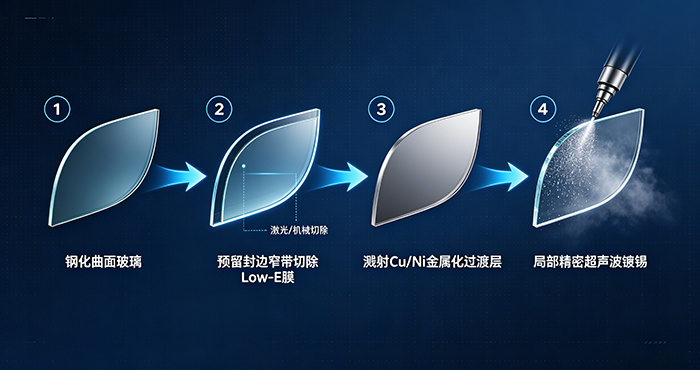
III. How Does Ultrasonic Soldering Improve Soldering on Glass Surfaces?
One of the biggest challenges in traditional soldering is wetting.
Even if the solder has melted, if it cannot form good wetting and spreading on the glass surface, the final solder joint may still have insufficient adhesion.
When an ultrasonic soldering iron is in operation, high-frequency vibrations act on the soldering interface.
1. Ultrasonic Cavitation and Interface Effects
Under specific solder and process conditions, ultrasound can create microscopic cavitation effects and strong interface disturbances in the molten solder.
This effect helps to:
Improve solder flow, reduce the influence of interfacial gases, break down some surface contaminant layers, improve the contact between the solder and the substrate, and enhance solder wetting and spreading on the substrate surface.
Therefore, ultrasound is not merely "heating the solder," but actively improving the soldering interface.
IV. Core Applications of Ultrasonic Soldering Irons in Vacuum Glass Tin Plating
1. Soldering Metallized Glass Layers
For glass surfaces that have already undergone metallization, such as certain conductive films, metal layers, or functional coating areas, ultrasonic soldering irons can be used for localized soldering.
Typical applications include:
Conductive glass layer → Soldering → Metal wire
Or:
Metallized glass area → Soldering → Electrode/connection terminal
Precise soldering can be achieved in smaller areas through localized heating and ultrasonic vibration.
2. Conductive Connections in Vacuum Glass
Some vacuum glass and functional glass products require electrical connections, such as:
Heated glass, electrically controlled glass, smart glass, defogged glass, electrically heated glass, and special-functional architectural glass.
These products typically require electrodes or wires to be connected to conductive areas on the glass surface.
Ultrasonic soldering irons can be used for:
Connecting conductive film/metal electrodes + solder + wires
Compared to traditional soldering methods, ultrasonic technology helps improve solder wetting and interfacial bonding, thereby increasing connection stability.
Reducing flux usage and improving glass processing cleanliness
In traditional glass soldering processes, certain types of flux are usually required to improve wetting.
However, in the production of some vacuum glass and high-cleanliness products, flux may introduce additional problems, such as: flux residue, increased subsequent cleaning processes, corrosion risks, organic residue, potential impact on the vacuum environment, and increased production process complexity. A key advantage of ultrasonic soldering irons is that they improve the soldering interface through high-frequency mechanical vibration, reducing reliance on traditional fluxes under suitable material systems and process conditions.
This is particularly valuable for high-cleanliness glass products.
It is important to note that whether completely flux-free soldering can be achieved requires actual testing and confirmation based on the glass surface treatment method, metallization layer, solder type, and ultrasonic parameters.
Vacuum glass and functional glass place higher demands on surface soldering technology than traditional metal soldering.
Ultrasonic soldering irons do not simply replace traditional soldering irons; rather, they improve the soldering interface and material wetting through "ultrasonic vibration + precise heating," providing a new process option for soldering glass and functional coatings.
Ultimately, ultrasonic soldering technology has significant process development potential in applications such as vacuum glass, Low-E glass, heated glass, smart glass, and conductive glass.
For manufacturers looking to reduce flux usage, improve solder wettability on glass surfaces, enhance solder joint consistency, and automate soldering processes, Ultrasonic Soldering Iron is worth testing and validating as a novel glass soldering technology.
In practical projects, the final equipment parameters should be matched to the glass type, surface coating, metallization method, solder material, and solder strength requirements. Optimal ultrasonic power, temperature, amplitude, and soldering time should be determined through sample testing.