  +86-15658151051                            sales@xingultrasonic.com 
Product Details
Home / Products / Ultrasonic Assisted Equipment / 60Khz Portable Ultrasonic Soldering Machine for Tinning Sn Handheld Gun

Product Category

News

loading

Share to:
facebook sharing button
twitter sharing button
line sharing button
wechat sharing button
linkedin sharing button
pinterest sharing button
whatsapp sharing button
kakao sharing button
snapchat sharing button
telegram sharing button
sharethis sharing button

60Khz Portable Ultrasonic Soldering Machine for Tinning Sn Handheld Gun

Ultrasonic machining is the removal of material by the abrading action of grit-loaded liquid slurry circulating between the workpiece and a tool vibrating perpendicular to the workface at afrequency above the audible range.
Frequency:
Amplitude of vibration (a):
Application :
Availability:
Quantity:
20Khz Portable Ultrasonic Soldering Machine for Tinning Sn Handheld Gun
60Khz Portable Ultrasonic Soldering Machine for Tinning Sn Handheld Gun
20Khz Portable Ultrasonic Soldering Machine for Tinning Sn Handheld Gun
  • RPS-SI60N

  • RPS-SONIC

60Khz Portable Ultrasonic Soldering Machine for Tinning Sn Handheld Gun


Introduction:


What is Ultrasonic Soldering?

In simple terms, ultrasonic soldering is a fluxless soldering process that uses high-frequency sound waves to clean metal surfaces and enable the solder to flow, all without the need for chemical flux.

It's primarily used for joining materials that are traditionally difficult to solder, such as aluminum, stainless steel, and ceramics, because their surfaces instantly form a tough, stable oxide layer that prevents wetting.

Ultrasonic soldering irons are advanced tools that combine traditional heating soldering with ultrasonic vibration. Their core advantage lies in utilizing the "cavitation effect" generated by ultrasound in molten solder to physically remove the oxide layer from the material and solder surface, thus completely eliminating dependence on chemical fluxes. This technology solves the problems of traditional soldering on dissimilar materials and heat-sensitive components,


The Core Principle: How It Works

The magic of ultrasonic soldering lies in two key phenomena caused by high-frequency vibrations:

Acoustic Cavitation: The soldering tool (called a sonotrode or horn) vibrates at an ultrasonic frequency (typically 20 kHz to 40 kHz or higher). These vibrations are transmitted into the molten solder bath or the solder joint itself. This intense agitation creates and collapses millions of microscopic bubbles in the liquid solder—a process called cavitation.

Oxide Removal: The implosion of these cavitation bubbles releases a tremendous amount of energy locally. This blast of energy is powerful enough to scrub away the oxide layer on the metal surfaces being joined. It literally shatters and disperses the oxides, exposing a perfectly clean, active metal surface.

Once the oxide barrier is removed, the clean molten solder can immediately wet and bond with the base metal, forming a strong metallurgical joint—all without any flux.


Parameter:


Model No. RPS-SI60N
Ultrasonic Frequency 60Khz
Maximum Output 400 Watt
Temperature Range 150 ~ 400 °C
Power Supply 220V / 50-60 Hz
Ultrasonic Generator Size 250(W) x 310(L) x 135(H) mm
Weight 5 Kg
Feature Ultrasonic Amplitude Adjustable
Pot dimension 65*8 mm
Avail Soldering Matrial ITO Glass, AL, Mo, Cu etc.,


5 (49)

7 (45)


Key Components of an Ultrasonic Soldering System

A typical system consists of:

Ultrasonic Generator: The power supply that converts standard electrical power into high-frequency electrical energy.

Transducer (or Converter): Converts the high-frequency electrical signal from the generator into high-frequency mechanical vibrations.

Booster / Acoustic Horn: Modifies the amplitude of the mechanical vibrations.

Sonotrode (Soldering Tip): This is the working tip that delivers the ultrasonic vibrations to the solder and the workpiece. It can be designed as a simple iron tip or as part of a larger soldering pot.


Application


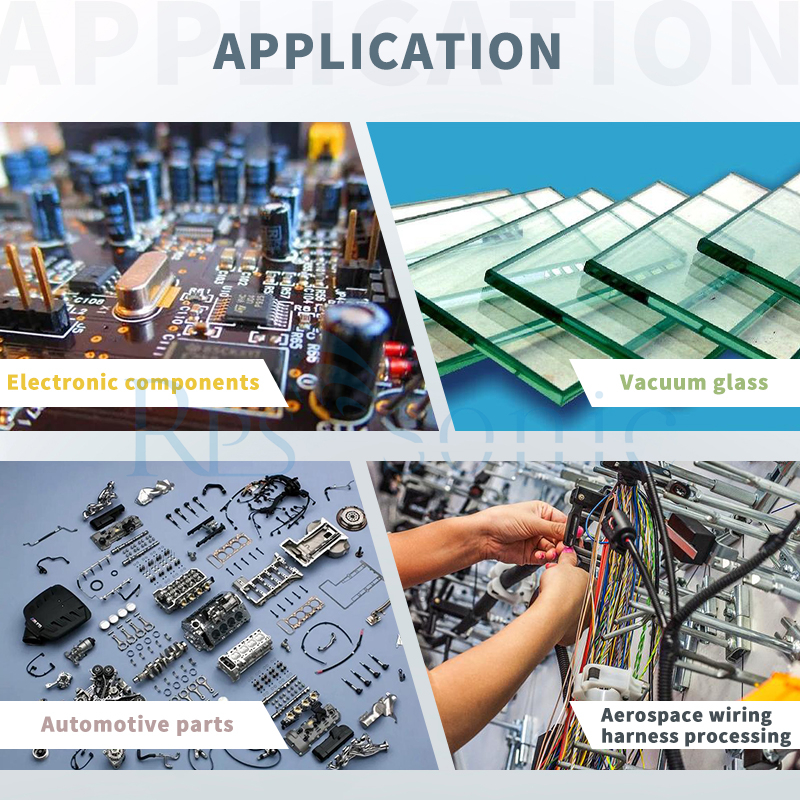
Electronics Manufacturing: Tinning of aluminum leads on capacitors, transformers, and other components before wave soldering.

Repair Work: Fixing aluminum wire connections and repairing aluminum heat exchangers.

Jewelry Manufacturing: Soldering aluminum or stainless-steel jewelry.

Aerospace and Automotive: Joining lightweight aluminum and stainless-steel components.

Medical Device Assembly: Where absolute cleanliness and no chemical residues are mandatory.


* Aluminum components
* Ferrite components
* Glass components
* Silicon wafers
* Ceramic components
* Semiconductor chips
* Metals etc.
电烙铁3电烙铁4


What material can the ultrasonic soldering Iron welding ? 


Tin, We can check the METAL MELTING POINT table as follws:

METAL MELTING POINT
(oC) (oF)
Babbitt 249 480
Beryllium 1285 2345
Beryllium Copper 865 – 955 1587 – 1750
Bismuth 271.4 520.5
Phosphorus 44 111
Platinum 1770 3220
Red Brass 990 – 1025 1810 – 1880
Rhenium 3186 5767
Rhodium 1965 3569
Selenium 217 423
Silicon 1411 2572
Silver, Pure 961 1761
Silver, Sterling 893 1640
Carbon Steel 1425 – 1540 2600 – 2800
Stainless Steel 1510 2750
Tantalum 2980 5400
Thorium 1750 3180
Tin 232 449.4
Titanium 1670 3040
Tungsten 3400 6150
Yellow Brass 905 – 932 1660 – 1710
Zinc 419.5 787

Our horn Temperature Range is 150~400, so the Tin can be melt by our horn.


The new model of the ultrasonic soldering iron comes complete with a newly designed ergonomic, lightweight handle, which ensures that there is a minimum of strain on the operator during the soldering process.

The ultrasonic soldering iron incorporates a powerful heater, rated at 60W, and a digital temperature controller which allows the user to adjust the soldering tip temperature and provides control from 50°C up to 400°C ±2°C.

The ultrasonic generator has 9 levels of ultrasonic activity, selected by push buttons, plus a function that allows the soldering iron to be used as a conventional soldering iron if required. The ultrasonic power is applied to the iron as needed by operating the provided footswitch or, alternatively, the power can be turned on and off using the button on the front of the unit.

An ultrasonic transducer is built into the soldering iron handle and to prevent this unit being overheated a continuous use of a cooling air is required. There is a safety system in place to ensure that if the air pressure has dropped and has stopped cooling the transducer the unit automatically turns off to prevent frequency drift and damage to the transducer. The cooling air supply can be provided by a small pump, not supplied, or from a facilities own 0.75-1bar clean air supply.

The iron comes with 3 interchangeable soldering tips, made from a high density hard copper, which have been matched to the ultrasonic generator to provide optimum performance. There are a variety of tips to choose from including various sizes of chisel, cone and point shapes from a range that Solbraze manufacture to suit the customers application.

The ultrasonic iron can be used worldwide as the ultrasonic irons power supply input can be switched to be either 110v or 230v depending on the local mains supply using a switch on the rear of the unit.


Previous: 
Next: 
Get in touch

CATEGORIES

NAVIGATION

GET IN TOUCH

 Ms. Yvonne
  sales@xingultrasonic.com   
  +86 571 63481280

  +86 15658151051
   1st Building NO.608 Road ,FuYang, Hangzhou, Zhejiang,China

QR-CODE

© RPS-SONIC |  Privacy Policy