Currently, research on the extraction of antioxidants and anti-aging drugs from natural products has attracted widespread attention from domestic and foreign scholars. Considerable research results have been achieved in this field, and based on comprehensive domestic and international research repor
The application of ultrasonic in the sewing industry mainly reflects the two major functions of ultrasonic: welding and cutting. In 2019, for masks that are popular all over the world, ultrasound is a household name for applying these two functions to the fullest. The cutting and welding of velvet c
Ultrasonic spray coating system is a technique for forming thin films with specific functions or properties on the surface of optical glass. It utilizes ultrasonic waves to atomize liquid into fine droplets and uniformly spray them onto the surface of optical glass. This article introduces the princ
Currently, research on the extraction of antioxidants and anti-aging drugs from natural products has attracted widespread attention from domestic and foreign scholars. Considerable research results have been achieved in this field, and based on comprehensive domestic and international research repor
The application of ultrasonic in the sewing industry mainly reflects the two major functions of ultrasonic: welding and cutting. In 2019, for masks that are popular all over the world, ultrasound is a household name for applying these two functions to the fullest. The cutting and welding of velvet c
Currently, research on the extraction of antioxidants and anti-aging drugs from natural products has attracted widespread attention from domestic and foreign scholars. Considerable research results have been achieved in this field, and based on comprehensive domestic and international research repor
Ultrasonic spray coating system is a technique for forming thin films with specific functions or properties on the surface of optical glass. It utilizes ultrasonic waves to atomize liquid into fine droplets and uniformly spray them onto the surface of optical glass. This article introduces the princ
Currently, research on the extraction of antioxidants and anti-aging drugs from natural products has attracted widespread attention from domestic and foreign scholars. Considerable research results have been achieved in this field, and based on comprehensive domestic and international research repor
Ultrasonic spray coating system is a technique for forming thin films with specific functions or properties on the surface of optical glass. It utilizes ultrasonic waves to atomize liquid into fine droplets and uniformly spray them onto the surface of optical glass. This article introduces the princ
What is ultrasonic tinning?Ultrasonic tinning is a kind of welding method that does not use flux. The ultrasonic probe produces cavitation in the molten solder core through mechanical vibration at ultrasonic frequency, and removes the oxide film on the metal surface for smooth and clean tinning. Ult
The application of ultrasonic in the sewing industry mainly reflects the two major functions of ultrasonic: welding and cutting. In 2019, for masks that are popular all over the world, ultrasound is a household name for applying these two functions to the fullest. The cutting and welding of velvet c
| Certification: | |
|---|---|
| Installation: | |
| Pressure: | |
| Frequency: | |
| Power: | |
| Max Capacity: | |
| Tip Head Material: | |
| Availability: | |
| Quantity: | |
SONOL20-3000
RPS-SONIC
8515900090
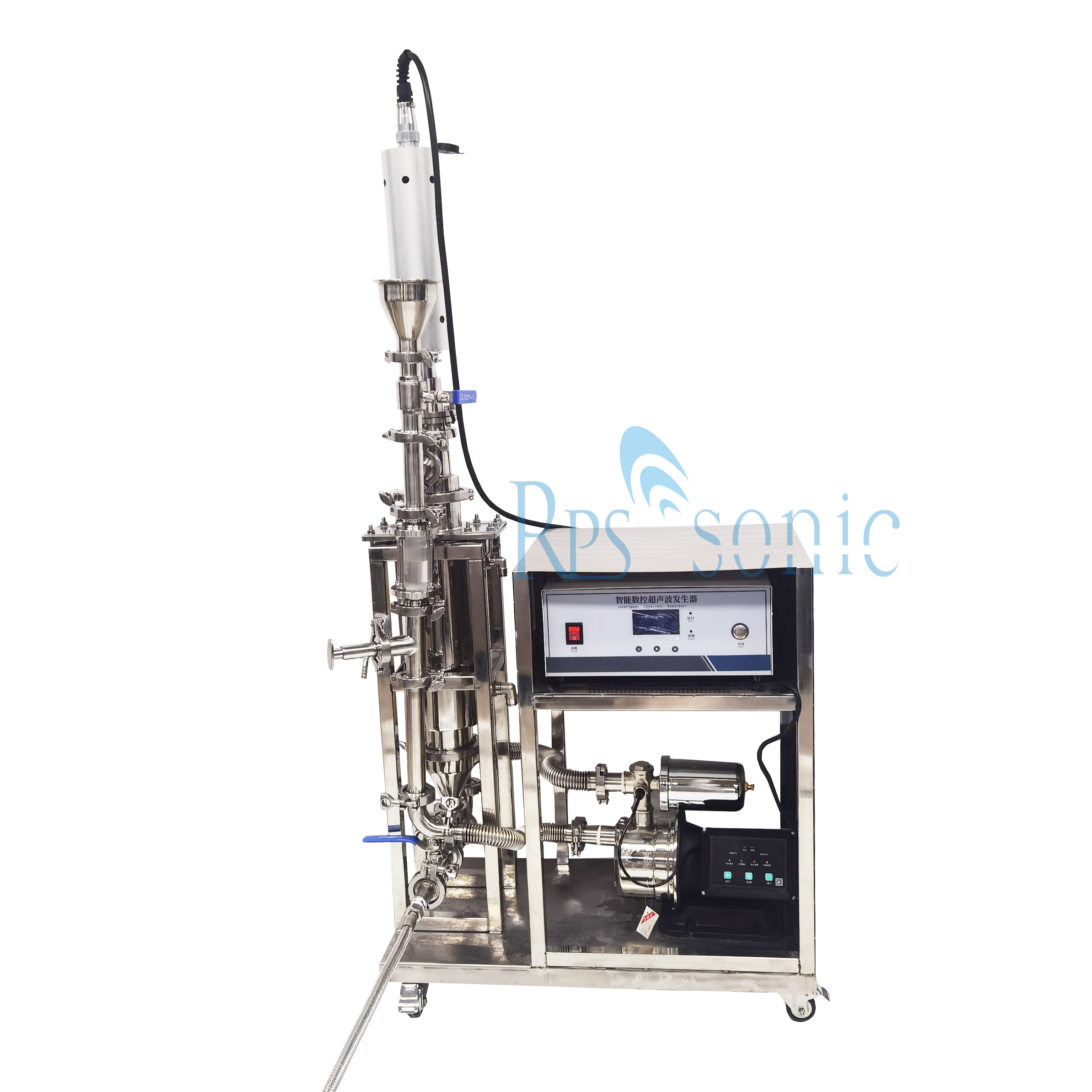
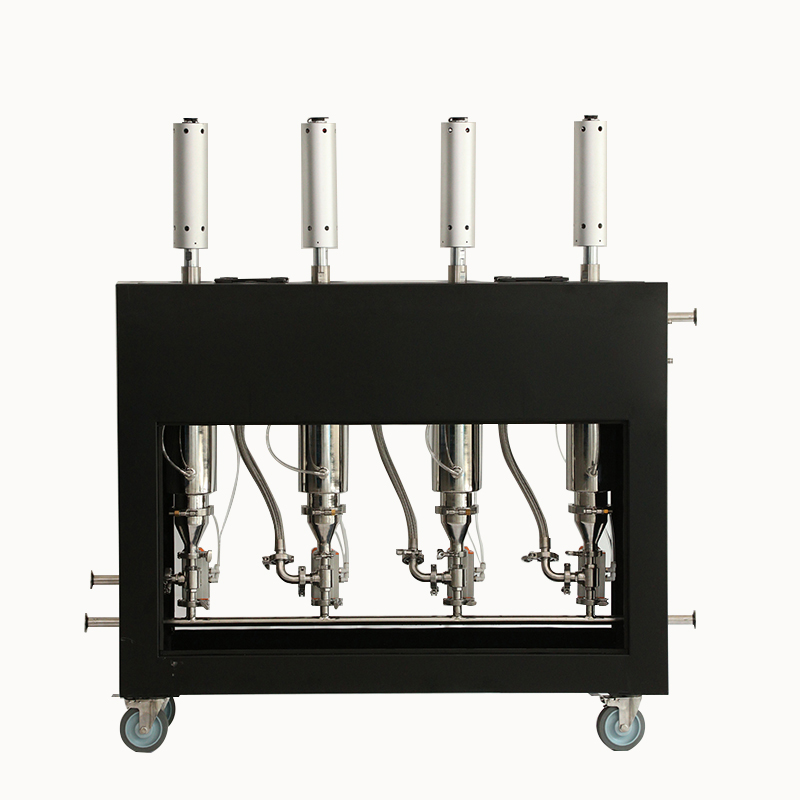
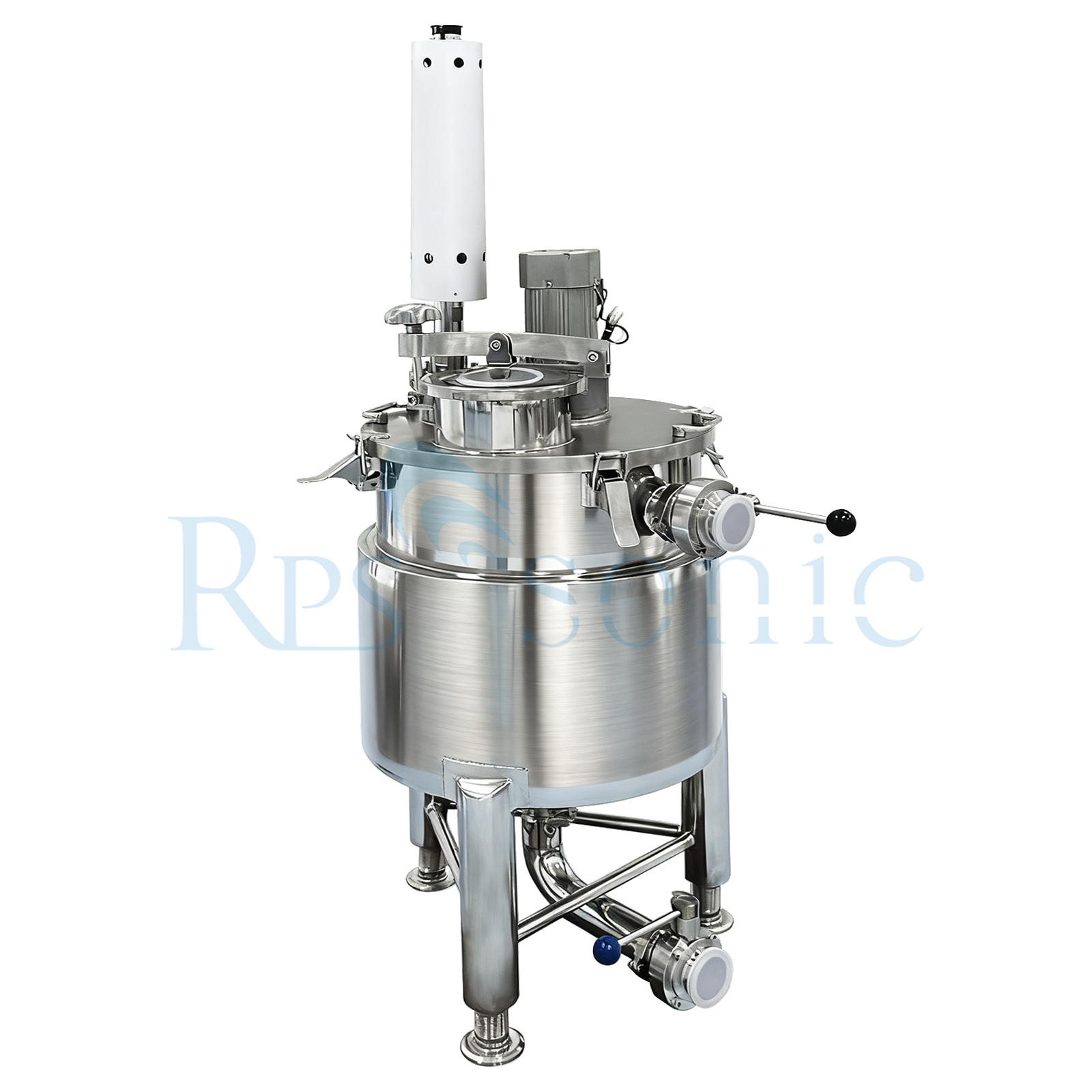
30L Industrial Ultrasonic Homogenizer Dispersion System for Nanoparticles
Description
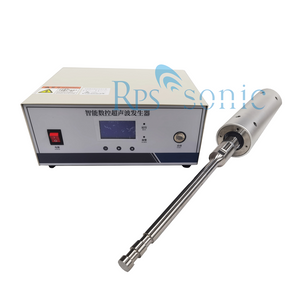
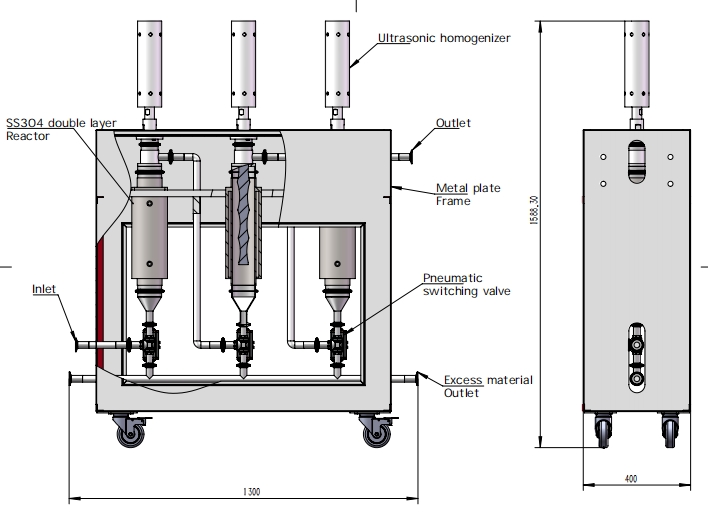
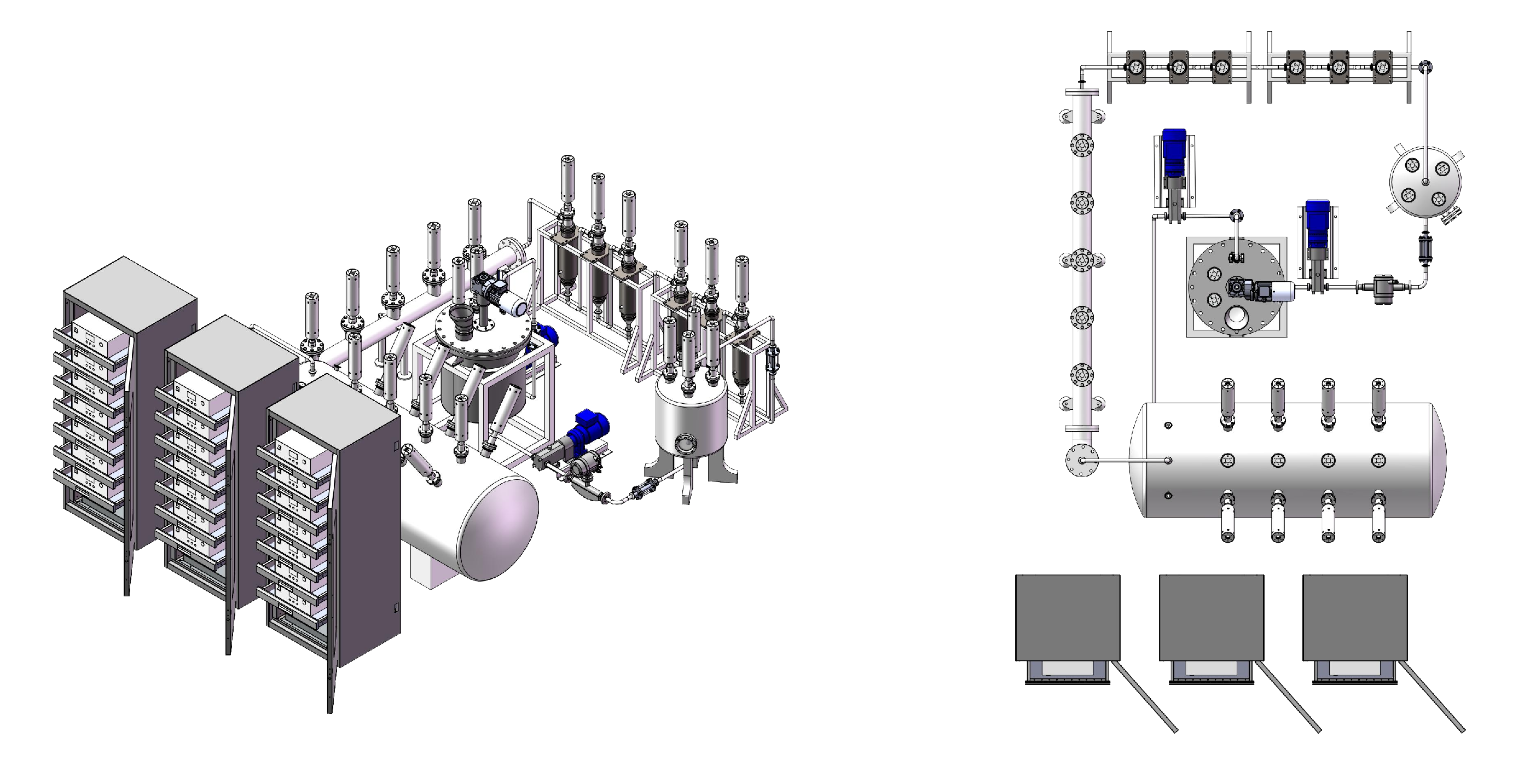
The 30L Industrial Ultrasonic Homogenizer Dispersion System is a high-capacity advanced processing solution designed for large-scale nanoparticle dispersion, emulsification, and deagglomeration. It uses powerful ultrasonic cavitation technology to generate intense micro-scale shockwaves, effectively breaking particle clusters and achieving uniform nano-level distribution in liquids.
Unlike conventional mixing or high-shear systems, this ultrasonic dispersion system directly acts on particle structures at the microscopic level, delivering superior dispersion efficiency, improved stability, and higher reproducibility. The 30L processing capacity makes it ideal for pilot production and small-to-medium industrial manufacturing, bridging the gap between laboratory research and full-scale production.
This system is widely used in nanomaterials, pharmaceuticals, chemical engineering, advanced coatings, and energy materials where precise particle size control and stable dispersion are critical.
Core Principle: The Amazing Cavitation Effect
Violent Implosion of Bubbles: When high-intensity ultrasound propagates in a liquid, it generates alternating high and low pressure cycles. In the low-pressure phase, numerous tiny vacuum bubbles (cavitation bubbles) form in the liquid. With continuous input of sound energy, these bubbles grow until they burst violently and implode-like during the high-pressure phase.
Extreme and Tiny Energy Release: The rupture of each cavitation bubble is a moment of highly concentrated energy. This process generates extreme conditions at the microscopic scale:
Local instantaneous high temperatures can reach over 1000°C.
Local instantaneous high pressures can reach 500 atm (approximately 50 MPa).
It generates microjets with speeds up to 1000 km/h and powerful shock waves.
Breaking up graphene aggregation: Van der Waals forces naturally exist between graphene sheets, making them extremely prone to aggregation. Ultrasonic dispersion utilizes the powerful mechanical force generated by the aforementioned cavitation effect to "shake" apart the aggregated graphene particles, overcome the van der Waals forces, and redisperse them into independent monolayers.
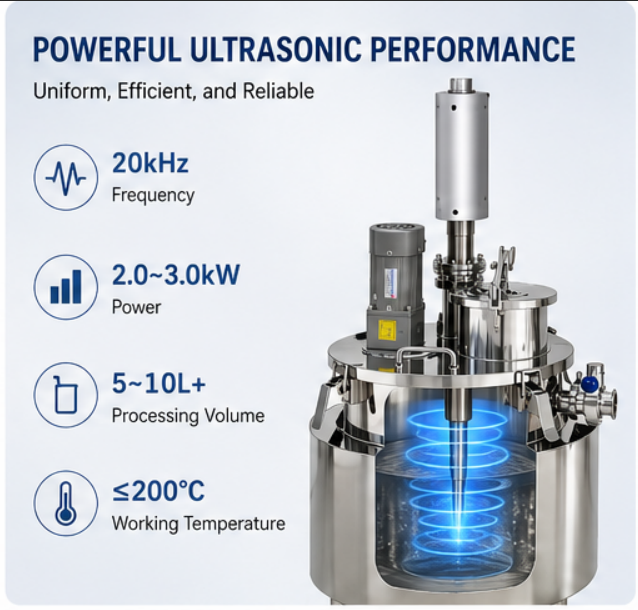
Parameter
Model | RPS-SONO20-30L |
Input voltage | 220/380V,50/60Hz |
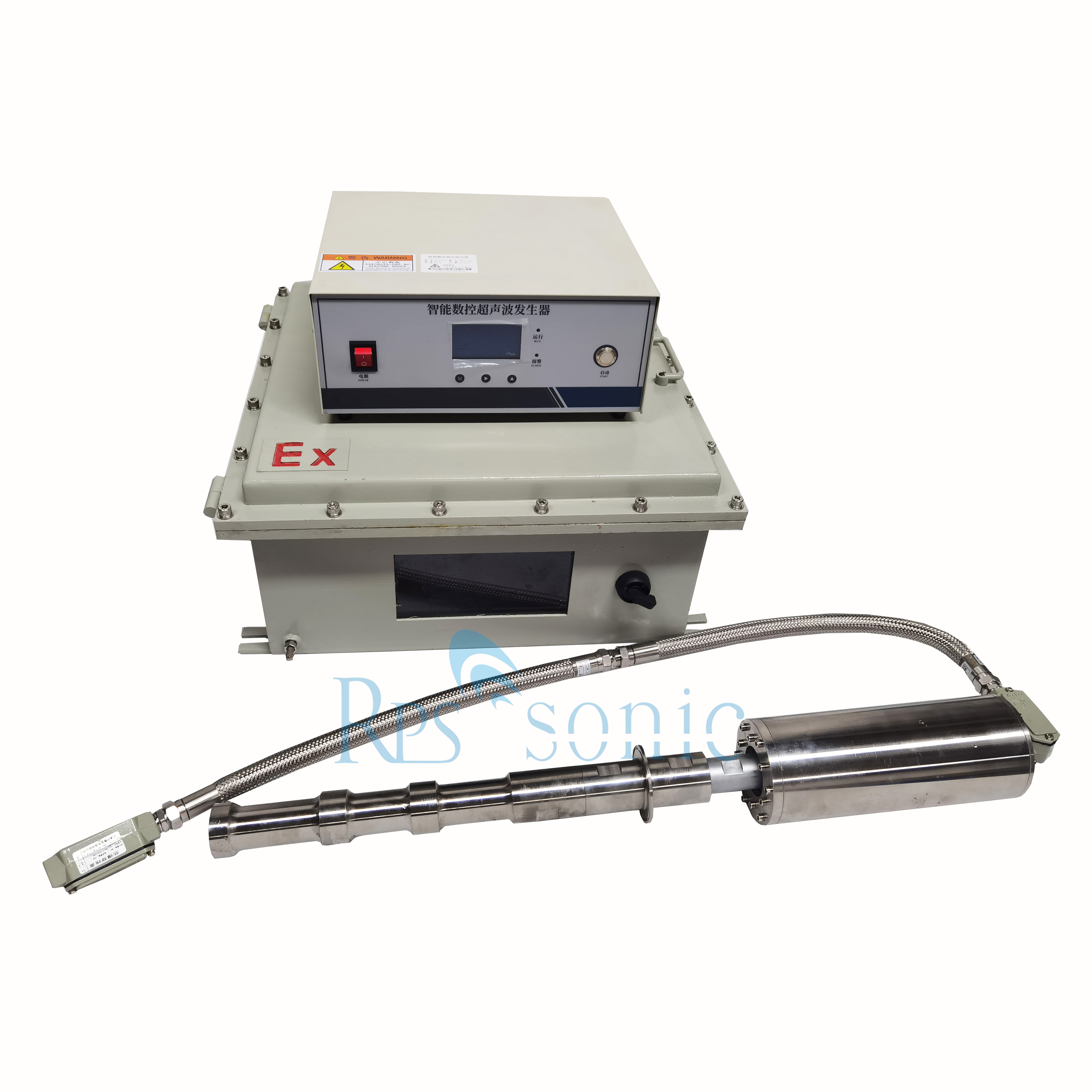
Controller | Digital controller with automatic frequency tracking |
Rated power(kW) | 3.0 |
Power adjust | 20%~100% |
Amplitude | 30~80μm |
Frequency(kHz) | 20±0.5,automatic frequency tracking |
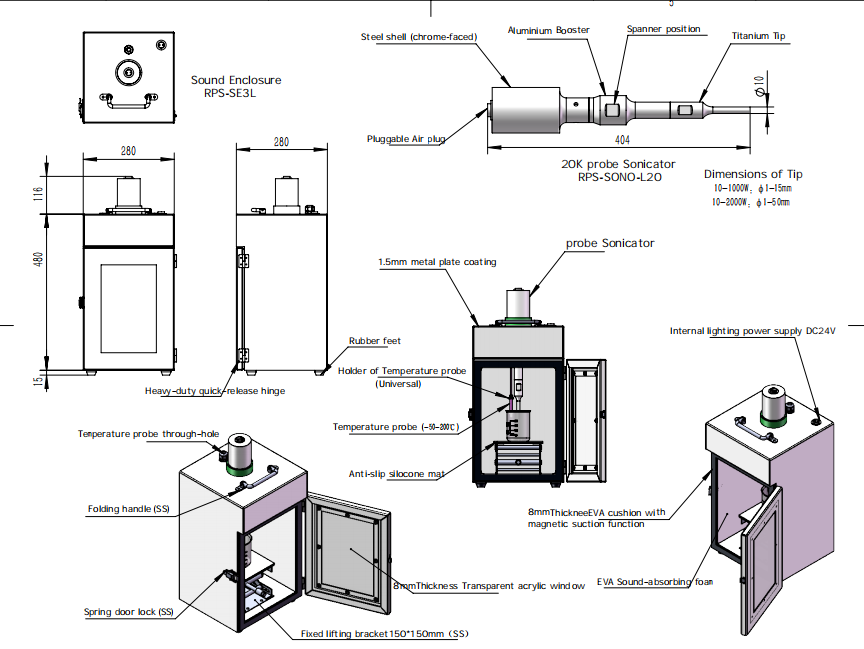
Horn material | Titanium alloy |
Horn diameter | 40~50mm |
Horn length | 400~450mm |
Flange | Tri-clamp/DN50 flange/customized flange |
Temperature control | Temperature control jacket for external temperature control system |
Tank material | Acrylic/SUS304L/SUS316L |
Processing volume | 30L,can be customized |
Blender speed | 0~800rpm,optional |
Operating method | Touch screen or buttons |
Working temperature | ≤100℃ |
Working pressure | ≤0.4MPa,can be customized |
The ultrasonic cavitation effect enables rapid particle size reduction to nano-scale levels, significantly improving product stability and performance compared to mechanical mixing systems.
It ensures high uniformity and reproducibility, making it suitable for demanding industrial applications where consistency is critical.
The system reduces processing time while improving dispersion efficiency, lowering overall production costs and energy consumption.
It operates without grinding media, eliminating contamination risks associated with bead mills or high-shear equipment.
The scalable 30L design provides a strong transition platform from R&D to industrial production, minimizing process redevelopment when scaling up.
Application
Nanoparticle dispersion and nano-suspension preparation
Pharmaceutical formulations (nano-drugs, liposomes, emulsions)
Advanced coatings and functional materials
Graphene, carbon nanotube, and nanomaterial processing
Chemical and polymer dispersion systems
Energy materials (battery slurries, electrode materials)
Cosmetic and skincare nano-emulsions
Pilot-scale industrial production and R&D scale-up
Main Application Areas: Ultrasonic graphene dispersion technology has important applications in several cutting-edge fields.
Materials Science: Used to prepare high-performance graphene composite materials. For example, uniformly dispersing graphene in polymer matrices such as rubber and plastics can significantly improve the electrical conductivity, thermal conductivity, and mechanical properties of the materials.
Energy: In energy storage devices such as lithium-ion batteries and supercapacitors, uniformly dispersed graphene can serve as a conductive additive, constructing a highly efficient conductive network, thereby improving the battery's charge/discharge speed and cycle life.
Biomedicine: Used to prepare graphene-based drug carriers. Ultrasonic dispersion technology can achieve efficient drug loading and controlled release. In addition, ultrasound itself is often used for cell disruption to extract intracellular biomolecules such as proteins and DNA.
Environmental Science: The cavitation effect generated by ultrasound can not only disperse materials, but the high temperature and pressure generated during its disruption can also directly decompose organic pollutants in water. Therefore, it also shows potential in environmental governance fields such as wastewater treatment and soil remediation.
Ultrasonic graphene dispersion technology is a key technology that is efficient, controllable, and relatively environmentally friendly. Through strong physical interactions at the microscale, it successfully solves the core problem of graphene's tendency to aggregate. Although challenges such as large-scale production remain, it is undoubtedly a significant force driving graphene from the laboratory to wider applications.
Advantages of RPS-SONIC ultrasonic devices
• Easy and flexible handling
• Time saving
• Powerful
• Precisely controllable
• Reproducible results
• Eco-friendly and energy efficient
• Extremely durable and long lasting
• Wide product range
• Wide range of accessories for a variety of applications
• Production, service and repair in germany
• Specialist for ultrasonic technology
Famous Customers
Catalogue of ultrasonic homogenizer
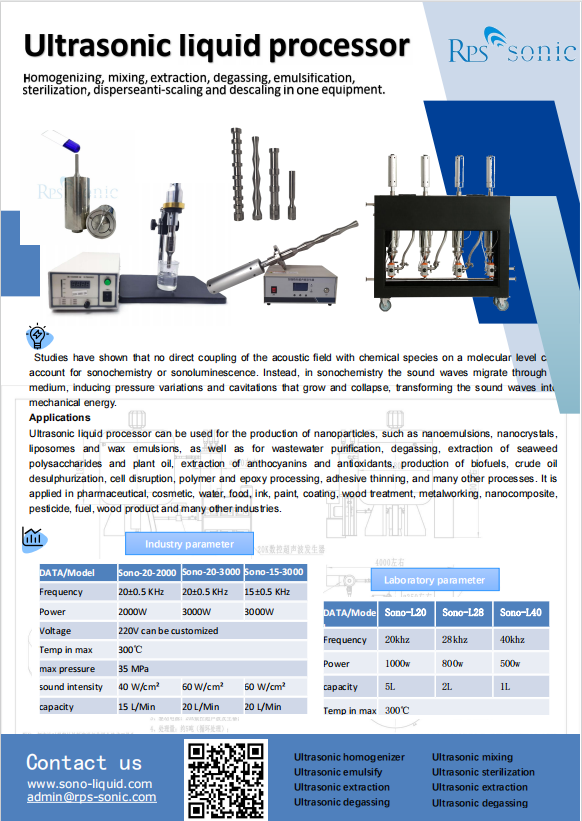
Ultrasonic homogenizers are powerful and reliable mixers for lab and industry for numerous applications. An ultrasonic homogenizer can be used for various applications, including:
Homogenization: Ultrasonic homogenizers can homogenize samples to create uniform and consistent mixtures.
Dispersion: Ultrasonic homogenizers can be used to disperse solid particles in liquids to create stable suspensions, to get nano-dispersions.
Emulsification: Ultrasonic homogenizers can be used to create stable emulsions and nanoemulsions by breaking up and dispersing immiscible liquids, such as oil and water.
Cell Disruption: Ultrasonic homogenizers can break open cells to extract intracellular components.
Degassing: Ultrasonic homogenizers can be used to remove dissolved gases from liquids. Anti-scaling and descaling, sterilizing,extraction Etc.

Ms. Yvonne
sales@xingultrasonic.com
+86 571 63481280
+86 15658151051
1st Building NO.608 Road ,FuYang, Hangzhou, Zhejiang,China