Currently, research on the extraction of antioxidants and anti-aging drugs from natural products has attracted widespread attention from domestic and foreign scholars. Considerable research results have been achieved in this field, and based on comprehensive domestic and international research repor
Currently, research on the extraction of antioxidants and anti-aging drugs from natural products has attracted widespread attention from domestic and foreign scholars. Considerable research results have been achieved in this field, and based on comprehensive domestic and international research repor
Currently, research on the extraction of antioxidants and anti-aging drugs from natural products has attracted widespread attention from domestic and foreign scholars. Considerable research results have been achieved in this field, and based on comprehensive domestic and international research repor
Why use ultrasonic impact gun to eliminate stress?Metal structure parts are generally welded by welding. During the metal filling process, there are residual heights, pits, undercuts and various welding defects at the joints, causing severe stress concentration and a certain welding residue. Pullin
Currently, research on the extraction of antioxidants and anti-aging drugs from natural products has attracted widespread attention from domestic and foreign scholars. Considerable research results have been achieved in this field, and based on comprehensive domestic and international research repor
Currently, research on the extraction of antioxidants and anti-aging drugs from natural products has attracted widespread attention from domestic and foreign scholars. Considerable research results have been achieved in this field, and based on comprehensive domestic and international research repor
Currently, research on the extraction of antioxidants and anti-aging drugs from natural products has attracted widespread attention from domestic and foreign scholars. Considerable research results have been achieved in this field, and based on comprehensive domestic and international research repor
Currently, research on the extraction of antioxidants and anti-aging drugs from natural products has attracted widespread attention from domestic and foreign scholars. Considerable research results have been achieved in this field, and based on comprehensive domestic and international research repor
Currently, research on the extraction of antioxidants and anti-aging drugs from natural products has attracted widespread attention from domestic and foreign scholars. Considerable research results have been achieved in this field, and based on comprehensive domestic and international research repor
The application of ultrasonic in the sewing industry mainly reflects the two major functions of ultrasonic: welding and cutting. In 2019, for masks that are popular all over the world, ultrasound is a household name for applying these two functions to the fullest. The cutting and welding of velvet c
Currently, research on the extraction of antioxidants and anti-aging drugs from natural products has attracted widespread attention from domestic and foreign scholars. Considerable research results have been achieved in this field, and based on comprehensive domestic and international research repor
Currently, research on the extraction of antioxidants and anti-aging drugs from natural products has attracted widespread attention from domestic and foreign scholars. Considerable research results have been achieved in this field, and based on comprehensive domestic and international research repor
Currently, research on the extraction of antioxidants and anti-aging drugs from natural products has attracted widespread attention from domestic and foreign scholars. Considerable research results have been achieved in this field, and based on comprehensive domestic and international research repor
Currently, research on the extraction of antioxidants and anti-aging drugs from natural products has attracted widespread attention from domestic and foreign scholars. Considerable research results have been achieved in this field, and based on comprehensive domestic and international research repor
What is ultrasonic tinning?Ultrasonic tinning is a kind of welding method that does not use flux. The ultrasonic probe produces cavitation in the molten solder core through mechanical vibration at ultrasonic frequency, and removes the oxide film on the metal surface for smooth and clean tinning. Ult
Why use ultrasonic impact gun to eliminate stress?Metal structure parts are generally welded by welding. During the metal filling process, there are residual heights, pits, undercuts and various welding defects at the joints, causing severe stress concentration and a certain welding residue. Pullin
Currently, research on the extraction of antioxidants and anti-aging drugs from natural products has attracted widespread attention from domestic and foreign scholars. Considerable research results have been achieved in this field, and based on comprehensive domestic and international research repor
The application of ultrasonic in the sewing industry mainly reflects the two major functions of ultrasonic: welding and cutting. In 2019, for masks that are popular all over the world, ultrasound is a household name for applying these two functions to the fullest. The cutting and welding of velvet c
What is ultrasonic tinning?Ultrasonic tinning is a kind of welding method that does not use flux. The ultrasonic probe produces cavitation in the molten solder core through mechanical vibration at ultrasonic frequency, and removes the oxide film on the metal surface for smooth and clean tinning. Ult
What is ultrasonic tinning?Ultrasonic tinning is a kind of welding method that does not use flux. The ultrasonic probe produces cavitation in the molten solder core through mechanical vibration at ultrasonic frequency, and removes the oxide film on the metal surface for smooth and clean tinning. Ult
loading
Share to:
Ultrasonic Sonochemistry Equipment for Chemical Reactions And Processes
Ultrasonic sonochemistry equipment applied in different liquid system such as homogenization, cell division, dispersion, degassing or extraction.
Ultrasonic Sonochemistry Equipment for Chemical Reactions And Processes
What's the theory of ultrasonic sonochemistry?
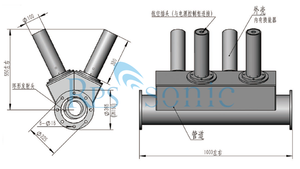
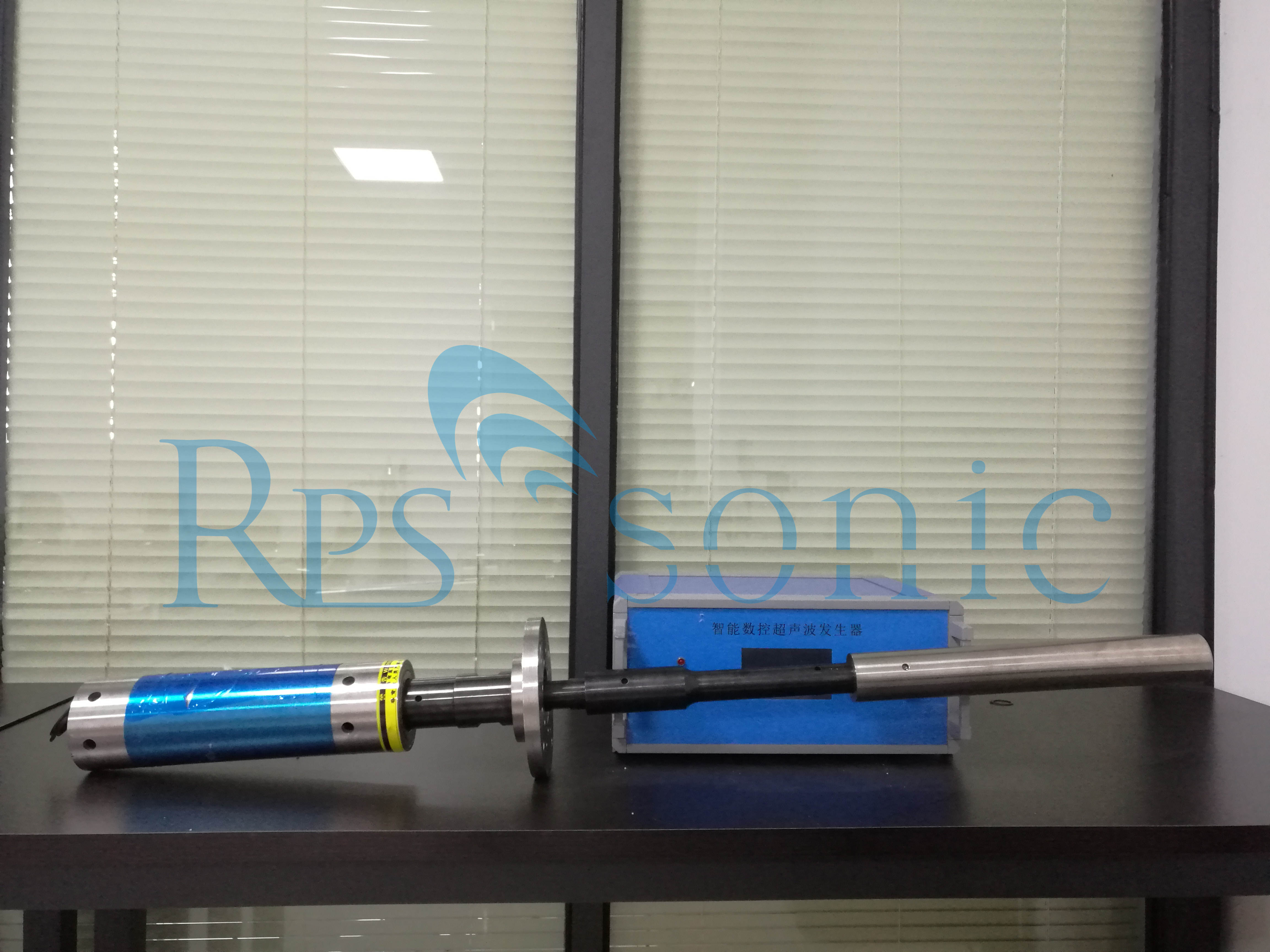
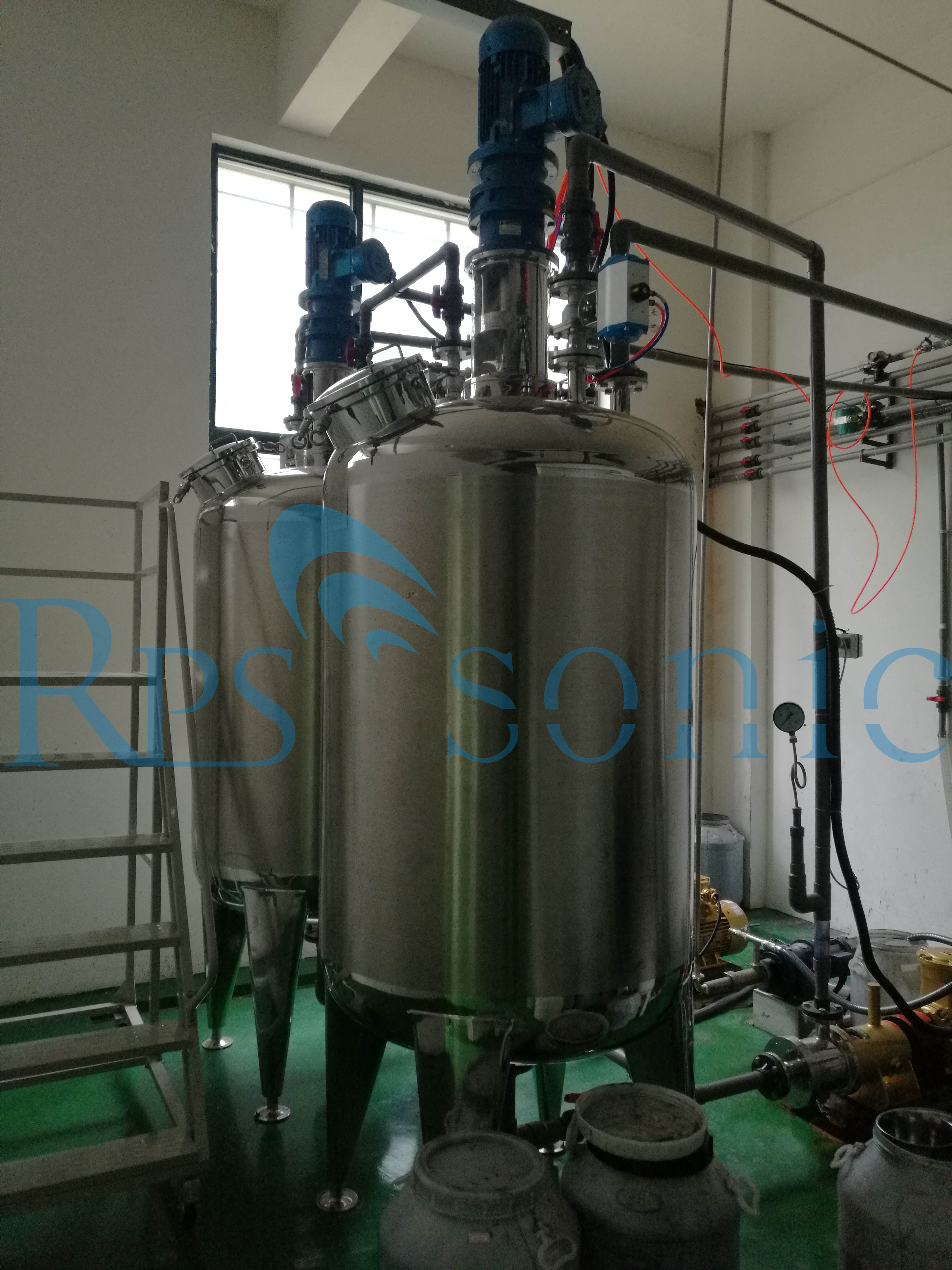
This industrial-grade 20kHz ultrasonic sonochemical reactor system is professionally developed for lab pilot and industrial continuous chemical processing. Based on high-power ultrasonic cavitation technology, the equipment generates intense micro-cavitation, shockwaves, shear force and local high-temperature high-pressure micro-environment inside liquid medium, greatly boosting mass transfer, molecular mixing, catalytic reaction efficiency, emulsification, homogenization, extraction, degradation and synthesis reactions.
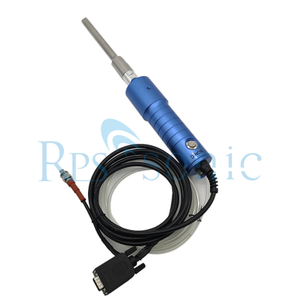
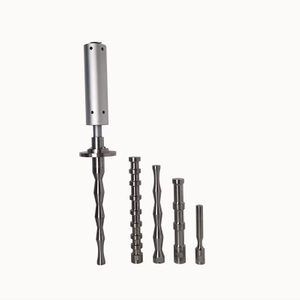
The complete set consists of ultrasonic driving transducer, titanium alloy sonotrode (replaceable amplitude rods), mounting flange and digital ultrasonic generator. Modular replaceable sonotrodes support flexible matching of different reaction volumes and process requirements, widely applicable to fine chemicals, new energy materials, biochemistry, environmental wastewater treatment, pharmaceutical synthesis, nanomaterial preparation and other sonochemistry fields.
Physical Effects
There are three different theories about cavitation – the hot-spot, the electrical and the plasma theory. The most popular one is the hot spot theory. Thus, it has been experimentally shown that the cavitational collapse creates drastic conditions inside the medium for an extremely short time: temperatures of 2000-5000 K and pressures up to 1800 atm inside the collapsing cavity. A remarkable event during the cavitation collapse is the emission light under certain conditions (Sonoluminescence). Furthermore, the collapse causes a couple of strong physical effects outside the bubble: shear forces, jets and shock waves. Thus, there are basically two groups of effects: radical and mechanical effects. These cavitation-induced effects can cause physical, chemical, and biological effects. Thus, ultrasound has been found applications in chemistry, materials and life sciences as well as medicine.
Chemical Effects
There is no doubt that the origin of sonochemical effects is cavitation. There are three possible reaction sides of a collapsing bubble: the cavity interior, the bubble vicinity and the bulk solution. Due to the extreme conditions inside the medium and other cavitation effects the following effects depending on the sonication conditions have been found:
Digital intelligent generator, frequency display, overload protection, overheat protection, automatic frequency locking
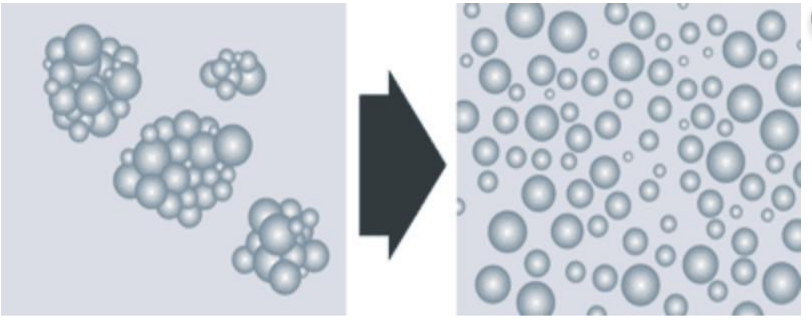
Before ultrasonic treatment After ultrasonic treatment
Application:
• Cell disrupter (extraction of plant substances, disinfecting, enzyme deactivation)
• Therapeutic ultrasound, i.e. induction of thermolysis in tissues (cancer treatment)
• Decrease of reaction time and/or increase of yield
• Use of less forcing conditions e.g. lower reaction temperature
• Possible switching of reaction pathway
• Use of less or avoidance of phase transfer catalysts
• Degassing forces reactions with gaseous products
• Use of crude or technical reagents
• Activation of metals and solids
• Reduction of any induction period
• Enhancement of the reactivity of reagents or catalysts
• Generation of useful reactive species
We need to customize according to your working conditions, liquid information, throughput, and spatial information....
So, before qutation, we may ask for many information about your application, like :
what's the liquid you dealing with?
what's the Temperature, pressure under work?
what's the capacity?
what's the inatll enviroment?
....
We have customized more than hundred ultrasonic liquid processing for different application.
Sonochemical reactions
Three classes of sonochemical reactions exist: homogeneous sonochemistry of liquids, heterogeneous sonochemistry of liquid-liquid or solid–liquid systems, and, overlapping with the aforementioned, sonocatalysis (the catalysis or increasing the rate of a chemical reaction with ultrasound). Sonoluminescence is a consequence of the same cavitation phenomena that is responsible for homogeneous sonochemistry. The chemical enhancement of reactions by ultrasound has been explored and has beneficial applications in mixed phase synthesis, materials chemistry, and biomedical uses. Because cavitation can only occur in liquids, chemical reactions are not seen in the ultrasonic irradiation of solids or solid–gas systems.
For example, in chemical kinetics, it has been observed that ultrasound can greatly enhance chemical reactivity in a number of systems by as much as a million-fold;[16] effectively acting to activate heterogeneous catalysts. In addition, in reactions at liquid-solid interfaces, ultrasound breaks up the solid pieces and exposes active clean surfaces through microjet pitting from cavitation near the surfaces and from fragmentation of solids by cavitation collapse nearby. This gives the solid reactant a larger surface area of active surfaces for the reaction to proceed over, increasing the observed rate of reaction.
While the application of ultrasound often generates mixtures of products, a paper published in 2007 in the journal Nature described the use of ultrasound to selectively affect a certain cyclobutane ring-opening reaction. Atul Kumar has reported multicomponent reaction Hantzsch ester synthesis in Aqueous Micelles using ultrasound.
Some water pollutants, especially chlorinated organic compounds, can be destroyed sonochemically.
Sonochemistry can be performed by using a bath (usually used for ultrasonic cleaning) or with a high power probe, called an ultrasonic horn, which funnels and couples a piezoelectric element's energy int
See also
Ultrasound
Sonication
Ultrasonics
ultrasonic homogenizer
homogenizer
Homogenization (chemistry)
Sonoelectrochemistry
Kenneth S. Suslick
1. Can your sonochemistry horn be used in an acid (alkali) environment?
Under the acid (alkali) environment, the horn need to be customized according to the actual working conditions of customers.
2. Can the ultrasonic sonochemistry work continuously?
Yes , it can work 24hours continue.
3. What kind of material is the horn?
Titanium alloy, we also customized ceramic horn for customer before.
4. What’s the time of delivery
For Conventional horn, 3 days, for customized horn 7 work days.
5. Does ultrasonic extraction also require the addition of a chemical catalyst?
No , but some time need Mechanical stirring.
6. What’s the advantage of ultrasonic extraction?
Decline the extraction time, and increase the extraction ratio.
7. What’s the Processing capacity of one set ultrasonic extraction equipment?
Different horn different Processing capacity, for 2000W Nine-section whip horn can dealing 2L~10L/min.
8. Are you manufacturer?
We only manufacturer the transducer and generator our-self, for the horn , we design and buy raw material ,and process by other companies.
9. What’s the warranty of your sonochemistry equipment?
All equipment one year warranty.
10. Do you have Foreign agent?
No, our price already very low for everyone, no agent. We have OEM customer in USA and Germany.
11. Is it difficult to install the ultrasonic sonochemistry equipment?
No , it is easy , we will share Installation diagram, also can take install video for you.