Ultrasonic Welding: Is It Really True That "higher Power Equals Better Welding"?
In an ultrasonic plastic welding workshop, these are some of the "soul-searching questions" that technicians hear almost daily:
"This product isn't welded properly, is the power insufficient? Should we try a higher-powered machine?"
"We specifically bought the highest-powered machine in the factory, so why are there still cold welds and material overflow?"
Many people instinctively believe that welding is like cooking: the higher the heat (higher power), the faster the food cooks (the stronger the weld). However, in the microscopic world of ultrasonic welding, the laws of physics are not so linear.
Today, we'll completely dispel this common misconception: in ultrasonic welding, higher power is not necessarily better; appropriate energy density is the soul of weld quality.
I. The Misunderstood "Power": What exactly is it?
First, we need to understand the role of "power" in ultrasonic welding.
Ultrasonic welding doesn't rely on high-temperature melting. Instead, it uses high-frequency mechanical vibration (typically between 15kHz and 40kHz) to generate friction at the plastic interface, converting mechanical energy into heat energy, which fuses the metal when the melting point is reached.
Here, "power" (usually referring to the generator's output power) determines how much energy the system can output per unit time. It's like the water flow rate from a faucet.
What we really need to focus on is the total energy injected into the weld (power × time), which is like the total amount of water flowing into the bucket.
Often, products "don't weld well" not because there isn't a sufficiently high "water flow rate," but because the water flow isn't precisely injected into the bucket, or it directly damages the bucket.
II. Excessive Power: The Unseen "Internal Damage"
Blindly pursuing high power often leads to the following counterproductive results:
1. Over-melting and Overflow When the instantaneous power is too high, the plastic interface generates a huge amount of heat energy in a very short time. 1. **Polymer Materials Over-Liquefy Before They Can Set in the Mold:** Polymer materials become over-liquefied before they can set in the mold, and are forced out of the weld by the immense vibration pressure, resulting in flash or overflow.
Result: An unsightly appearance. Furthermore, because the molten resin is squeezed out, the actual bond layer at the weld is thinner, leading to decreased strength.
2. **Molecular Chain Breakage and Material Degradation:** Ultrasonic waves heat through shear force. If the power is too high, the intense shear force acts like an invisible pair of scissors, directly cutting the long molecular chains of the plastic, causing localized degradation, charring, carbonization, and even producing smoke and odor.
Result: Although it may appear "fused" together, it is actually two clumps of degraded, fragile materials bonded together, with extremely low strength, crumbling at the slightest touch.
3. **Near-Field Damage and Stress Cracking:** For precision electronic components or parts containing sensitive substrates, excessive power means excessive amplitude and impact force. This mechanical impact can directly cause internal cracking of fragile components or create hidden micro-cracks around the solder joint, becoming a potential failure hazard during product use.
4. Energy Waste
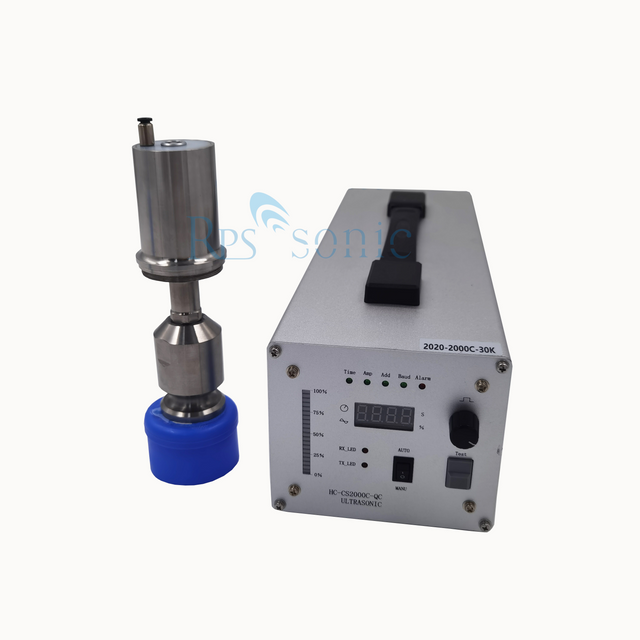
An ultrasonic welding system includes a transducer, amplitude modulator, and welding head. Each component has its rated power limit. Forcing a machine with excessively high power to weld a small part is like using a cannon to kill a mosquito—not only is the energy conversion efficiency low, but the excess energy is also lost as heat in the vibration system, accelerating welding head fatigue and even breakage.
III. Ideal Welding Results: Finding the "Golden Window"
So, if higher power isn't always better, what kind of power is good?
There is usually a "golden energy window" between welding quality and input power.
Too low power: Insufficient heat generation from interfacial friction; the plastic stops vibrating before it is fully melted, resulting in a cold weld or a weak weld. This is what people commonly refer to as a "weak weld."
Moderate power (golden window): Sufficient intermolecular friction reaches the optimal molten state; polymer chains diffuse and entangle under pressure, forming a strong physical bond after cooling. At this point, the appearance is good, and the strength meets the requirements.
Too high power: Entering the over-welding zone, material degradation, carbonization, and overflow occur, leading to a sharp decrease in strength. The conclusion is: your goal is not to pursue the maximum power, but to find the "optimal power point" that allows the weld quality to reach its peak.
IV. What factors affect welding results?
If even a high-power machine cannot weld well, the problem is often in the following areas, rather than insufficient power:
1. Interface Design and Energy Direction
This is the most critical factor. If the product design does not include energy-conducting ribs, or the contact surface is too large, even a large power will be dispersed, resulting in an inability to concentrate energy for melting.
Solution: Optimize mold and product design to allow energy to "concentrate firepower" to break through the melting point.
2. Precise Amplitude Matching
Amplitude is the amplitude of the welding head's vibration. Different plastics (such as amorphous PS and crystalline nylon) require different optimal amplitudes. High power often means a large amplitude, but excessive amplitude can be disastrous for some plastics (such as PC). Choosing the appropriate amplitude is more important than simply increasing power.
3. Intelligent Selection of Welding Modes
Modern ultrasonic generators typically support multiple modes:
Time Mode: Welds for a fixed time, easily affected by environmental fluctuations.
Energy Mode: Sets the total energy (joules), ensuring consistent total heat input for each weld. This is a common method to correct the illusion of insufficient power.
Absolute Height/Relative Distance Mode: This is the most advanced control method, ensuring weld quality by controlling the final product sinking.
Often, the feeling of "weak welds" is because the machine is still using the outdated time mode. Simply switching to energy or depth modes and finding the correct parameter combination can achieve extremely strong welds even with low-to-medium power equipment.
V. Summary
Returning to the initial question: Does higher power always result in better welding?
The answer is no.
Ultrasonic welding is an art of energy resonance and precise control. Power is merely a means, not an end. Blindly pursuing high power not only wastes costs but may also damage product structure, leading to degradation and unusable products.
What truly determines welding quality are precise energy input, scientific amplitude matching, reasonable mold design, and intelligent process control.
Therefore, when your product isn't welded firmly, don't rush to switch to a higher-powered machine. Take a moment to calmly analyze whether you're using your energy correctly. Sometimes, the key to solving the problem isn't increasing the heat, but concentrating it on the most critical areas.