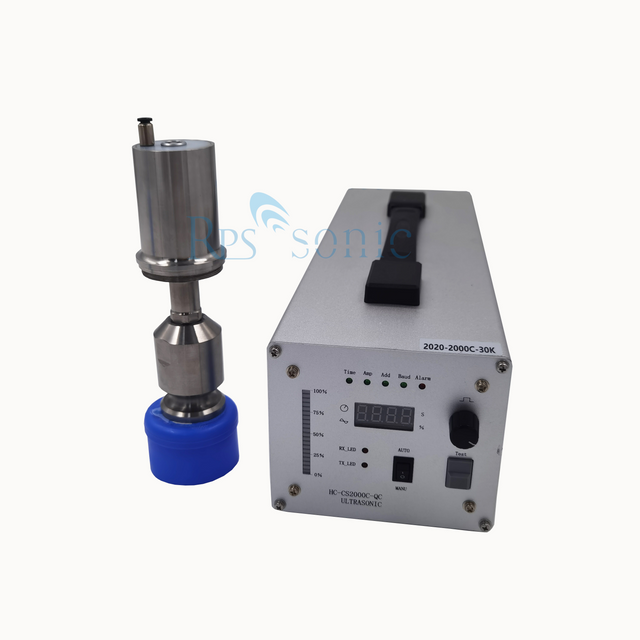
What Is Ultrasonic TPU Airbags Welding?
Ultrasonic welding of TPU airbags is a technically feasible and mature process, particularly well-suited for the welding of precision airbags. It enables the achievement of exceptionally high airtightness; however, the process window is relatively narrow, necessitating rigorous control over operational parameters.
Technical Feasibility: Challenges and Solutions Coexist
The reason ultrasonic welding of TPU is not typically found among standard, readily available guidelines is that the material's inherent "softness" poses a fundamental technical challenge: it tends to absorb and dampen vibrational energy, potentially preventing that energy from being effectively transmitted to the welding interface.
However, this does not imply that it cannot be welded. Through the selection of specialized equipment and precise parameter control, high-quality welds can be fully realized.
To accommodate the soft characteristics of TPU, equipment selection requires targeted optimization; key considerations include low frequency, high precision, and excellent thermal conductivity.
Part | Unrecommended Features | Recommended features | Why choose this way? |
Welding frequency | High frequency ( above 40kHz ) | Loe frequency (15-20kHz) | The lower the frequency, the longer the vibration wavelength, and the stronger the energy penetration. This helps overcome the "soft" characteristic of TPU and enables the energy to be effectively applied to the welding interface. |
Horn material | Aluminum alloy or other metals with poor thermal conductivity | titanium alloy | TPU is sensitive to temperature. Titanium alloy, which combines strength with excellent thermal conductivity, can quickly dissipate heat and prevent the accumulation of heat from causing material thermal degradation or burning. |
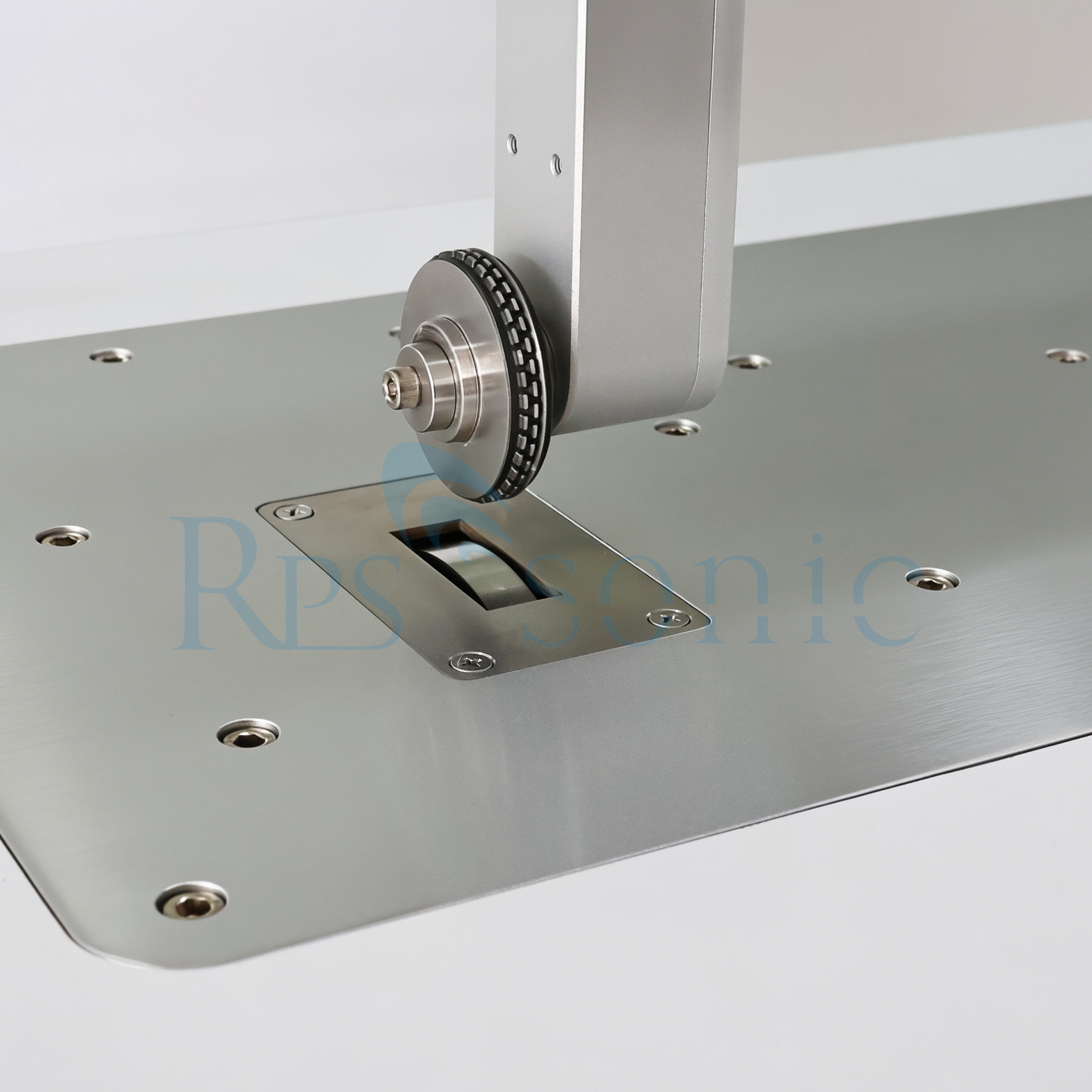
Horn surface | smooth surface | Pointed patterns / Granular surface | The textured welding head can enhance the clamping force on the TPU material, preventing the material from slipping during vibration, thereby ensuring stable and uniform energy conduction. |
Power | - | Small pieces / thin films: Approximately 1500W Large pieces / thick walls: 2000 - 2500W | Sufficient power is the foundation for generating sufficient amplitude, overcoming the elasticity of the TPU, and achieving fusion. |
Process Parameters: Precise Control is Key
Employing a lower frequency (e.g., 15–20 kHz) and moderate amplitude—combined with a short welding duration and stable pressure—is essential to achieve weld seams that closely approximate the inherent strength of the base material itself.
Key Requirements: Quality Control at the Source
Surface Pre-treatment: Prior to welding, any dust or oil residue on the TPU surface must be thoroughly removed; otherwise, these contaminants will become sources of welding defects. For products with exceptionally stringent requirements, plasma treatment (typically at ~300 W for 30 seconds) may be applied before welding to enhance surface energy.
Material Selection:
Hardness: It is recommended to use medium-to-high hardness TPU films with a Shore A hardness rating of 85A to 95A.
Thickness: Ultrasonic welding is particularly well-suited for thin-layer TPU ranging from 0.1 mm to 1.0 mm in thickness, making it an ideal choice for manufacturing precision air bladders. While TPU films are currently available in thicknesses ranging from 0.015 mm to 5 mm, ultrasonic welding presents greater challenges when applied to thicker materials.
Physical Properties: Select high-performance TPU films characterized by a peel strength exceeding 25 N/cm (far surpassing the basic requirement of 8 N/cm) and capable of withstanding a fatigue endurance of 50,000 inflation-deflation cycles.
Mold Design: Both the welding horn (sonotrode) and the anvil (bottom mold) must precisely match the 3D contours of the air bladder to ensure uniform pressure distribution.
Application Scenarios
Medical Devices: Manufacturing components requiring high airtightness and cleanliness—such as blood pressure monitor cuffs—with thicknesses ranging from 0.1 mm to 1.0 mm, thereby meeting lightweighting requirements.
Consumer Electronics: Producing miniature waterproof-breathable vents or integrated air bladders for devices such as sports watches and True Wireless Stereo (TWS) earbuds.
Automotive Industry: Used in the production of automotive lumbar support bladders, seat ventilation bags, and similar components.
Massage & Wellness Equipment: Manufacturing the internal massage bladders found in massage chairs and massage shawls.
Specialty Apparel & Gear: Used to create components such as waterproof zippers for outdoor jackets and inflatable air columns for tents.
Ultrasonic vs. High-Frequency Welding
Ultrasonic welding is often discussed alongside another technique commonly used for TPU products: "High-Frequency Welding" (also known as Radio Frequency Welding). The two methods differ in their underlying principles and applicable scenarios:
Comparison dimensionality | ultrasonic welding | high-frequency welding |
working principle | Through the high-frequency mechanical vibration of the welding head and the heat generated by friction | Utilizing high-frequency electromagnetic fields to cause the polar molecules (such as TPU) to vibrate and generate heat by themselves |
technical advantage | High speed, with a single welding time of less than 2 seconds; capable of precisely positioning small-area welding; can be integrated with online monitoring | The heating is more uniform, making it more suitable for the overall welding of large-area and complex-shaped products. |
boundedness | The welding head needs to come into contact with the workpiece. For molds with complex three-dimensional structures, the cost will be higher. | The equipment cost is usually higher. The electrode plates need to be customized and there are requirements regarding the material polarity. |
applicable scene | Small-sized, precise and large-scale airbags, such as those used in medical devices and consumer electronics | Large, extensive, and complex-shaped airbags, such as those in massage chairs and industrial shock absorbers |
It is worth emphasizing that for precision components such as blood pressure monitoring cuffs, ultrasonic welding represents an ideal choice. Furthermore, for applications demanding extremely high production throughput, the exceptionally short cycle time of ultrasonic welding—typically ranging from 0.2 to 1.5 seconds per weld—is unmatched by any other manufacturing process.
**Summary and Recommendations**
Ultrasonic welding of TPU cuffs is a precision process; its key principles can be summarized as follows:
**Feasibility Confirmation:** TPU is indeed suitable for ultrasonic welding, with optimal results achieved when using materials of medium-to-high hardness (85A–95A) and thin-sheet stock (0.2 mm–1.0 mm).
**Equipment Selection is Critical:** It is imperative to select low-frequency equipment operating in the 15–20 kHz range, and to ensure that the welding horn (sonotrode) is constructed from titanium alloy.
**Parameter Tuning is Core:** Begin testing with low pressure (0.3 MPa) and short duration (0.5 seconds), then gradually increase these values to avoid overheating. The primary focus should remain on maintaining a short welding duration (typically < 2 seconds).
**Process Validation is the Safeguard:**
**Step 1:** Conduct a Design of Experiments (DOE) using small material samples to identify the optimal combination of welding parameters.
**Step 2:** Weld complete cuff prototypes using the optimized parameters, and subject them to pressure retention tests (e.g., holding 0.5 MPa pressure for ≥ 30 seconds with a leakage rate of < 5 ml/min) as well as peel strength tests (target: ≥ 8 N/cm).
**Step 3:** Conduct a small-batch trial production run to validate the stability and robustness of the welding process.