When considering which welding method is best for your projects, it's important to evaluate the materials you are using, the quantity of items you need to produce, and their intended purpose. The comparison of ultrasonic welding vs friction welding can yield different results based on these factors. RPS-SONIC specializes in ultrasonic welding solutions, providing tailored options to meet your specific needs. Before making a decision, it's crucial to assess your requirements. Selecting the right technology not only ensures strong welds but also enhances the quality of your final products.
Key Takeaways
Pick the right welding method for your materials. Friction welding works best with metals. Ultrasonic welding is good for plastics and fragile parts.
Think about how many items you need to make. Ultrasonic welding is faster. It is great for making lots of things. Friction welding is better for small batches.
Look at how strong and good the joint is. Both ways make strong bonds. Ultrasonic welding gives quick and steady results. It does not hurt the materials.
Check the cost and what tools you need. Friction welding needs special tools and trained workers. Ultrasonic welding uses less energy. It is also easier to use with machines.
Always test welds on extra pieces before making the real thing. This makes sure the method works for your project.
Friction Welding Basics
How Friction Welding Works
Friction welding joins two pieces without melting them. The process uses heat from rubbing surfaces together. In linear friction welding, a tool spins and touches the workpiece. The spinning makes heat from friction. This heat softens the material. The tool mixes the soft part. Pressure from the tool helps make a strong bond. The material does not melt during joining. You get a solid bond and better strength in the welded area.
Linear friction welding works with many materials. You can use it for:
Steel and stainless steel
Aluminum and its alloys
Copper and copper alloys
Titanium and nickel alloys
Dissimilar metal combinations
Some materials besides metals
This process is used in battery enclosures, motor housings, and hybrid structures. These jobs need strong and leak-proof joints.
Advantages of Friction Welding
Friction welding has many benefits. You do not need extra materials like filler metals. This saves money. Linear friction welding is very fast. You can weld in seconds after reaching the right speed. The process makes high-quality joints. The bond is even across the joint. You also make less waste. Friction welding can cut material waste by 25–50%. The heat-affected zone is smaller. You spend less time on machining. You do not need shielding gases or flux, so you save energy. The process lowers emissions and does not make UV radiation.
Limitations of Friction Welding
You should know the downsides before choosing friction welding. Linear friction welding needs big forces to work. The process does not fit all shapes. It works best with similar thicknesses and certain joints. Sometimes, it is slower than other welding methods. You need special equipment and tools, which can cost more. Skilled workers are needed for hard jobs.
Limitation | Description |
High forces required | Big forces are needed for mechanical pressure. |
Geometric limitations | Not good for different thicknesses and some joints. |
Slower weld speeds | Slower than some fusion welding methods. |
Specialized equipment | Needs expensive special equipment and tools. |
Skill requirements | Needs skilled workers for hard jobs. |
You may have problems with complex shapes or thin materials. Special tool designs are needed. The process can cause defects if not done right. Tool design is very important for success in linear friction welding.
Ultrasonic Welding Overview
How Ultrasonic Welding Works
Ultrasonic welding joins materials using fast vibration waves. These waves help make a strong bond between the materials. You put two surfaces together and press them. The machine sends vibrations into the materials. The vibrations make the surfaces rub and stick together. The materials join without melting. You do not need as much pressure as friction welding. Ultrasonic welding uses lower heat and is faster. You can join different metals and delicate materials. This process does not make sparks, so it is safe for many jobs.
Ultrasonic welding uses fast vibration waves.
Two surfaces are pressed together to join.
The surfaces rub and bond at a tiny level.
The process uses less heat and is quick.
You do not need a lot of pressure.
You can join different metals.
The process saves energy and does not make sparks.
Key Benefits of Ultrasonic Welding
Ultrasonic welding has many good points. You can finish welds very quickly, sometimes in less than a second. The welds are always the same and strong. You do not get bent or burned parts. The machine only uses power where it is needed. This saves energy. Thin and different metals stay strong because there is little heat.
Benefit | Description |
Speed | Welds finish in less than one second. |
Precision | Welds are always the same and do not bend or burn. |
Energy Efficiency | Uses up to 80% less energy than old heating ways. |
Ultrasonic welding works with many kinds of plastics. Here are some examples in the table below.
Resin Type | Characteristics | Applications |
ABS | Strong, hard, easy to join | Used for strong welds in many things |
Polycarbonate | Clear, tough, good for medical tools | Used in medical and see-through items |
Polyamide (Nylon) | Very strong, stands up to heat | Used in cars and machines |
Polypropylene | Good price, can be joined with changes | Used in many products |
Polyethylene | Like PP, joins well with control | Used in lots of industries |
RPS-SONIC Ultrasonic Welding Solutions
RPS-SONIC makes advanced ultrasonic welding machines and portable tools. You can use these for cars, medical, and fabric making. The welds finish in 0.1 to 1 second. You can make more products faster and use machines to help. The machines use energy only on the weld spot, so you save power. You can set the time, energy, and pressure very exactly. This gives you the same results every time. RPS-SONIC helps you make strong, clean welds and use less energy.
Tip: You can go to RPS-SONIC’s website to see more about ultrasonic welding for your work.
Ultrasonic Welding vs Friction Welding
Process Comparison
It is important to know how each welding process works. Friction welding uses motion and pressure to make heat at the joint. The materials get soft but do not melt. They stick together and form a bond. This method works well for metals and some plastics. People use friction welding in cars and airplanes.
Ultrasonic welding uses fast vibrations to join materials. The process is quick and does not need much heat. You press the parts together. The machine sends sound waves into the joint. The materials stick together at a tiny level. This method is good for electrical parts, battery packs, and plastic items.
Here is a table to help you see the differences:
Feature | Ultrasonic Welding | Friction Welding |
Speed | Fast, completes in seconds | Slower, depends on material thickness |
Best For | Electrical components, wire harnesses, battery packs | Automotive, aerospace, heavy-duty metal fabrication |
Both methods can be used with machines. Ultrasonic welding is better for making lots of things fast. RPS-SONIC has machines that work in automated lines. This makes your job easier and quicker.
Material Compatibility
You need to think about what materials you want to join. Friction welding works best with metals like steel and aluminum alloys. It can also join some different metals. It does not work well if the materials melt at very different temperatures.
Ultrasonic welding lets you join many types of materials. You can use it for high-purity non-ferrous metals, ABS, polystyrene, and other plastics. It does not work with PTFE or things that block sound waves. You get strong bonds with plastics and some metals.
Here is a table to show what each method can join:
Welding Method | Compatible Materials | Limitations |
Friction Welding | Steel, Aluminium Alloys | N/A |
Ultrasonic Welding | High-purity Non-ferrous Metals, ABS, PS | Limited by acoustic resistance and melting points; not suitable for PTFE. |
Check your list of materials before you pick a method. RPS-SONIC machines can join many plastics and non-ferrous metals. This gives you more choices for your projects.
Joint Strength and Quality
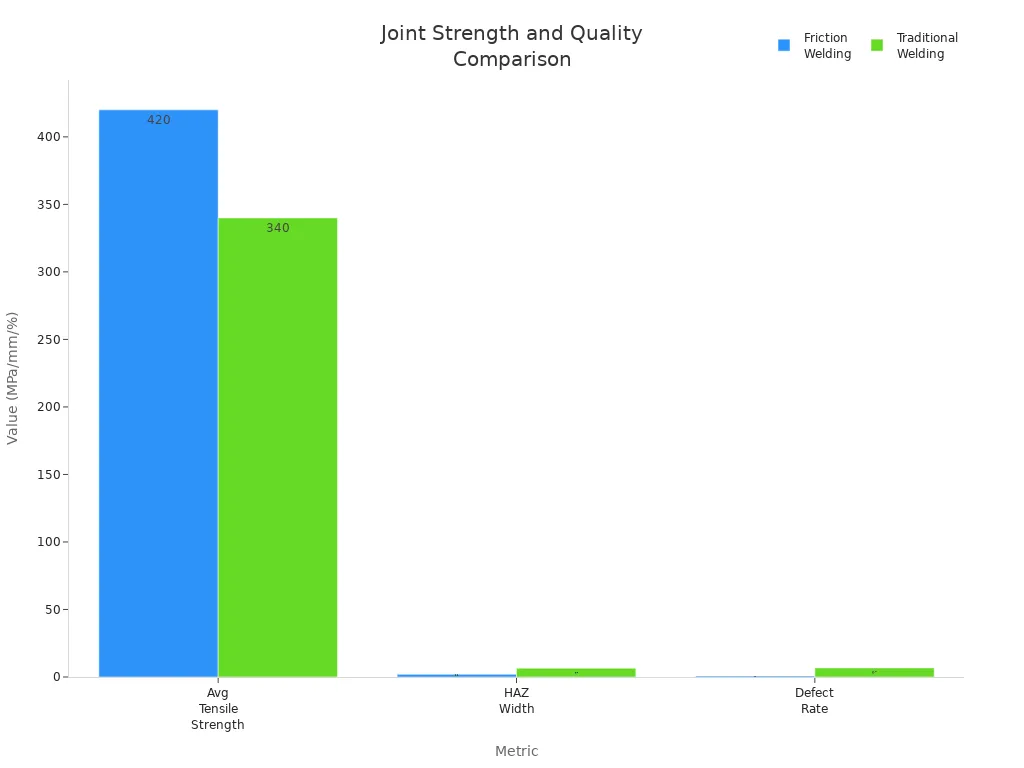
You want your welds to be strong and neat. Friction welding makes strong joints with a small area heated up. The average strength is about 420 MPa. The heated area is only 1–3 mm wide. This means less damage to the rest of the material. The chance of mistakes is low, about 0.8%.
Ultrasonic welding also makes strong joints. The bond can be as strong as the original material. The process uses local vibration and friction. This helps the joint stay strong and last long. You get the same results every time you weld.
Here is a chart that shows strength, heated area, and mistake rate:
Checking the weld quality is important for both ways. You can use sound waves, X-rays, and special tests to check the weld. Ultrasonic testing sends sound through the weld to find problems. Phased-array ultrasonic testing gives a close look at the weld.
RPS-SONIC equipment helps you make good welds every time. You can trust the results for your factory needs.
Speed and Efficiency
Speed and saving energy are important in factories. Ultrasonic welding is very fast. You can finish a weld in 0.25 to 5 seconds. This includes pressing and cooling. Fast welding helps you make more products and save money. The process uses energy only where it is needed.
Friction welding takes longer, especially with thick materials. It may need more time to set up and cool down. You get strong joints, but it is not as fast as ultrasonic welding.
RPS-SONIC machines help you work faster and save energy. You can use them with machines that make lots of products. The equipment is good for making many things quickly and meeting your goals.
Tip: Pick ultrasonic welding if you want speed, energy savings, and to join many kinds of materials. Use friction welding for big metal parts that need to be extra strong.
Choosing the Right Welding Method
Matching Method to Materials
You need to pick the right welding method for your material. Friction welding works best with metals like steel, aluminum, and copper. Ultrasonic welding can join plastics, non-ferrous metals, and fragile parts. Some materials, like aluminum and copper, melt at different temperatures. These differences make it hard to get a strong bond. If you use the wrong method, weak spots can form in the joint. You should check what type and thickness your material is before you choose. RPS-SONIC has ultrasonic welding machines for many plastics and thin metals. This helps you make strong and clean welds for your projects.
Criteria | Description |
Material Type | Pick based on metal or plastic |
Material Thickness | Thicker parts may need friction welding |
Welding Position | Some ways work better in certain positions |
Joint Design | The shape of the joint matters |
Project Specifications | Special needs can change your choice |
Welder's Skill Level | Some ways need more skill |
Equipment Availability | Use what you have or can get |
Cost | Think about machine and supply costs |
Environmental Conditions | Clean and safe places are important |
Production Volume Considerations
You should think about how many parts you want to make. Friction welding is good for strong, single joints or small batches. Ultrasonic welding is better for making lots of parts fast. This method finishes welds in just a few seconds. You can use it with machines that work by themselves. RPS-SONIC solutions help you make more products in cars, medical, and fabric jobs. You save time and energy with each weld.
Application-Specific Needs
Your project will help you pick the best way to weld. Car parts often need friction welding because they must be strong. Medical tools use ultrasonic welding for clean and careful joints. Fabric products also use ultrasonic welding because it does not hurt soft materials. You should look at what your project needs, like speed, joint quality, and safety. RPS-SONIC gives you machines for many types of work. You can find the right tool for cars, medical tools, or fabrics.
Tip: Always pick your welding method based on your material, how many you need, and what you are making. This helps you get strong and safe results every time.
RPS-SONIC in Industry Applications
Automotive Solutions
Ultrasonic welding is used a lot in making cars. This method joins plastic parts without melting them. You can use it for many car parts. Some examples are:
Joining dashboards, door panels, and bumpers made of plastic.
Making strong bonds in headlamp housings and taillight covers.
Welding nonwoven fabrics for seat covers and trunk liners.
Making leak-proof connections in fluid tanks and air filters.
Ultrasonic welding gives you good results. The process is fast and keeps plastic parts strong. You can use it for both small and big car parts.
Medical and Textile Uses
You need safe ways to make medical and textile products. RPS-SONIC ultrasonic welding makes strong and neat bonds. The table below shows how you can use this method:
Application Area | Description |
Medical Devices and Equipment | Welding parts like infusion sets and catheters for leak-free connections. |
Medical Packaging | Making sterile packaging by welding, keeping things clean inside. |
Textiles and Nonwovens | Welding face masks and gowns, replacing sewing for better sealing. |
Advantages of Ultrasonic Welding | Clean, efficient, strong welds that meet biocompatibility needs and work well with machines. |
You can use ultrasonic welding for plastic medical tools and packaging. The process helps keep everything clean. In textiles, you can weld plastic fibers in masks and gowns. This method replaces sewing and gives better sealing.
Product Highlights: Ultrasonic Portable Welding Equipment & Rotary Welding
RPS-SONIC Ultrasonic Portable Welding Equipment is good for flexible jobs. This tool lets you weld plastic parts in different places. You can move it easily and use it for repairs or small jobs. The machine gives clean and strong welds every time.
Ultrasonic Rotary Welding is best for jobs that need long seams. You can use it for making long seams in plastic fabrics or nonwoven materials. This technology helps finish big rolls of material fast. You get strong and smooth bonds without glue or thread.
Tip: If you need fast, clean, and reliable plastic welding, RPS-SONIC has the right machine for your job. You can trust these machines for bonding plastics in cars, medical tools, and textiles.
You should choose friction welding for strong metal parts in automotive and heavy-duty jobs. Ultrasonic welding fits best for plastics, medical tools, and textiles. To select the right process, follow these steps:
Check the cost of each welding method.
Test welds on scrap materials.
Review your skill level and equipment.
Look at material type, thickness, and joint design.
Think about your work environment.
RPS-SONIC can help you find the best welding solution for your needs.
FAQ
What materials can you weld with ultrasonic welding?
You can join plastics, non-ferrous metals, and nonwoven fabrics. Materials like ABS, polycarbonate, and polypropylene are good for this. Metals such as aluminum and copper can also be joined with ultrasonic welding.
Is ultrasonic welding safe for medical products?
Yes. You get clean and strong welds without glue or chemicals. This way keeps medical tools and packages safe from germs. Many hospitals and companies use ultrasonic welding because it is safe.
How fast can you finish a weld with ultrasonic welding?
You can finish a weld in less than one second. Most jobs take between 0.25 and 5 seconds. This fast speed helps you make more products and save time.
Can you use ultrasonic welding for large-scale manufacturing?
Yes. You can use ultrasonic welding machines in automatic factories. This method works well for making lots of things in cars, medical, and fabric jobs.