Home / Articles / Ultrasonic Atomization vs. Conventional Spraying: What Should Be Compared?
Ultrasonic Atomization vs. Conventional Spraying: What Should Be Compared?
Views: 0 Author: Site Editor Publish Time: 2026-11-22 Origin: Site
Compare the atomization principle first
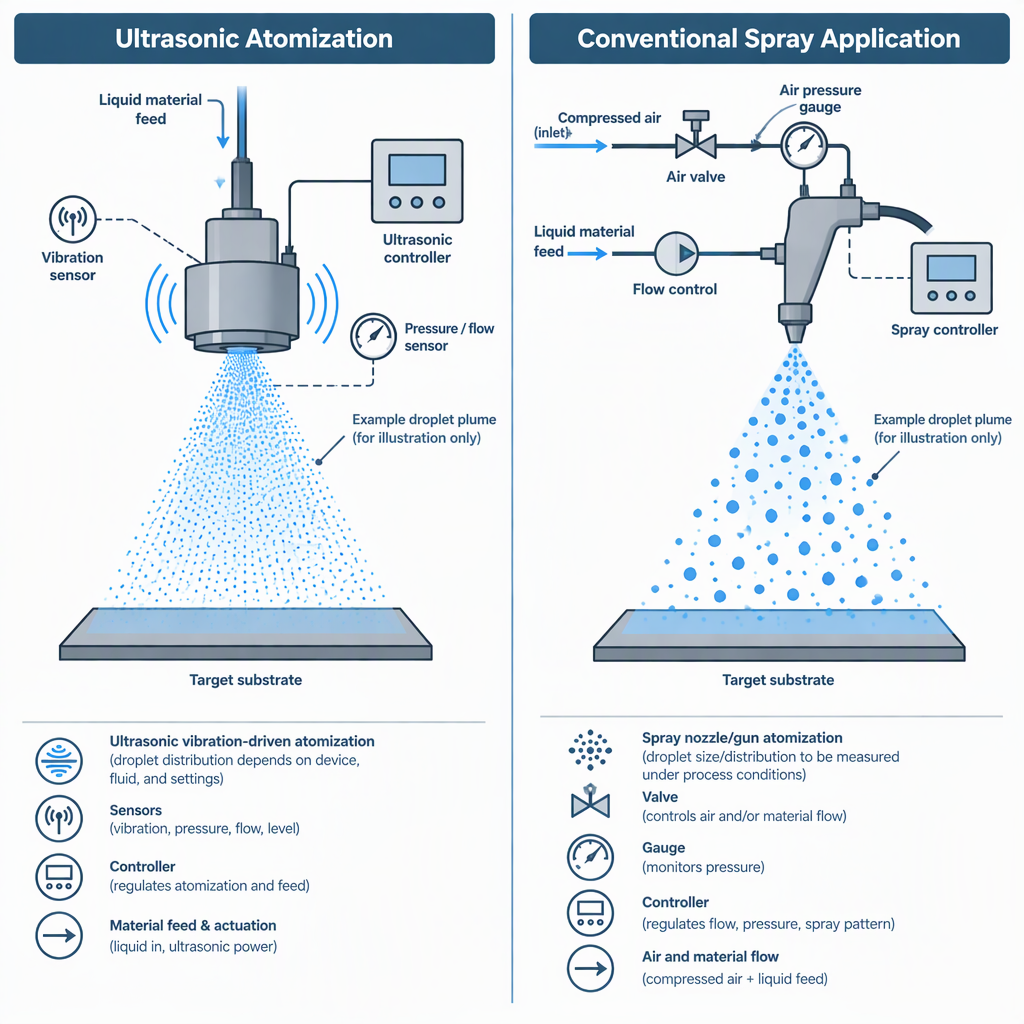
The first comparison is how liquid is broken into droplets: ultrasonic atomization is tied to vibration-driven surface-wave breakup, while conventional spraying should be evaluated by the energy and nozzle or gun method used in the existing process.
Ultrasonic atomization
In ultrasonic nebulization research, droplet formation is associated with capillary-wave or Faraday-wave behavior, and droplet results depend on device type, frequency, capillary wavelength, and breakup mechanism. That means the word “ultrasonic” is not enough to predict the coating result.
Conventional spraying
For many surface-coating environments, conventional spray comparison must include the selected application technology, operator practice, booth or enclosure design, and overspray filtration. These items can matter as much as the atomization method when a process is regulated.
For engineers and integrators, the practical question is not whether one label is modern and the other is old. The useful question is whether the atomization mechanism can produce the required droplet population with the fluid, substrate geometry, throughput, and control requirements of the line.
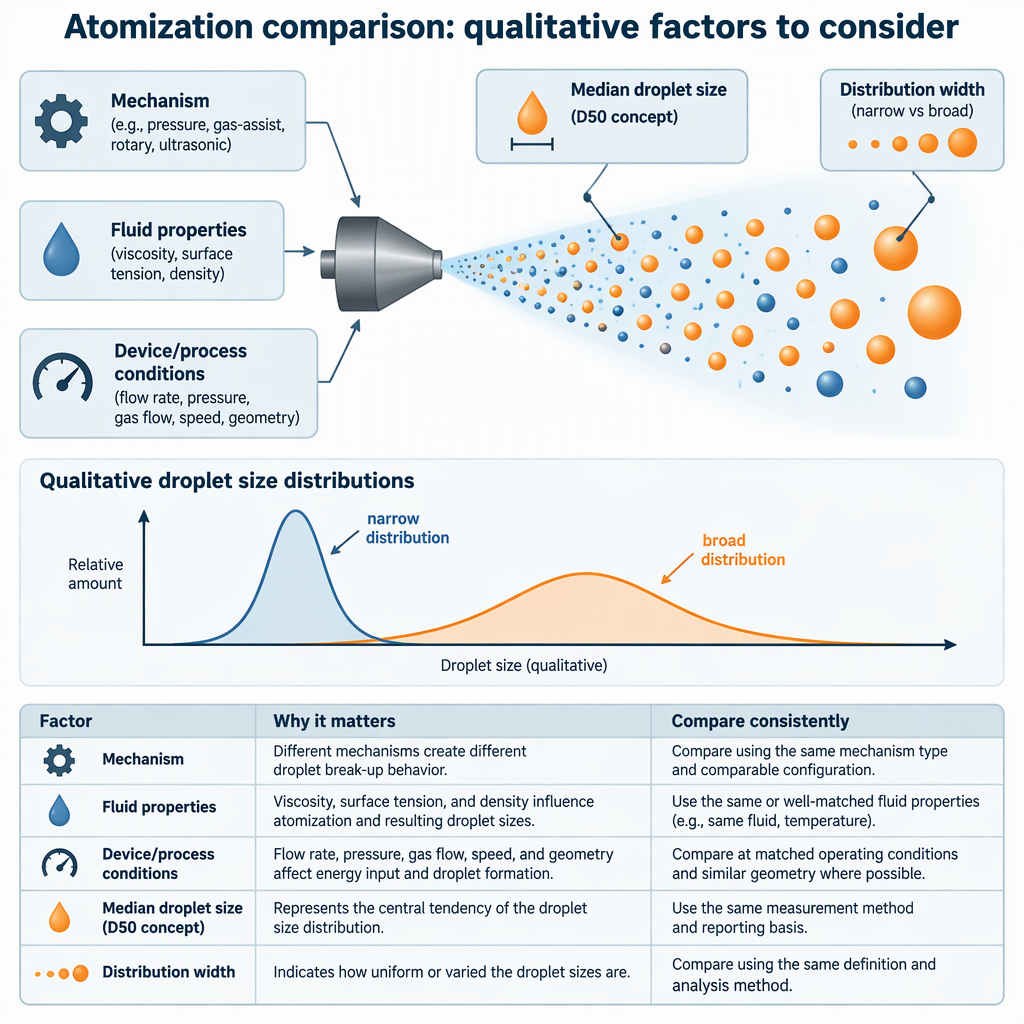
Compare droplet size and distribution, not just average size
Use median droplet size and the width of the droplet-size distribution together; an average droplet number alone can hide spray populations that behave very differently on the target.
Comparison item
Why it matters
How to compare it
Median droplet size
Ultrasonic droplet studies report droplet-size behavior in relation to device type, frequency, wavelength, and breakup mechanism.
Measure the selected fluid under the same operating window you plan to use, instead of relying on a nominal technology label.
Distribution width
Different ultrasonic nebulizer designs can produce different droplet-size distributions, so “ultrasonic” does not automatically mean one uniform droplet population.
Compare full distribution curves or percentile values when available, not only a mean value.
Coating target result
Droplet behavior is linked to the breakup mechanism and device conditions, so the same liquid may need different settings or hardware to reach a coating goal.
Evaluate wet film appearance, coverage uniformity, edge behavior, drying or curing compatibility, and defects under the same substrate and environment.
Compare overspray control and transfer-efficiency assumptions
Compare overspray and transfer efficiency as a test-and-control question, not as an assumed percentage advantage for either method.
If the process condition is...
Compare this before choosing
Decision implication
Open or difficult-to-enclose application
Whether the operation needs booth, enclosure, or overspray-filter controls under the applicable coating rules.
Do not judge the atomizer alone; judge the complete capture and control system.
Existing spray-gun process
Whether the current method is one of the recognized application technologies for the regulated operation, or whether an equivalent method must be approved.
Keep documentation of the application method, controls, and any required equivalency review.
R&D trial for a new coating
Whether the droplet population created by the trial setup matches the coating target and material behavior.
Run side-by-side tests with the same fluid, substrate, distance, environment, and measurement criteria.
For a narrow U.S. regulatory context, 40 CFR § 63.11173 includes requirements for certain affected paint stripping and miscellaneous surface-coating area sources, including painter training, spray booths or enclosures, overspray filters, and specified spray-application technologies. Confirm the current adopted rule, applicability, and any local requirements before specifying equipment.
Compare regulatory and approval boundaries before specifying equipment
If a coating operation is regulated, ultrasonic atomization should not be treated as an automatic replacement for an approved spray process without checking whether the rule accepts the method or requires documented equivalency.
Use 40 CFR § 63.11173 as a regulatory-context checkpoint when the operation falls within its scope, then confirm the current official requirement and local enforcement expectations with the responsible authority or compliance specialist.
For global projects, make the compliance comparison jurisdiction by jurisdiction. A method that is technically promising in a lab may still need approval documentation, operator training records, enclosure design review, emissions controls, or customer-specific qualification before it replaces an established process.
Build a test plan before choosing a process
A useful selection test holds the coating goal constant and varies only the process factors needed to compare ultrasonic atomization with the conventional spray baseline.
Define the required coating outcome before selecting the atomizer: target area, wetting behavior, allowable defects, film appearance, and downstream drying or curing constraints.
Measure droplet-size distribution for the candidate setup, not only a supplier headline value or a general technology category.
Record fluid properties and operating conditions because ultrasonic droplet behavior depends on device type, frequency, wavelength, and breakup mechanism.
Document overspray capture, enclosure, filtration, and operator-training requirements when the application is within a regulated surface-coating context.
Compare integration space and any manual maintenance, cleaning, or access task using the official equipment manual; before manual access, cleaning, or clearing, switch off and disconnect the applicable electrical, pneumatic, or battery power source.
Start with the conventional baseline: measure current coating result, reject modes, overspray handling, and operating window.
Run the ultrasonic candidate with the same fluid and substrate, then capture droplet-size distribution and coating-result data under defined settings.
Repeat at the practical edge of the process window, including expected viscosity, flow, distance, substrate geometry, and environment ranges.
Before manual cleaning, unclogging, or access to powered equipment during trials, switch off and disconnect the applicable electrical, pneumatic, or battery power source, then follow only the access and cleaning steps allowed by the specific equipment manual.
Decide from measured coating quality, control requirements, integration burden, and compliance fit rather than from the atomization label alone.
Use a decision table, not a universal winner
Neither ultrasonic atomization nor conventional spraying is the universal winner; the stronger choice is the one that fits the verified droplet behavior, coating objective, control system, and approval path.
Selection situation
Ultrasonic atomization may fit when...
Conventional spraying may fit when...
Droplet control is the main concern
Testing shows the ultrasonic device creates the droplet distribution needed for the fluid and coating target.
The existing gun or nozzle process already meets droplet, coverage, and defect requirements with known controls.
Process qualification is strict
The team can document method suitability and any required equivalency or approval path for the regulated operation.
The process already uses an accepted application technology and established booth, enclosure, filtration, and training controls.
Integration risk is high
Equipment layout, manual cleaning access after power disconnection, safety isolation, and control interfaces can be validated without disrupting the line.
The plant needs a familiar technology with known spare parts, operator practice, and maintenance routines.
R&D flexibility is the priority
The team can evaluate frequency, device configuration, fluid behavior, and measured droplet distribution across trial conditions.
The team needs rapid screening using existing spray infrastructure and established measurement procedures.
Conclusion
The safest comparison rule is simple: define the coating result, measure droplet-size distribution under real process conditions, compare overspray and controls, and check regulatory acceptance before specifying the equipment.
Do not compare ultrasonic atomization and conventional spraying by name alone; compare mechanism, device conditions, and measured droplet behavior.
Do not assume a regulated spray process can be replaced without checking accepted technologies, controls, and approval requirements.
Use trials, documentation, and supplier questions to close model-specific gaps before purchasing or integrating equipment.
FAQ
These questions help engineers, R&D teams, and equipment integrators turn the comparison into a practical selection discussion.
Is ultrasonic atomization always better than conventional spraying?
No. Ultrasonic atomization should be compared by measured droplet distribution, device conditions, fluid behavior, and coating result. The technology name alone does not prove a better process.
Should I compare mean droplet size or the whole distribution?
Compare the whole distribution when possible. Median or mean size is useful, but distribution width and outlier droplets can affect coverage, wetting, overspray, and coating defects.
Can ultrasonic atomization reduce overspray?
Treat overspray as a measured process result, not a guaranteed claim. Compare capture, enclosure, filtration, target geometry, operating conditions, and coating result for both methods.
Can ultrasonic atomization replace HVLP, airless, or electrostatic spraying in a regulated operation?
Not automatically. In the U.S. context described by 40 CFR § 63.11173, specified application technologies and approved equivalents are part of the requirement for affected operations. Confirm applicability and any required approval before changing the method.
What should an R&D trial measure first?
Start with the coating result and droplet-size distribution for the actual fluid and device conditions. Then compare coverage, defects, process stability, cleaning needs, and integration limits.
What should equipment integrators ask suppliers?
Ask for test conditions, compatible fluids, control interfaces, manual cleaning steps that require switching off and disconnecting the applicable power source before access, documentation for the intended jurisdiction, and evidence that the proposed setup can meet the project’s coating target.
When should conventional spraying remain the baseline?
Keep conventional spraying as the baseline when the existing process already meets coating requirements, uses recognized controls, and has a clear compliance and maintenance path. A new atomization method should outperform the baseline in measured, project-specific criteria before replacement.