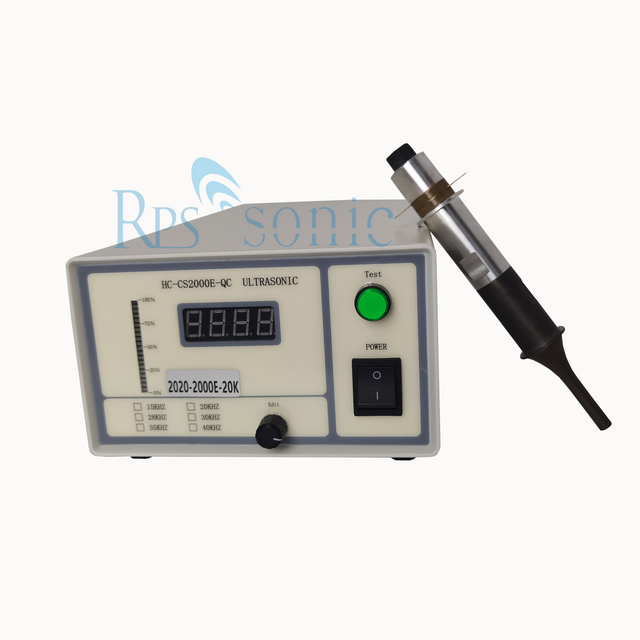
What Is Ultrasonic Battery Slurry Spraying Equipment?
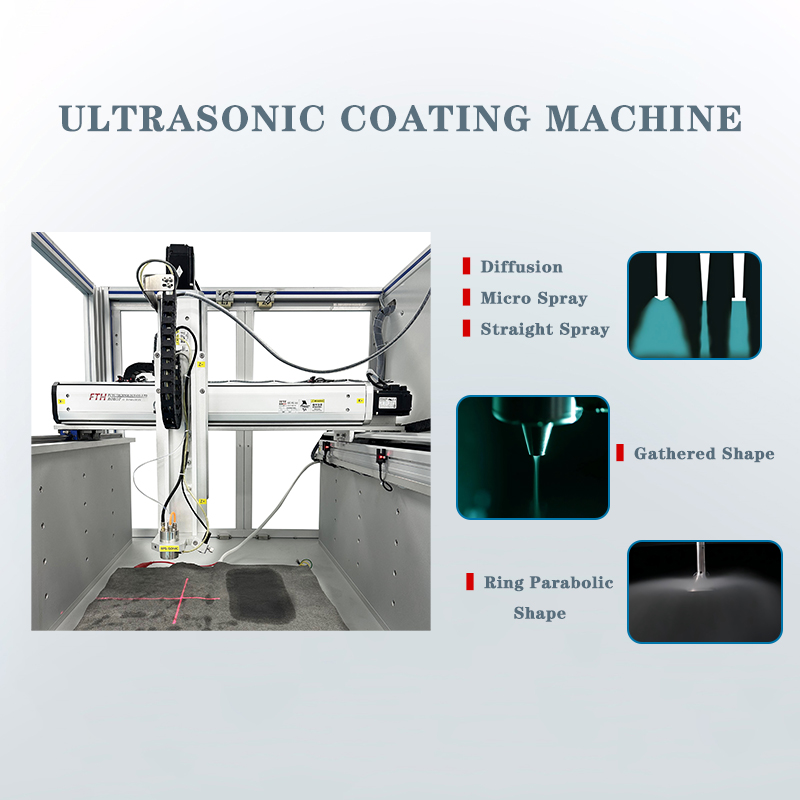
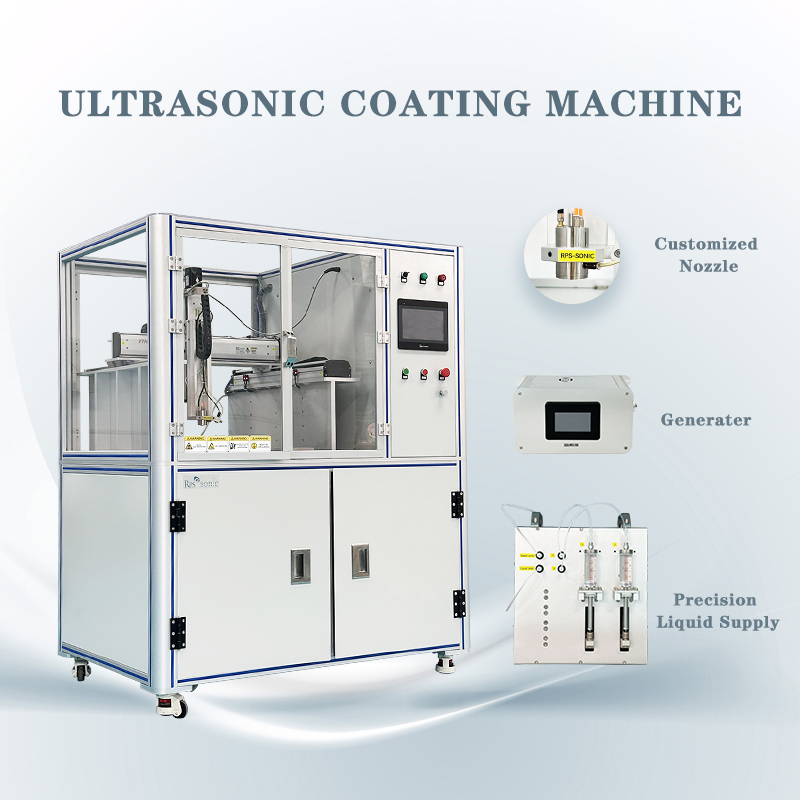
Ultrasonic battery slurry spraying is a high-end manufacturing technology that uses high-frequency ultrasonic energy to atomize battery slurry into micron-sized droplets and precisely spray them onto the surface of a substrate. It is mainly used to manufacture functional layers such as electrodes and separators in batteries. Its core advantage lies in its ability to form coatings with high uniformity, high density, and controllable thickness, thereby significantly improving battery performance.
Core Principle: Ultrasonic Atomization
The core of this technology lies in its gentle and efficient atomization method, which is completely different from traditional high-pressure airflow spraying:
Ultrasonic Atomization: The system converts electrical energy into high-frequency mechanical vibrations of 20kHz to 200kHz through a piezoelectric ceramic transducer. This high-frequency vibration energy breaks down the molecular structure inside the slurry, "shattering" it into uniform micron-sized (1-50μm) atomized droplets.
Precise Spraying: The formed fine droplets are then gently transported to the surface of the substrate (such as aluminum foil, copper foil, or separator) by a low-pressure, low-velocity carrier gas (such as nitrogen). Due to the very low kinetic energy, the spraying process involves almost no splashing or bounce.
Film Formation: Tiny droplets sprayed onto the substrate are then rapidly dried on a heated platform, ultimately forming a uniform, dense functional coating.
Compared to traditional coating processes, ultrasonic spraying technology exhibits several advantages:
Coating Quality and Precision: It can produce ultra-thin (≤10μm), pinhole-free, and uniformly thick coatings. For example, the thickness deviation of a diaphragm coating can be controlled within ±0.5μm. Furthermore, the porosity of the coating can be precisely controlled by adjusting parameters.
Cost and Environmental Friendliness: The spraying process produces almost no splashing or bounce, resulting in extremely high slurry utilization, typically exceeding 85%. In addition, non-contact spraying effectively protects fragile substrates and reduces organic solvent evaporation by 30%-50%, making it more environmentally friendly.
Production Efficiency: This technology is easily integrated into automated production lines (such as roll-to-roll processes), enabling continuous and rapid coating. Experiments show that its production efficiency can be increased by 25%-30% compared to traditional processes.
Main Application Scenarios
This technology has become a key process in the manufacturing of next-generation high-performance batteries, especially in fields with extremely high coating quality requirements:
**High Energy Density Electrodes:** Used for spraying slurries of materials such as high-nickel ternary electrodes and silicon-carbon anodes, forming an ultra-thin and uniform coating to suppress volume expansion and reduce internal resistance.
**Solid-State Batteries:** Enables the fabrication of submicron-scale (0.5-5μm) defect-free solid electrolyte layers, one of the few feasible solutions for this process. It is also used for spraying buffer layers to improve the interfacial stability between the electrode and electrolyte.
**Separator Functional Coatings:** Spraying ceramic (e.g., Al₂O₃) or polymer coatings onto polypropylene/polyethylene (PP/PE) separators significantly enhances the separator's heat resistance (up to 200℃ or higher), mechanical strength, and electrolyte wettability.
**Flexible and Micro-Batteries:** Suitable for flexible substrates such as polyethylene terephthalate (PET)/polyimide (PI), enabling precise spraying of microelectrode patterns.
Typical Process Flow and Key Parameters
A complete ultrasonic spraying process typically includes several key steps. Precise control of various parameters is crucial for ensuring coating quality.
Key Steps and Key Descriptions
1. Slurry Preparation: The viscosity, solids content, and surface tension of the slurry must be matched to the process. For example, excessively high viscosity can lead to atomization difficulties, while excessively low viscosity may cause coating sagging. Ultrasonic or ball milling dispersion treatment is necessary beforehand to prevent nanoparticle agglomeration.
2. Parameter Control: Multiple parameters need to be optimized synergistically. Ultrasonic frequency (20-150kHz) determines droplet size; nozzle movement and slurry flow rate (e.g., 0.5-5mL/min) jointly determine coating thickness; carrier gas pressure affects spray pattern; substrate temperature (20-150℃) controls solvent evaporation rate, affecting film quality.
3. Spray Deposition: The atomized slurry is uniformly deposited onto the substrate. Multiple spray passes (e.g., 3-5 passes) can be used to precisely control the total coating thickness and prevent excessive coating thickness and sagging.
4. Drying and Curing: Using a segmented temperature-controlled drying channel or heating platform, the solvent in the coating slowly evaporates within 3-5 minutes, forming a dense functional layer.
In summary, ultrasonic battery slurry spraying technology, with its superior precision, uniformity, and material utilization, is profoundly changing the manufacturing landscape of high-performance batteries. Although challenges remain in slurry compatibility and large-scale production speed, it is undoubtedly one of the key processes driving next-generation battery technologies such as lithium-ion and solid-state batteries from the laboratory to mass production.