Ultrasonic Technology: Application of Drug Coating Technology
Views: 107 Author: Site Editor Publish Time: 2026-02-03 Origin: Site
Ultrasonic Technology: Application of Drug Coating Technology
In the field of peripheral artery disease treatment, a silent revolution is brewing in catheter laboratories. When traditional drug-eluting coating technology encounters bottlenecks, ultrasonic atomization coating technology, with its precise "fogging" art, is redefining the therapeutic boundaries of drug-eluting balloons and peripheral stents. This cutting-edge technology, integrating acoustics, fluid dynamics, and pharmaceutics, is not only about optimizing device performance but also carries the mission of restoring life pathways for countless patients.
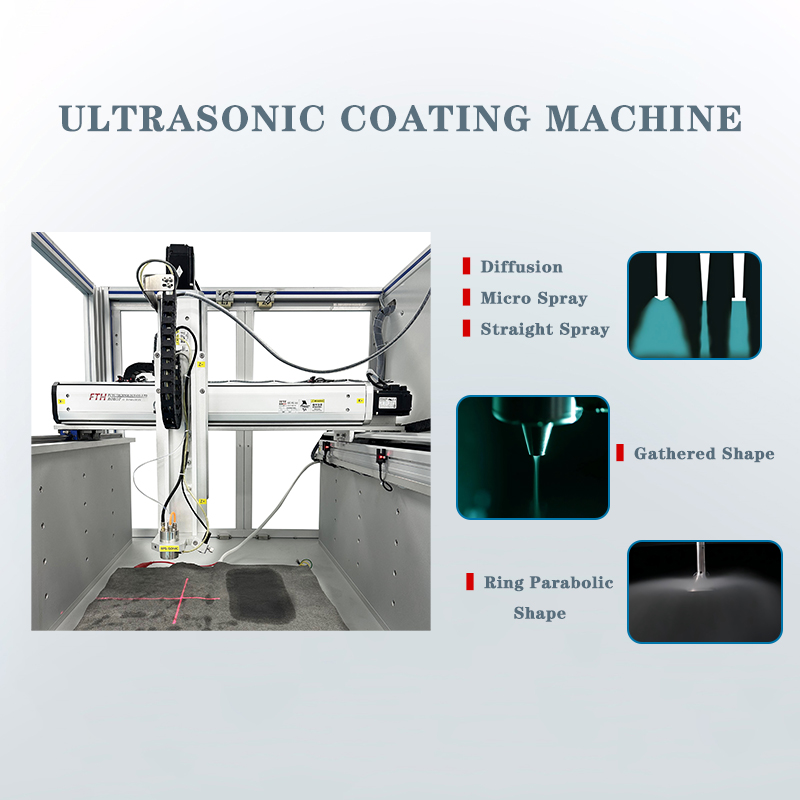
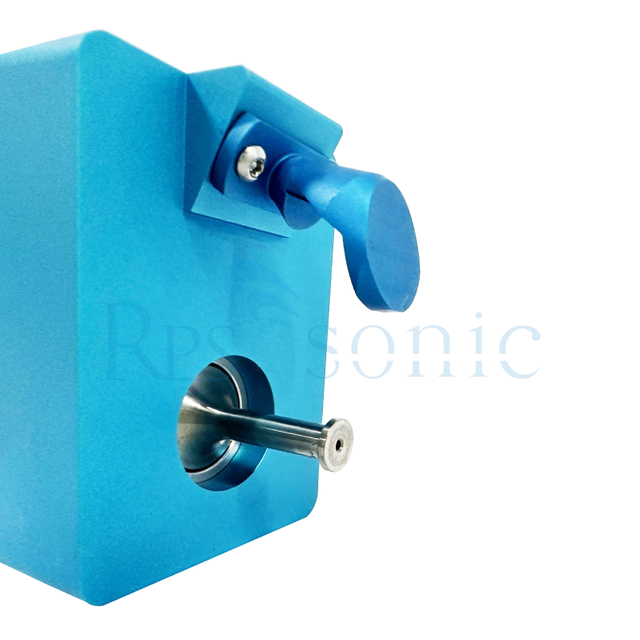
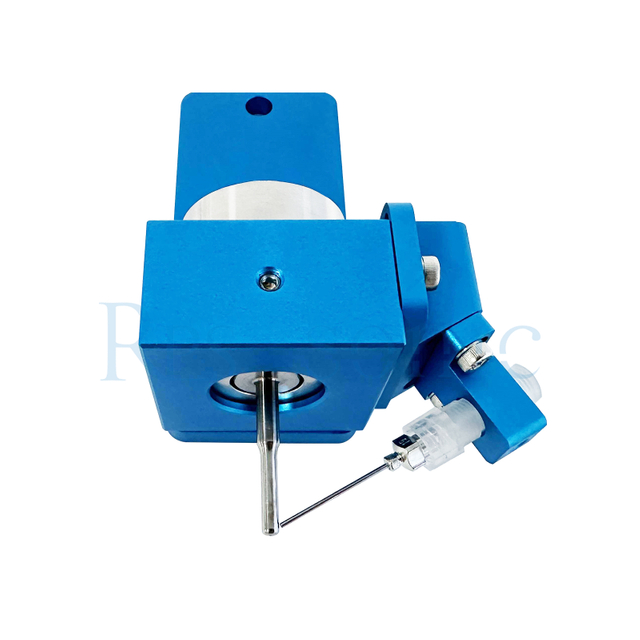
The core of ultrasonic nozzle technology lies in converting electrical energy into high-frequency mechanical vibration, causing the drug solution to form micron-sized droplets at the tip, achieving unprecedented spatial resolution. Compared to traditional spraying, the droplet size distribution produced by ultrasonic atomization is extremely narrow, allowing for molecular-level precision mapping on the balloon or stent surface. This control surpasses the limits of the human eye, constructing a uniform drug matrix at the microscale, ensuring that every square micrometer of the treatment area carries a precise dose.
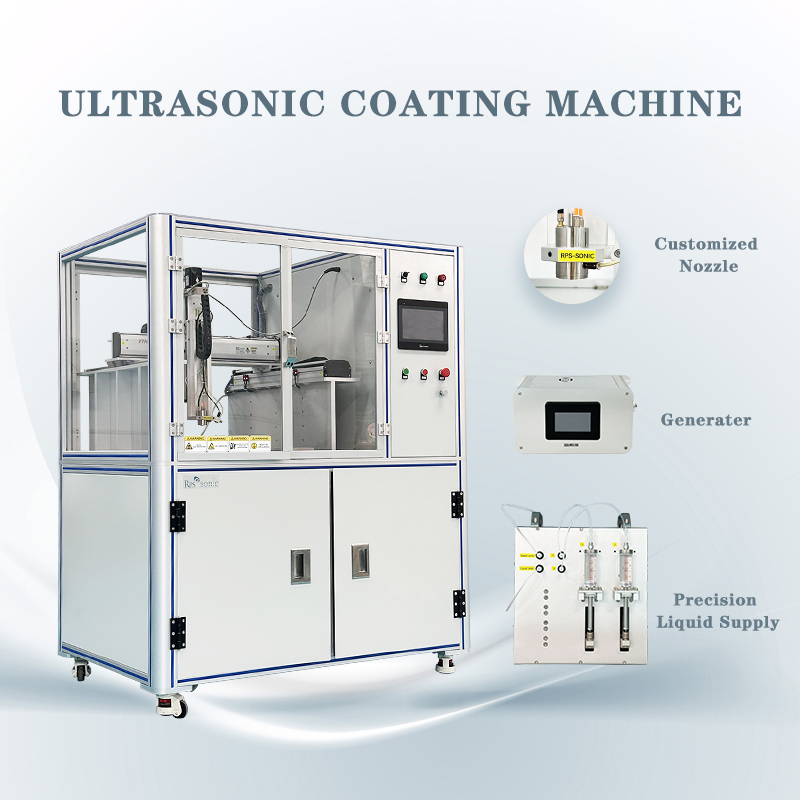
The complex anatomy of peripheral blood vessels and the diverse lesion morphologies require coating technology to adapt to varied three-dimensional surfaces. The patented multi-catheter clamping system, through multi-axis linkage and intelligent path planning, enables balloons or stents to rotate and translate at a uniform speed within an ultrasonic mist field. Whether simulating bifurcation lesions or tortuous vascular morphologies, the system maintains a constant mist inflow angle and distance, achieving uniform coverage of complex geometric surfaces. This dynamic adaptability is like "tailor-made" for each unique lesion, eliminating the risk of drug burst release or underdosing caused by uneven coating thickness.
The drug crystallization morphology directly determines its release kinetics. A unique atomization humidification technology cleverly regulates the solvent evaporation rate by creating a controllable microenvironment in the deposition area. When drug droplets impact the surface, the surrounding humidity delays solvent escape, providing a time window for drug molecules to self-assemble, promoting the formation of thermodynamically stable microcrystalline structures. This "humidity field-induced crystallization" technology avoids amorphous aggregation or crystal defects caused by rapid drying, resulting in excellent mechanical stability and reproducible release curves.
Under a microscope, defects common in traditional coatings, such as uneven adhesion, pinholes, and cracks, are almost completely eliminated with this technology. The soft-landing characteristic of ultrasonic atomization allows microdroplets to reach the substrate with lower kinetic energy, avoiding impact damage to the already formed coating. Simultaneously, the uniform deposition pattern eliminates localized stress concentrations, enabling simultaneous drying and shrinkage processes and forming a cohesive, continuous film layer. This structural integrity ensures that the coating will not peel off or be damaged when the device passes through tortuous blood vessels or calcified lesions, making "full-dose delivery" a reality.
Peripheral interventional devices require rigorous pretreatment and delivery environments. This coating system exhibits excellent chemical inertness and high tolerance to various organic solvents (such as acetone and tetrahydrofuran commonly used in preparation). This compatibility not only broadens the scope of formulation development, allowing the use of superior drug-load solvents, but also ensures the stability of the coating during device folding and sheathing. When the balloon deploys at the lesion site, it carries not only the drug, but also a "treatment commitment" that has withstood the test of chemistry.
Conclusion: Ultrasonic atomization coating technology propels interventional therapy from the "device arrival era" to the "precision delivery era." It addresses not only coating process issues but also bottlenecks in clinical efficacy—by optimizing pharmacokinetics, improving local bioavailability, and reducing systemic side effects, it provides a safer and more durable solution for complex peripheral arterial diseases.
In the microscopic world, every droplet generated by ultrasonic vibration carries the mission of extending vital pathways. When technological precision and medical humanism converge here, we see not only the disappearance of coating defects but also the reduction of treatment uncertainty and the improvement of patients' quality of life.