The application of ultrasonic technology in the dispersion of graphene
Ultrasonic technology is one of the most commonly used and effective methods for preparing and dispersing graphene (especially few-layer or monolayer graphene). Essentially, it utilizes the extreme physical forces generated by cavitation to overcome the van der Waals forces between graphene sheets, thereby achieving exfoliation and dispersion.
Below is a detailed analysis of the application principles, methods, advantages, disadvantages, and key considerations of ultrasonic technology in graphene dispersion.
I. Core Principle: Ultrasonic Cavitation Effect When high-intensity ultrasonic waves propagate in a liquid medium (such as solvents, water with dispersants), periodic high-pressure and low-pressure cycles are generated.
Low-pressure stage: Tiny vacuum bubbles (cavitation nuclei) form in the liquid.
High-pressure stage: These bubbles are rapidly compressed and instantly implode (collapse).
Implosion moment: This generates localized extreme high temperatures (approximately 5000 K), high pressures (approximately 1000 atmospheres), and intense microjets (velocities up to 400 km/h).
When these microjets and shock waves act on graphite raw materials (such as graphite powder, expanded graphite, and graphite oxide), they generate powerful shear and tearing forces sufficient to disrupt the van der Waals forces between graphite layers. This allows multilayer graphite to be exfoliated into thinner graphene sheets (such as few-layer graphene) and prevents re-aggregation.
II. Main Application Methods There are two main strategies for ultrasonic dispersion of graphene, corresponding to different raw materials and target products:
1. Liquid Phase Exfoliation Method
Process: Natural graphite powder or flake graphite is directly added to a suitable solvent (such as N-methylpyrrolidone, dimethylformamide, or a water/surfactant solution), and exfoliation is performed using ultrasound.
Product: High-quality, low-defect few-layer graphene.
Key Points: The surface tension of the solvent must match that of the graphene to reduce the exfoliation energy and stabilize the dispersion. Dispersants (such as SDS, PVP, and polymers) are often added to prevent the exfoliated graphene from re-aggregating.
2. Graphene Oxide Exfoliation Assistance
Process: First, graphite is chemically oxidized to generate hydrophilic graphene oxide. Graphene oxide swells and exfoliates very easily in water. Then, gentle ultrasonic treatment can efficiently and completely separate the graphene oxide sheets, forming a stable aqueous solution of graphene oxide.
Subsequent Steps: Graphene oxide can be converted to reduced graphene oxide through chemical or thermal reduction.
Product: High yield, good water dispersibility, but the graphene structure contains defects and oxygen-containing functional groups.
III. Types of Ultrasonic Equipment
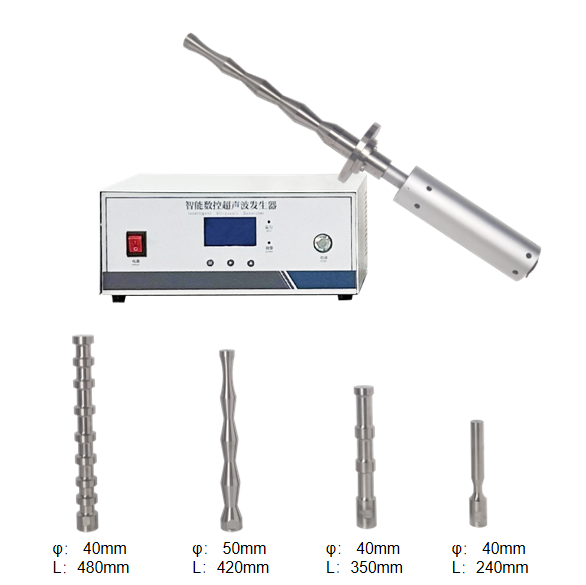
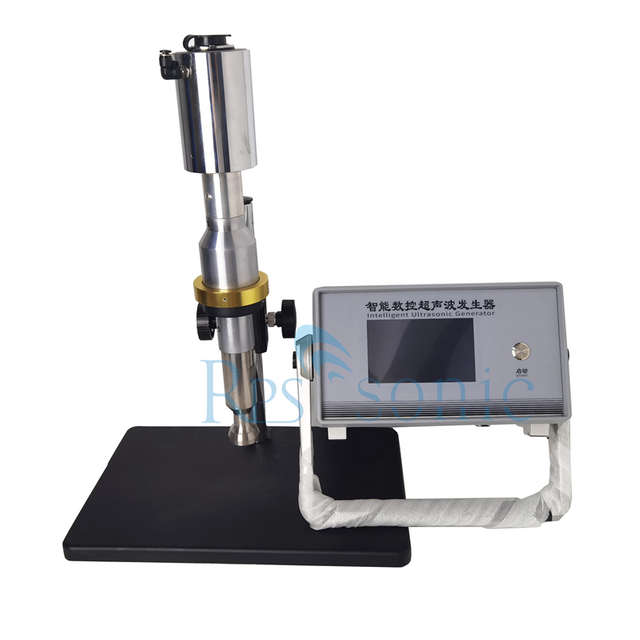
Ultrasonic Probe/Ultrasonic Cell Disruptor:
Principle: Ultrasonic energy is directly inserted into the solution through a titanium alloy probe (amplifier rod), generating a high-intensity, localized cavitation effect.
Advantages: Concentrated energy, extremely high efficiency, short processing time (usually a few minutes to tens of minutes), suitable for small-batch, high-concentration dispersion.
IV. Advantages and Disadvantages Analysis
Advantages: Highly efficient and direct: Physical method, graphite exfoliation can be achieved without complex chemical reactions.
Relatively simple operation: The equipment is widely available and easy to operate in the laboratory.
Highly controllable: By adjusting the ultrasonic power, time, solvent, and dispersant, the number of graphene layers, size, and quality can be controlled to a certain extent.
Wide applicability: It can process both natural graphite and graphite oxide.
Disadvantages and challenges: Yield versus size trade-off: Prolonged or high-power ultrasound reduces sheet size, generating numerous nanofragments and affecting intrinsic properties such as electrical and thermal conductivity.
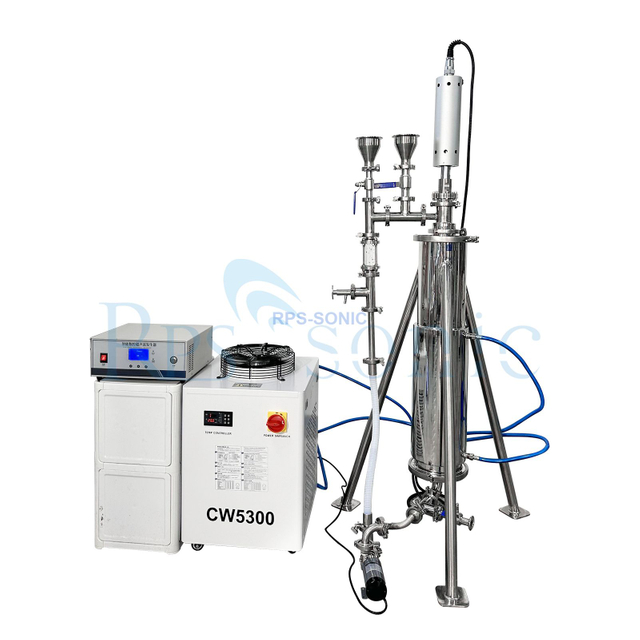
High energy consumption and difficulty in scaling up: The ultrasonic probe method processes small volumes, making scale-up difficult; the ultrasonic bath method is extremely time-consuming. Both have high industrial production costs.
Dispersion stability: Relying solely on ultrasound, the dispersion stability is limited; it usually requires the use of a dispersant.
Reproducibility issues: Slight changes in ultrasonic parameters (position, temperature, liquid volume) can lead to batch-to-batch variations.
V. Key Process Parameters and Optimization
Ultrasonic power/amplitude: Higher power results in higher exfoliation efficiency, but also a greater risk of defects and sheet breakage. A balance needs to be found.
Ultrasonic time: Insufficient time leads to incomplete exfoliation; excessive time results in smaller sheets and increased defects. There is usually an optimal time window.
Solvent/Dispersion System: Selecting a solvent with matching surface energy or an effective dispersant is a prerequisite for obtaining a high-concentration, stable dispersion.
Raw Material Concentration: Excessive concentration reduces the transmission efficiency of ultrasound waves and increases the likelihood of sheet re-agglomeration.
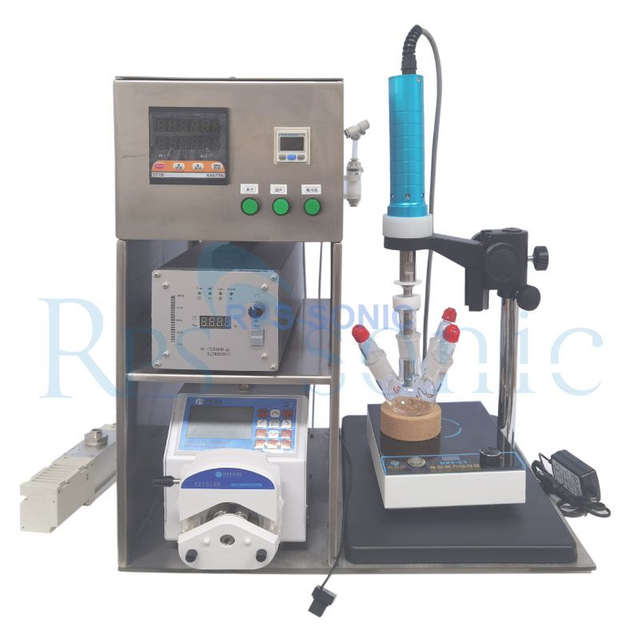
Temperature Control: The ultrasonic process generates a large amount of heat, causing solvent evaporation or property changes. An ice bath or cooling circulation system is needed for temperature control.
VI. Summary and Outlook
Ultrasonic technology is a "main force" in graphene laboratory research and small-to-medium-scale preparation, playing an irreplaceable role, especially in the preparation of aqueous or solvent-based graphene dispersions (for coatings, composite materials, conductive inks, etc.).
In summary, ultrasonic dispersion is a powerful and flexible physical tool whose successful application depends on a fine balance between energy input (ultrasonic parameters) and stabilization strategy (solvent/dispersant) to achieve optimal results in terms of yield, quality, and performance.