How Ultrasonic Spraying Uses Superhydrophobic Technology To Overcome Corrosion Problems?
Metallic materials, with their excellent physical and chemical properties, play an indispensable role in our daily lives and industrial production. From magnificent architectural bridges to precision aerospace devices, metals are ubiquitous.
However, an invisible killer constantly threatens the lifespan and reliability of metals—corrosion. It not only leads to reduced metal strength and equipment failure, but can even cause catastrophic safety accidents. How to provide effective "protective clothing" for metals has always been an important topic in materials science.
I. The Dilemma of Traditional Protection
To combat corrosion, surface protection technology has long been used, covering the metal surface with a coating to prevent direct contact with corrosive media. Traditional anti-corrosion coatings, such as epoxy resins and polyurethanes, while widely used, are not foolproof. Due to their inherent hydrophilicity, corrosive ions (such as chloride ions) and water molecules can still gradually penetrate the coating, reaching the metal interface and causing protective failure.
So, is there a way to make corrosive media "retreat"? The answer is yes, and this is the much-discussed superhydrophobic coating in recent years.
II. What is a Superhydrophobic Coating?
The lotus leaf in nature gave us inspiration. Water droplets falling on a lotus leaf form round beads that quickly roll off, carrying away surface dust—this is the famous "lotus effect."
Scientists define a surface as superhydrophobic when the water contact angle is greater than 150° and the roll-off angle is less than 10°. This means water droplets can hardly spread or stay on such a surface; they can only "stand" on the surface or roll away quickly.
Applying this property to metal protection has revolutionary effects: superhydrophobic coatings can create an "air cushion" or barrier on the metal surface, greatly reducing the direct contact area between corrosive media and the metal, thus significantly improving corrosion resistance.
Constructing superhydrophobic surfaces requires two key factors: first, building nanometer-scale roughness; and second, using low surface energy materials for modification. Achieving this fine structure stably, uniformly, and controllably is the key technological challenge.
III. Ultrasonic Spraying: A Precision Tool for Building an "Invisible Raincoat"
Among various preparation methods, ultrasonic spraying technology, with its unique advantages, has become a highly promising solution.
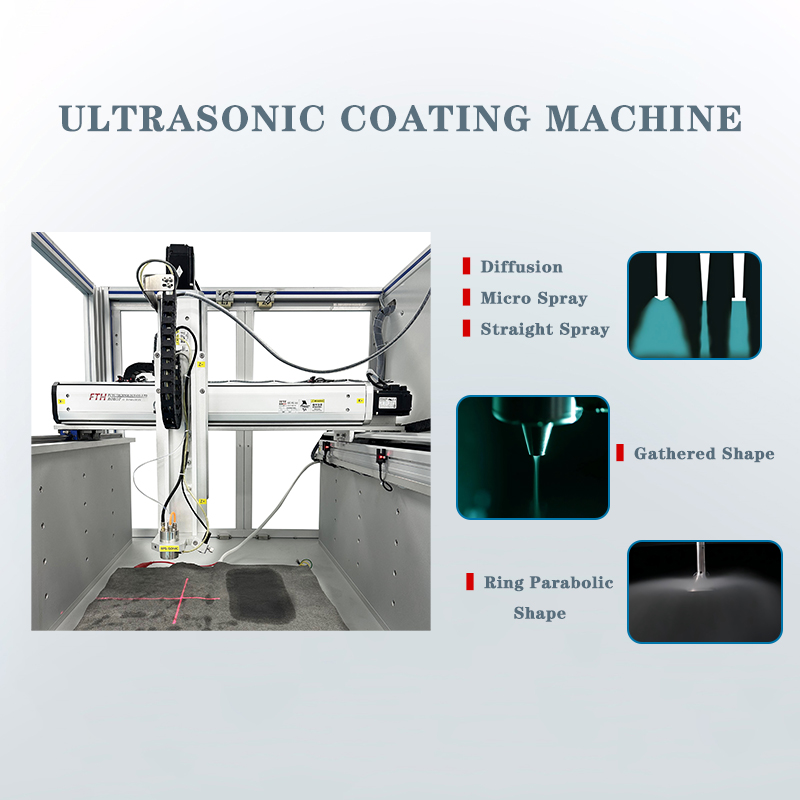
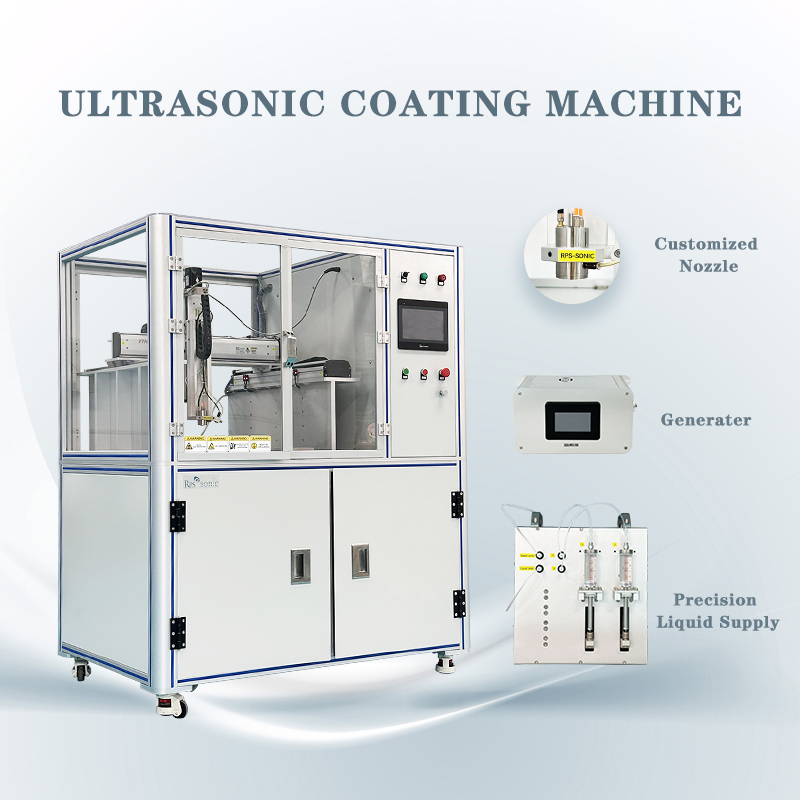
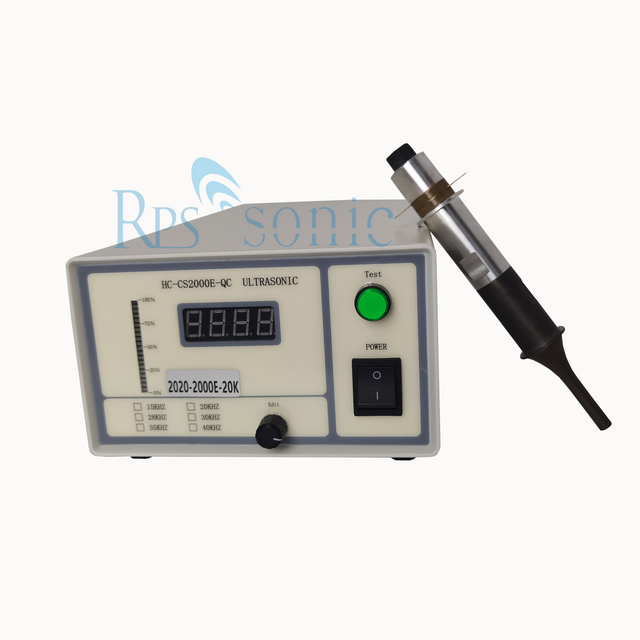
Traditional spraying (such as using spray guns) relies on high-pressure air to atomize the paint, resulting in uneven droplet size and inconsistent coating thickness and morphology. Ultrasonic spraying, on the other hand, uses ultrasonic vibrations to break down liquid paint into uniform, fine droplets, which are then gently deposited onto the metal surface.
What breakthroughs has this technology brought to the preparation of superhydrophobic coatings?
Precise Construction of Micro/Nano Structures: Ultrasonic spraying enables highly controllable coating morphology. By adjusting the paint formulation and spraying parameters (such as spraying speed, flow rate, and number of passes), the stacking pattern of nanoparticles (such as silicon dioxide SiO₂) can be precisely controlled to form ideal nano/micro-scale rough structures, which is key to trapping air and achieving superhydrophobicity.
Uniform Coverage and High Adhesion: The fine atomization effect ensures that the paint forms a uniform film even on complex-shaped metal substrates, avoiding defects such as pinholes and cracks, and enhancing the adhesion between the coating and the substrate.
Wide Material Adaptability: Ultrasonic spraying is not only suitable for common silica/polymer hybrid coatings, but also for depositing more complex metal oxide films (such as aluminum-doped tin oxide SnO₂), providing a broad process platform for developing high-performance anti-corrosion coatings.
IV. The Evolution of Superhydrophobic Coatings: From "Passive Defense" to "Intelligent Active Protection" While early superhydrophobic coatings offered excellent protection, they also suffered from poor durability and susceptibility to damage and failure. To address this, scientists have continuously explored new avenues, and the next generation of superhydrophobic coatings is becoming increasingly "intelligent" and "robust."
Combination of Ultra-High Hydrophobicity and Durability: Recent research shows that by optimizing the preparation process, the performance of superhydrophobic coatings can reach astonishing levels. For example, studies have shown that composite coatings prepared using a simple spraying method can achieve water contact angles exceeding 160°, withstanding not only 700 cm of sandpaper abrasion and over 60 minutes of high-speed water flow impact, but also 200 hours of ultraviolet radiation, demonstrating extremely strong mechanical stability and environmental durability.
Giving Coatings "Self-Healing" Life: The real breakthrough lies in transforming "passive defense" into "active protection." Inspired by the cuticle structure of mussels, researchers have developed metal-organic framework (MOF)-derived nanocomposite coatings. These coatings not only possess 160° superhydrophobicity and 97.5% corrosion protection efficiency, but also, upon damage, form a protective adsorption film through an intermediate layer, achieving corrosion-triggered self-repair.
Intelligent Sensing and Damage Warning: Going further, some intelligent coatings are designed not only to self-repair but also to "report" their damage status. For example, utilizing the photothermal properties of polydopamine, damaged coatings generate temperature gradients under light, which can be easily detected by infrared thermography, enabling real-time monitoring of corrosion.
Stimulus-Responsive "Intelligent Pharmacists": Another intelligent strategy involves storing corrosion inhibitors (such as benzotriazole BTA) in specially modified microcapsules (such as activated palygorskite). When the coating is scratched, causing a change in the local pH value, these microcapsules respond rapidly, automatically releasing the inhibitor to form a new protective film at the defect, preventing corrosion spread. This "one-step spraying" method of preparing intelligent coatings demonstrated exceptional corrosion resistance in simulated seawater.
V. Conclusion The use of ultrasonic spraying technology to prepare superhydrophobic coatings has opened a completely new path for metal corrosion protection. It's no longer simply about putting a passive "raincoat" on metal; rather, through precise microstructural design and the introduction of smart materials, it endows this "raincoat" with self-cleaning, self-repairing, and even damage-sensing capabilities.
While many challenges remain in moving from the laboratory to large-scale industrial applications, with the continuous advancement of materials science and preparation technologies, this amazing "invisible raincoat" holds promise for protecting every inch of metal in the future, providing a more perfect solution to the age-old problem of corrosion.