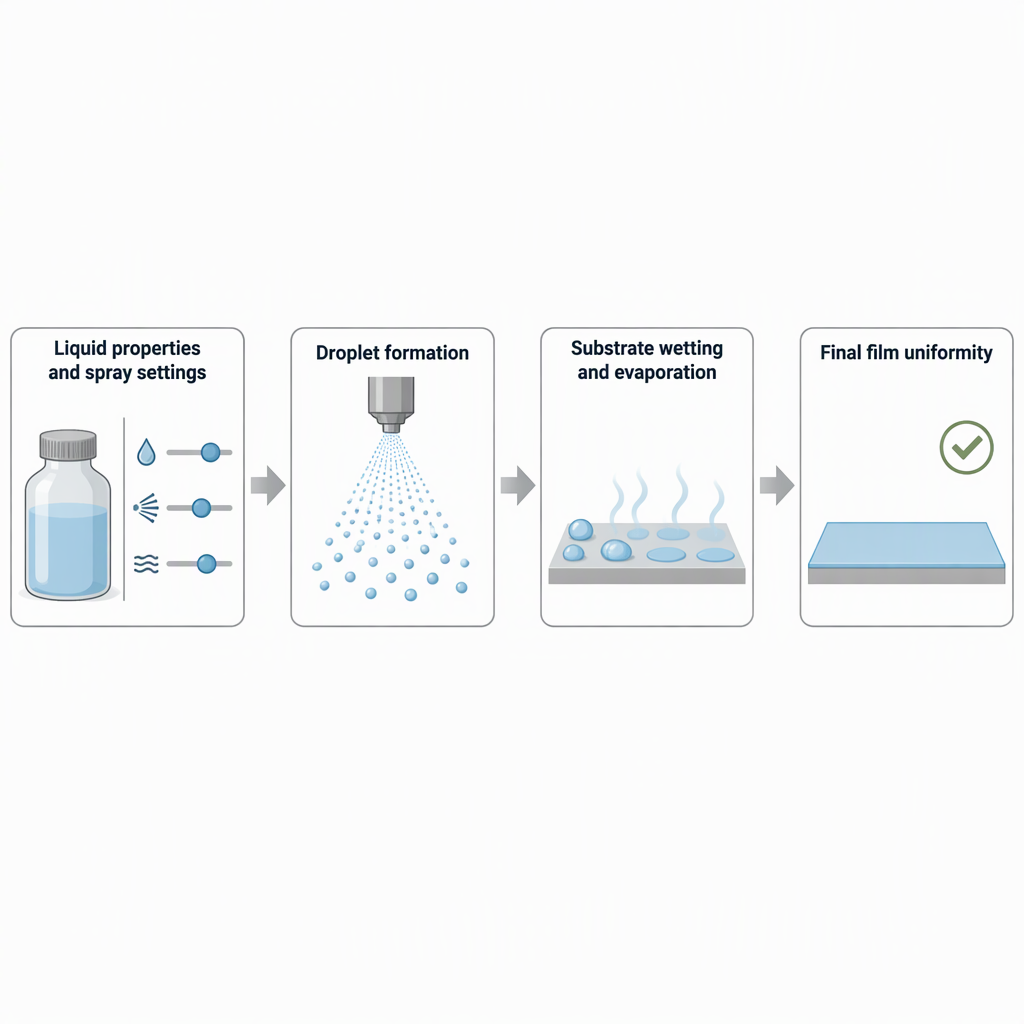
For ultrasonic spray coating uniformity, define the droplet requirement and the film requirement separately: droplet size is shaped by atomization conditions and liquid properties, while final coating uniformity also depends on wetting, surface energy, evaporation, and the substrate condition.
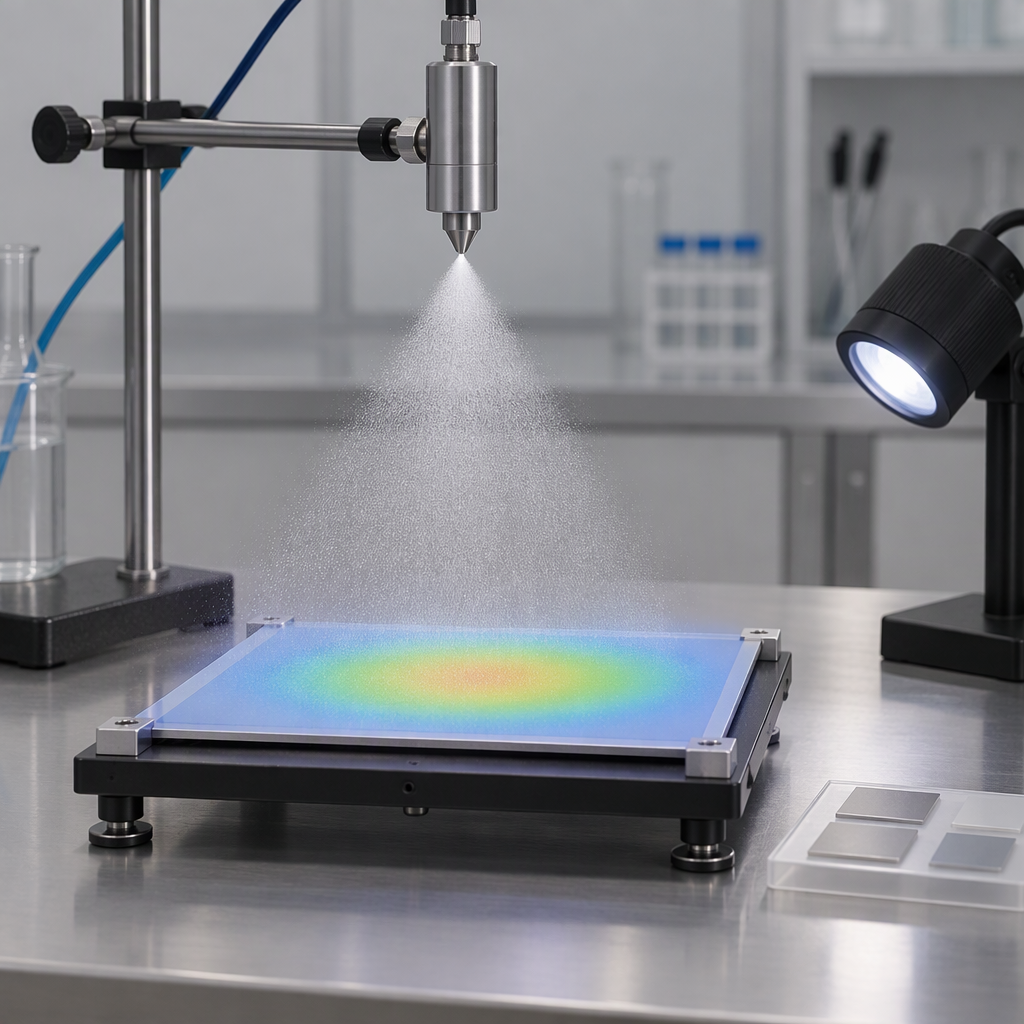
Define droplet requirements before selecting ultrasonic spray parameters
A droplet requirement should state the target droplet-size range or distribution, the acceptable spread around that target, and the liquid conditions under which the requirement must be met, because ultrasonic atomization droplet size changes with frequency, power, flow rate, viscosity, surface tension, and nozzle geometry.
| Requirement item | What to define | Why it matters for selection |
| Droplet size or distribution | Specify the required range, distribution target, or measurement basis instead of asking for a generic “fine mist.” | Higher ultrasonic frequency is reported to reduce droplet size, but other liquid and process variables also affect formation. |
| Droplet transport | Define how droplets will be delivered to the substrate, including whether velocity or carrier/shroud gas must be characterized. | A study of ultrasonic spray-coater droplets measured both droplet size and speed to relate spray behavior to process variables. |
| Liquid state during testing | Record viscosity, surface tension, solids or concentration, and flow-rate condition for each trial. | Droplet formation depends on liquid properties as well as operating settings, so a result without liquid context is hard to transfer. |
Do not reduce the requirement to one nominal droplet number unless the measurement method, liquid formulation, flow condition, and transport condition are also defined. Droplet size alone cannot prove coating uniformity on a real substrate.
Map droplet variables to the requirement sheet
The requirement sheet should map each controllable or measurable variable to the droplet outcome it may influence, then identify which variables the process team will hold constant during comparison trials.
| Variable | How to treat it in requirements | How this guides selection |
| Ultrasonic frequency | State the frequency basis for the trial or request droplet data at the candidate operating frequency. | Published analysis reports that higher frequency decreases droplet size in ultrasonic atomization. |
| Power and flow rate | Define the flow-rate range and power condition used for droplet evaluation. | Power and flow-rate ranges affect droplet formation, so comparison should not mix unrecorded settings. |
| Viscosity and surface tension | Measure or specify the liquid properties at the relevant formulation state. | Viscosity and surface tension are among the liquid properties linked to droplet-size behavior. |
| Nozzle geometry | Keep geometry consistent during screening or request the geometry basis behind supplied droplet data. | Nozzle geometry is identified as one of the factors affecting ultrasonic atomization droplet size. |
For the droplet-size dependency claim, readers can review the PubMed Central article on microdroplets produced by ultrasonic atomization, which discusses frequency, power, flow rate, viscosity, surface tension, and nozzle geometry within ultrasonic atomization research.
Coating uniformity should be defined as a substrate-level acceptance requirement, not assumed from atomization alone, because wetting, surface tension, evaporation, and surface energy influence whether a film becomes smooth, homogeneous, continuous, or wrinkled.
| Uniformity question | Define this before trials | Decision value |
| What counts as a continuous film? | State the inspected area, minimum coverage expectation, and defect types that are unacceptable. | A uniform wetting layer is described as a precondition for continuous film formation in ultrasonic spray coating of organic films. |
| What surface condition is being coated? | Record substrate material, pre-existing film condition, surface energy, and wetting behavior. | Substrate and pre-existing film surface energy influence whether the final film is smooth and homogeneous. |
| How will evaporation be controlled? | Define solvent system, drying environment, pass strategy, and inspection timing. | Solvent evaporation and surface tension are linked to film morphology, including smoothness and wrinkling behavior. |
For a peer-reviewed example of how wetting and surface effects are tied to film formation, see the Scientific Reports article on ultrasonic spray coating of polymer and small-molecular organic films.
Build a validation path from droplets to film uniformity
A practical validation path starts with liquid characterization, measures droplet behavior under defined process settings, then verifies the deposited film on the actual substrate and acceptance area.
- Characterize the coating liquid: record viscosity, surface tension, concentration or solids, and the formulation state used during testing.
- Select candidate atomization settings: document frequency, flow rate, power, and nozzle geometry before comparing spray results.
- Measure droplet behavior where it matters for the process: droplet size, distribution, and, when relevant, droplet speed or transport behavior can be characterized instead of inferred.
- Run substrate trials: evaluate whether wetting, evaporation, surface energy, and existing surface condition produce the intended continuous or homogeneous film.
- Convert observations into acceptance rules: define the inspection map, film-thickness target if applicable, allowed variation, defect categories, and rework or rejection criteria.
- Use the same liquid condition when comparing droplet measurements across settings.
- Separate atomization capability from coating acceptance; a stable mist still needs substrate validation.
- Inspect film morphology after the relevant drying or evaporation stage, not only during wet deposition.
- When droplet transport affects the process, include velocity or gas-flow characterization in the validation plan.
The arXiv record for droplet velocity and size measurement from an ultrasonic spray coater illustrates why measurement should connect droplets to process variables such as viscosity, concentration, and shroud-gas speed rather than relying only on a visual spray pattern.
Set applicability boundaries for published ultrasonic spray results
Use published ultrasonic spray results to shape the test plan, but validate your own liquid, substrate, and acceptance criteria before treating a published droplet or film result as a purchasing specification.
Use published research for process logic
Ultrasonic atomization research supports the logic that droplet size changes with frequency, power, flow rate, viscosity, surface tension, and geometry.
Film studies support the logic that wetting, surface tension, evaporation, and substrate surface energy affect final morphology.
Do not copy results across applications
A result shown for organic films does not establish the same coating uniformity for every liquid, substrate, device stack, or industrial line.
A droplet-size correlation from one ultrasonic atomization context should be translated through your own formulation and operating window.
If the application involves battery, fuel-cell, semiconductor, medical, glass, textile, or other material-specific coatings, ask suppliers and internal stakeholders for test data on that material system rather than assuming that a general ultrasonic spray reference proves final film performance.
Prepare the requirement sheet for supplier or integrator discussion
A useful supplier or integrator requirement sheet should combine coating-liquid data, droplet targets, substrate uniformity criteria, and validation expectations before equipment options are compared.
- Liquid inputs: atomization flow rate, viscosity, corrosiveness, solids content, and any particle-size or uniformity requirement that must be considered.
- Atomization inputs: target droplet size or distribution, frequency basis, power condition, flow-rate range, and nozzle geometry basis for trials.
- Substrate inputs: substrate material, surface condition, wetting expectation, existing film layers, and evaporation or drying constraints.
- Measurement inputs: droplet-size method, droplet-transport or speed requirement if relevant, coating-thickness mapping method, and inspection area.
- Acceptance inputs: required continuity, smoothness, homogeneity, allowed defects, and the point in the process when the film will be judged.
| If the requirement is unclear | Ask this before selection | Why it prevents misselection |
| Only “small droplets” are requested | What droplet range, distribution, liquid state, and measurement method define success? | Droplet size depends on multiple variables, so a vague target cannot anchor equipment comparison. |
| Only “uniform coating” is requested | What film area, thickness or coverage target, surface condition, and defect limits define uniformity? | Film uniformity depends on wetting, evaporation, surface tension, and substrate energy, not atomization alone. |
| Spray appearance is treated as proof | Which droplet and film measurements will be recorded during trials? | Droplet size and speed can be measured and related to process variables, giving a stronger basis than appearance alone. |
Conclusion
The strongest ultrasonic spray coating selection process defines droplet behavior, validates film uniformity on the target substrate, and keeps published results inside their material and process boundaries.
- Define droplet size, distribution, and process conditions together.
- Define uniformity at the film and substrate level, including wetting and evaporation effects.
- Use measurements and controlled trials to connect droplets to coating outcomes.
For application selection, the requirement sheet should be more specific than a product inquiry. It should tell the supplier or integrator what liquid is being atomized, what droplet behavior is acceptable, what substrate must be coated, how the film will be inspected, and which acceptance criteria decide success.
FAQs about ultrasonic spray coating uniformity
The most useful FAQs separate atomization questions from substrate-level coating questions, because both affect ultrasonic spray coating uniformity.
Does smaller droplet size always mean better coating uniformity?
No. Smaller droplets may help a process goal, but film uniformity also depends on wetting, surface tension, evaporation, substrate surface energy, and the condition of any pre-existing film.
Which variables most directly affect ultrasonic atomization droplet size?
Frequency, power, flow rate, viscosity, surface tension, and nozzle geometry are reported as droplet-size influences in ultrasonic atomization research.
Should droplet velocity be part of the requirement?
It should be considered when droplet transport affects deposition. Research on ultrasonic spray-coater droplets measured both size and speed and related them to variables such as viscosity, concentration, and shroud-gas speed.
How should coating uniformity be measured?
Define the acceptance area, thickness or coverage target if applicable, defect categories, surface condition, and inspection timing after wetting and evaporation have affected the film.
Can one published film result become my supplier specification?
Use it as process guidance, not as a direct specification for a different material system. Validate the specific liquid, substrate, surface energy, and evaporation condition used in your application.
What should be sent to an equipment supplier first?
Send the liquid properties and operating inputs the supplier needs to evaluate atomization, including flow rate, viscosity, corrosiveness, solids content, and particle-size or uniformity requirements, along with your substrate and film acceptance criteria.
Is visual inspection enough for ultrasonic spray coating uniformity?
Visual inspection can screen obvious defects, but selection decisions are stronger when droplet behavior and film results are measured under defined process variables.