
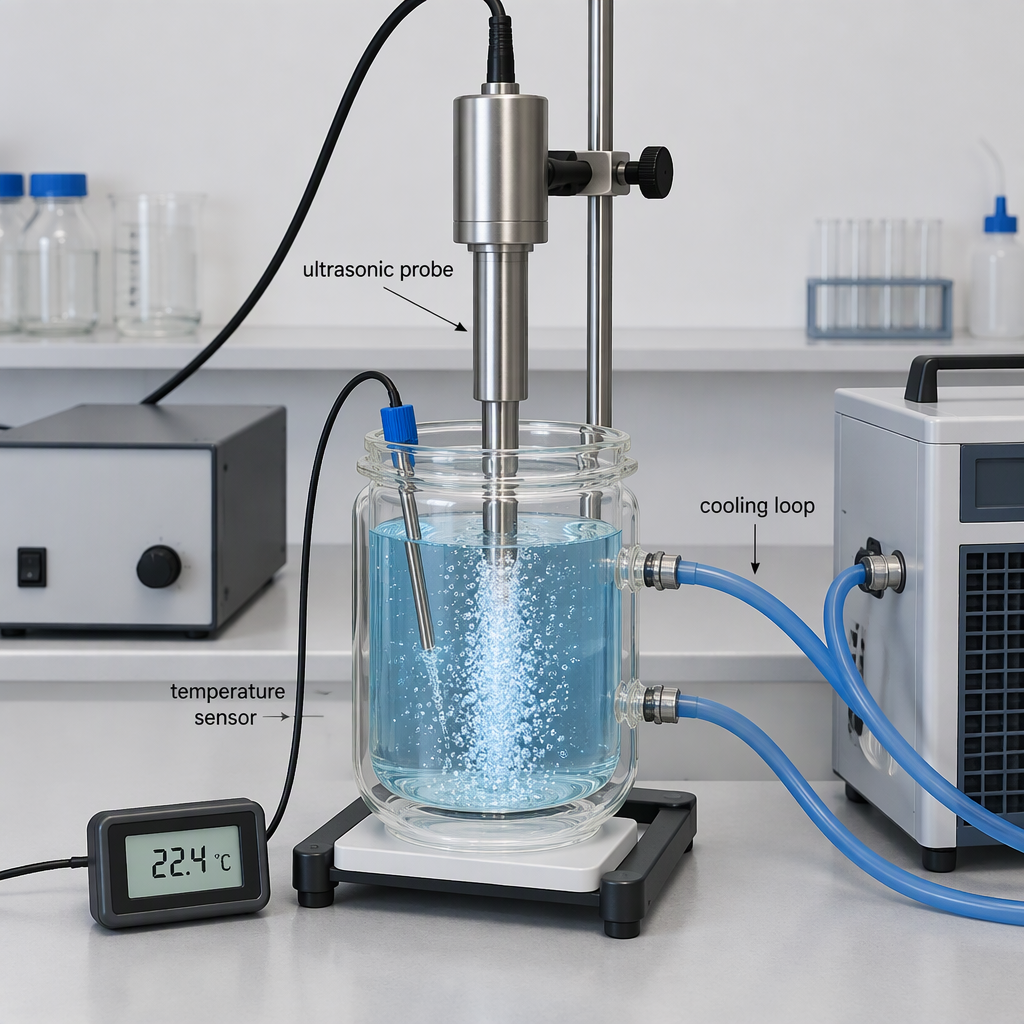
Why Temperature Control Matters in Ultrasonic Liquid Processing
Temperature matters because high-intensity ultrasonic liquid processing can create a meaningful bulk temperature rise, so the measured thermal history should be treated as part of the process condition rather than as a background detail.
A practical guide to acoustic power determination and heat management in high-intensity ultrasound describes thermal effects, pulsed operation, ice-bath cooling, thermosonication, and the need to report thermal histories when interpreting energy delivery in liquid systems; readers can review the academic discussion in Unraveling the Thermal Effects of High-Intensity Ultrasound.
For heat-sensitive liquids, temperature control helps separate the intended ultrasonic effect from heating that may change viscosity, reaction behavior, product quality, microbial inactivation interpretation, or the apparent result of an R&D trial.
For process engineers and equipment integrators, the practical question is not whether the bath, probe, or flow cell can be fitted with cooling hardware. The practical question is whether the selected configuration keeps the liquid within the thermal window needed for the application while still delivering the intended acoustic exposure.
What Drives Temperature Rise During Sonication?
Temperature rise is driven by how ultrasonic energy couples into the liquid, how cavitation develops, and how quickly the system removes or retains heat.
In liquids, ultrasonic waves can produce acoustic cavitation: bubbles grow and collapse, and the behavior depends on conditions such as frequency, acoustic pressure, liquid properties, and gas or vapor behavior, as explained in Ultrasonics and sonochemistry: Editors’ perspective.
- Acoustic input creates local effects. Cavitation events concentrate energy at small scales, while the measured process temperature reflects the combined bulk response of the liquid and vessel.
- Exposure time accumulates heat. Longer sonication periods can produce greater thermal history unless heat removal is sufficient.
- Duty cycle changes the balance. Pulsed operation gives the system intervals for heat dissipation and can be selected when continuous input overheats the sample.
- Cooling changes the boundary condition. Ice baths, circulating jackets, or other heat-exchange methods may reduce bulk temperature rise, but they do not replace temperature measurement in the processed liquid.
Because ultrasonic processing temperature depends on both energy delivery and heat removal, two runs with the same nominal time can behave differently if liquid volume, vessel geometry, probe placement, cooling method, or duty cycle changes.
What to Record Before Comparing Ultrasonic Runs
Before comparing ultrasonic runs, record the temperature history together with the sonication conditions, because temperature alone or power alone is not enough to explain the process outcome.
- Initial liquid temperature and measured temperature over the run, including the location and timing of the measurement.
- Sonication mode, including continuous or pulsed operation and the selected duty cycle.
- Exposure time, liquid volume, vessel type, and whether the setup is batch or flow-through.
- Cooling method, such as ice bath, jacketed vessel, recirculating coolant, or no external cooling.
- Acoustic power or the method used to estimate acoustic energy delivery when that measurement is part of the protocol.
- Process intent: temperature minimization, controlled heating, mixing, extraction, dispersion, microbial reduction, or another application-specific target.
This record allows an R&D team to identify whether a result came from ultrasonic exposure under a stable temperature strategy, from uncontrolled heat accumulation, or from an intentional thermal-ultrasonic combination.
How to Select a Temperature-Control Method
Select the control method by asking whether heating is unwanted, tolerable, or intentionally part of the process; then match the sonication mode and cooling approach to that answer.
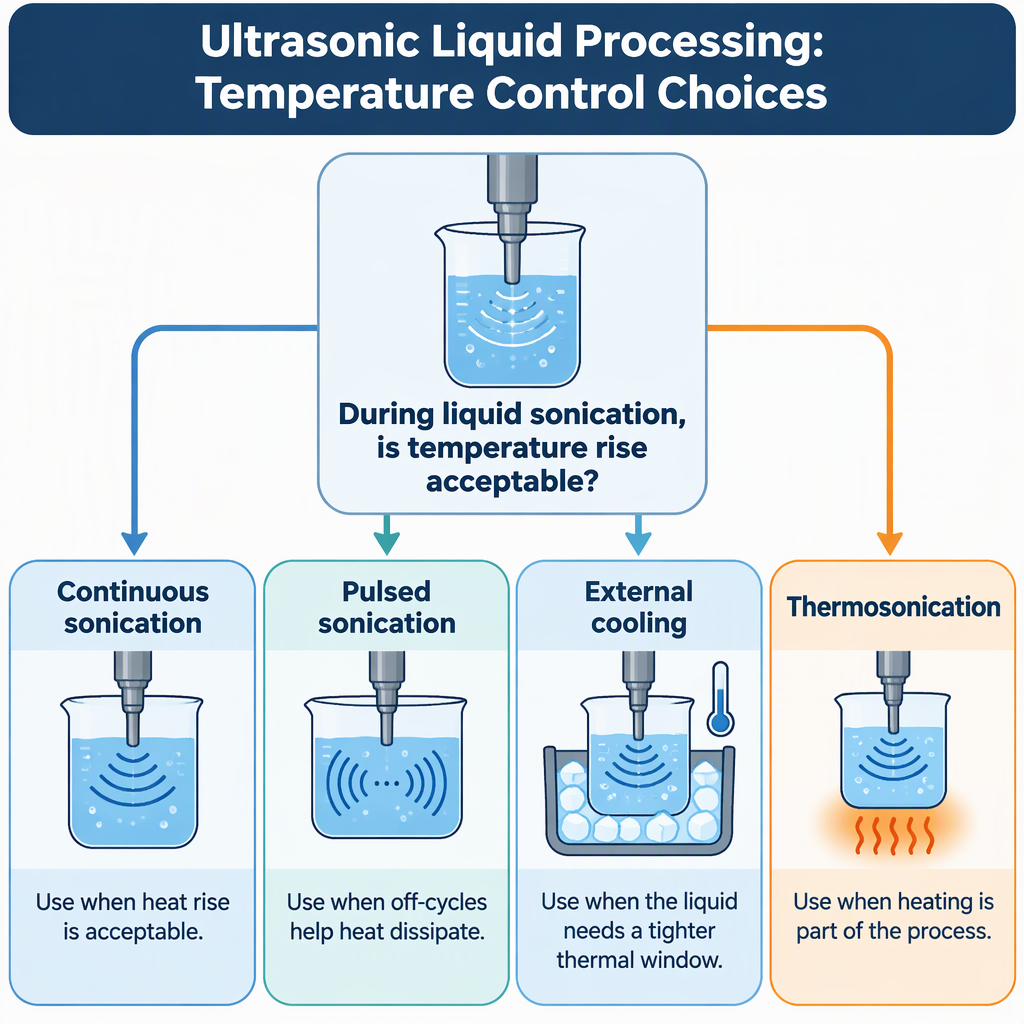
| Process condition | Likely control choice | Buyer check |
|---|---|---|
| The liquid is heat-sensitive and the target is mainly ultrasonic exposure. | Consider pulsed sonication and active cooling. | Confirm that the actual measured liquid temperature stays inside the application window. |
| Moderate heat rise is acceptable during the run. | Continuous sonication may be practical if monitoring shows acceptable thermal history. | Compare final and time-resolved temperature, not only nominal run time. |
| Heating is part of the desired process effect. | Thermosonication may be the appropriate design route. | Define both the ultrasonic exposure and the temperature profile as process variables. |
| The setup must transfer from bench testing to integration. | Specify monitoring points, cooling capacity, and duty-cycle logic during design review. | Ask the equipment supplier how temperature is measured, logged, and controlled for the intended vessel or flow path. |
| Method | Best fit | Main limitation |
|---|---|---|
| Continuous sonication | Useful when heat rise is acceptable or controlled by system design. | Can accumulate heat if exposure time and heat removal are not balanced. |
| Pulsed sonication | Useful when off-cycles are needed to manage thermal rise. | Requires duty-cycle documentation before comparing runs. |
| External cooling | Useful when the liquid must remain within a tighter temperature window. | Cooling hardware alone does not prove the sample stayed at the intended temperature. |
| Thermosonication | Useful when ultrasound and controlled heat are deliberately combined. | The temperature profile must be reported as an intended process variable. |
Monitoring and Verification Checklist
Verify the strategy by measuring the liquid temperature during the run, documenting the thermal history, and checking that cooling or pulsing performs under the actual load.
- Measure temperature at a location that represents the processed liquid, and define whether the value is point, average, inlet, outlet, or final temperature.
- Log temperature over time for development work, especially when comparing continuous and pulsed sonication.
- Run a control test with the selected cooling method before assuming that an ice bath or circulating loop is sufficient.
- Document the duty cycle, total exposure time, and any pause intervals used for heat dissipation.
- For integrated equipment, define how the control system responds when temperature approaches the process limit.
- When manual access to powered processing equipment is required for cleaning, clearing, probe adjustment, or inspection, switch off and disconnect the relevant power source before access, and follow only the access steps permitted by the model manual.
A cooling accessory should be treated as a heat-management tool, not as proof of temperature control. The proof is the measured temperature history under the selected liquid volume, exposure time, duty cycle, and heat-removal condition.
Applicability Boundaries for This Guidance
Use this guidance for process selection and documentation, but set final limits from the liquid, product objective, equipment configuration, and supplier documentation for the specific application.
There is no universal temperature setpoint for every ultrasonic liquid process; the appropriate control target depends on the material, desired effect, exposure time, acoustic energy delivery, and whether heat is harmful, acceptable, or desired.
- For R&D screening, prioritize measured thermal history so that promising conditions can be repeated and compared.
- For equipment integration, specify temperature sensing, logging, cooling, and duty-cycle behavior as part of the process requirement.
- For mechanism discussions, remember that cavitation depends on liquid and acoustic conditions, so a change in formulation or operating condition can change the thermal response.
- For procurement, ask suppliers for application-specific documentation instead of assuming that a generic ultrasonic processor configuration provides adequate temperature control.
Conclusion
The best temperature-control choice is the one that makes the ultrasonic process repeatable for the intended liquid: measure the thermal history, decide whether heat must be limited or used, and document the sonication mode, cooling method, and control response before scaling or integrating equipment.
Because cavitation behavior depends on liquid and acoustic conditions, teams should treat temperature control as part of the application design rather than as a final hardware add-on.
FAQs About Ultrasonic Processing Temperature
These questions help engineering teams turn ultrasonic processing temperature control into a practical selection and documentation checklist.
Does ultrasonic processing count as nonthermal processing?
It can be discussed as a nonthermal technique in some applications, but high-intensity ultrasonic processing can still produce significant thermal history. Treat the measured temperature profile as part of the process condition.
Is pulsed sonication always better than continuous sonication?
No. Pulsed sonication is useful when heat dissipation during off-cycles helps maintain the target thermal window, while continuous sonication may be suitable when heat rise is acceptable or controlled.
Can an ice bath prove that the liquid stayed cold enough?
No. An ice bath can support heat removal, but the processed liquid still needs temperature measurement because actual thermal history depends on energy input, exposure time, liquid volume, and heat transfer.
What should equipment integrators specify for temperature control?
Specify where temperature is measured, how it is logged, what cooling method is used, how duty cycle is controlled, and what the system should do when temperature approaches the application limit.
Why can two ultrasonic runs with the same time have different temperatures?
They can differ because liquid volume, vessel geometry, sonication mode, cooling condition, acoustic power delivery, and measurement location can change the balance between energy input and heat removal.
When is thermosonication the right choice?
Thermosonication is appropriate when controlled heat and ultrasonic exposure are intentionally combined. In that case, the temperature profile should be defined and reported as a planned process variable.
What is the safest next step before choosing a processor?
Define the liquid, target temperature window, exposure time, sonication mode, monitoring method, and cooling requirement, then ask the supplier for documentation that matches that exact application.