
Before ultrasonic flow cell selection, specify the process window first: target residence time, flow-rate range, feed concentration, ultrasound power or amplitude range, temperature-control method, and the validation outputs needed for scale-up. For wet-chemical nanoparticle and MOF-type work, also treat fouling or clogging as a scale-up risk to test, not as an afterthought.
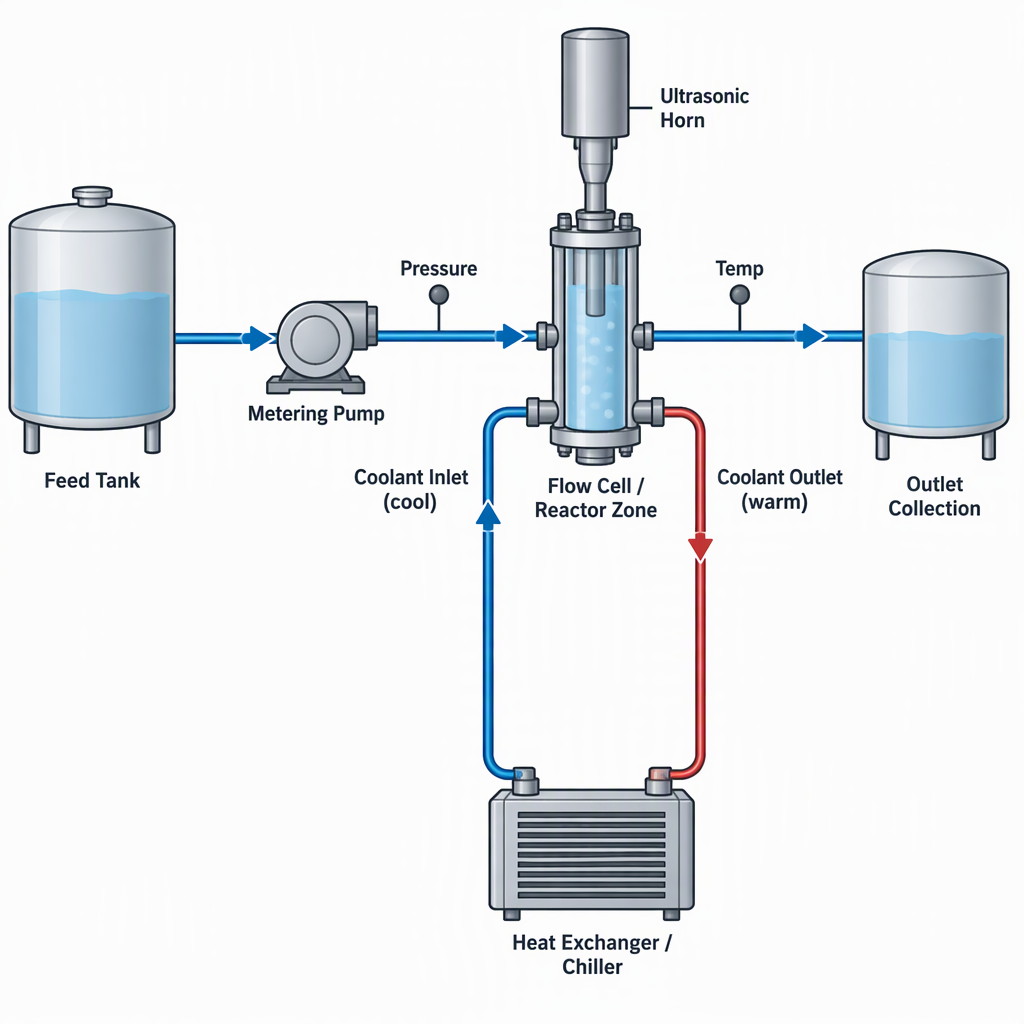
Why flow-cell selection must start before scale-up
A flow cell is not only a larger vessel around a sonicator; it changes mixing, heat removal, residence time, and fouling behavior, so selection should begin while the scale-up window is still being defined.
A Communications Chemistry study on ultrasound-assisted continuous aqueous MOF synthesis describes the combination of continuous-flow heat and mass-transfer advantages with sonochemical effects such as mixing and nucleation. The same research context identifies fouling and clogging as practical scale-up concerns in wet-chemical nanoparticle synthesis.
For procurement validation, start by writing the operating envelope you need the flow cell to hold. If the process still depends on trial settings from a beaker test, supplier discussions can become a search for wattage or chamber volume instead of a controlled scale-up design.
Specify the process window before choosing a cell
Define the variables the cell must control or tolerate: residence time, flow rate, reaction temperature, feed concentration, ultrasound input, flow configuration, and fouling response.
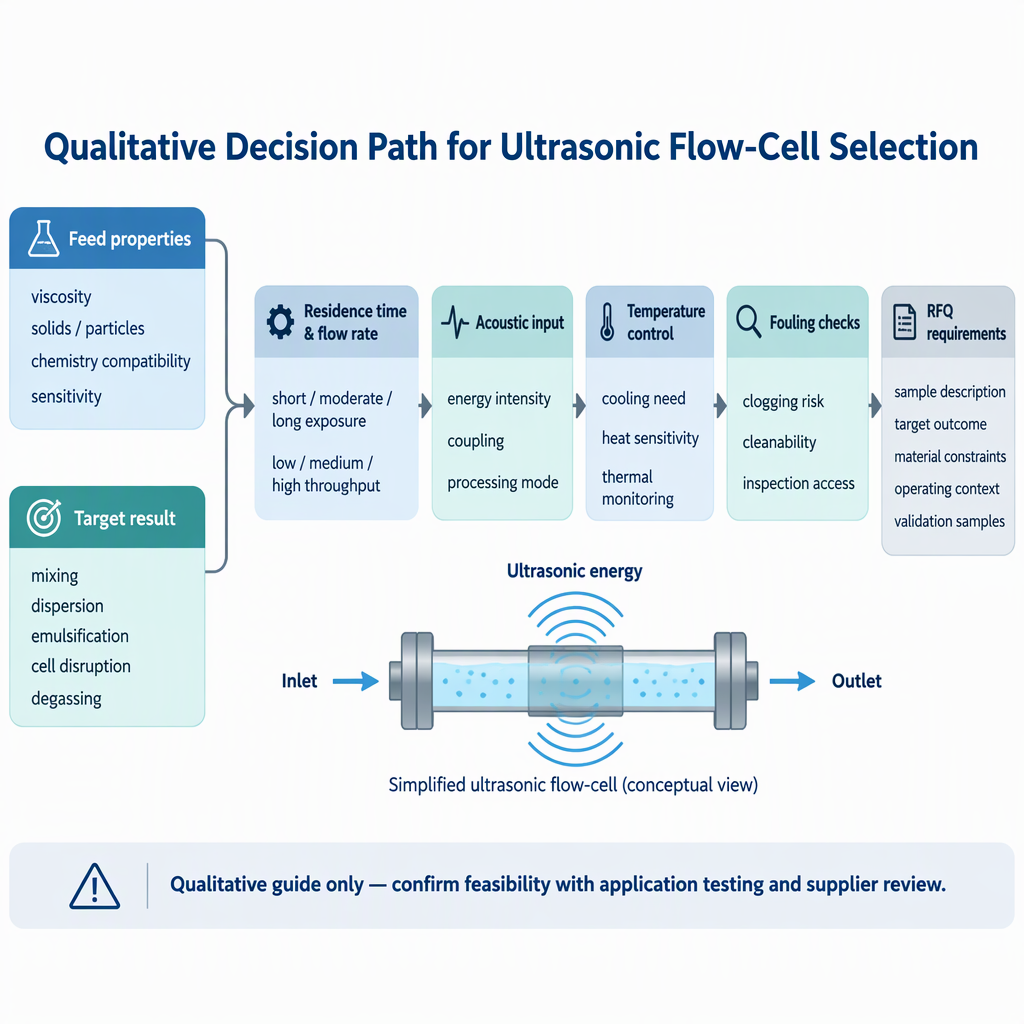
| Specification item | What to define before supplier review | Why it matters |
|---|---|---|
| Residence time | Set a target residence-time range and connect it to the expected flow-rate range rather than asking for flow rate alone. | The cited continuous-reactor study varied reaction time and residence time, so the cell choice should preserve the process exposure you intend to test. |
| Temperature control | Specify whether the setup needs active temperature control, cooling capacity, temperature monitoring, or a controlled jacket around the reaction zone. | The study reports a second-generation reactor with dynamic temperature control, making thermal management a scale-up variable rather than a cosmetic accessory. |
| Ultrasound input | Ask how ultrasound power or amplitude is adjusted, measured, limited, and recorded during continuous operation. | The study varied ultrasound power, so acoustic input should be part of the process record instead of a single fixed assumption. |
| Feed concentration and phase behavior | Define precursor or solids concentration, whether gas or a second phase is intentionally present, and how phase behavior affects pumping. | The reactor work varied precursor concentration and used two-phase flow to address clogging in its own research domain. |
| Hydraulic limits | Ask the supplier for documented flow-rate and pressure limits for the exact cell, fittings, and pump arrangement under review. | Supplier-practice guidance treats flow rate, residence time, and pressure limits as operating constraints that should be observed for flow-cell use. |
For a technical RFQ, the most useful output is a process-window sheet that links each requested cell feature to a variable you will validate: residence time, temperature, acoustic input, concentration, flow mode, fouling response, and sample collection points.
Translate batch sonication into continuous parameters
Convert a batch sonication recipe into continuous requirements by translating exposure time into residence time, sample volume into flow rate, vessel cooling into in-line thermal control, and visible settling or fouling into feed-preparation and clogging tests.
- Record the lab recipe as variables, not as a final equipment size: concentration, temperature, sonication time, acoustic setting, observed solids, and target product attributes.
- Choose a trial residence-time range and calculate the corresponding flow-rate range for the expected cell volume; then verify that the pump and cell can operate inside documented limits.
- Translate batch cooling into continuous heat removal: define acceptable inlet, outlet, and cell-zone temperature behavior during steady operation.
- Test fouling and clogging risk with the actual feed or a representative formulation, especially when particles form during reaction.
- Plan sample points and acceptance criteria before scale-up so the team can compare single-pass, recirculating, or staged operation using the same outcome measures.
| Batch question | Continuous-flow specification | Buyer check |
|---|---|---|
| How long is the liquid exposed? | Residence-time range | Can the pump and cell hold that range without exceeding flow or pressure limits? |
| How is heat removed from the vessel? | In-line or jacketed temperature-control method | Can temperature be monitored and controlled during steady operation? |
| Does product or feed accumulate on surfaces? | Fouling and cleaning-risk assessment | Can the process run long enough to expose blockage behavior before committing to scale-up? |
Define flow-cell and integration constraints
Ask for cell-specific hydraulic, thermal, feed-preparation, and duty-cycle limits before selecting a flow cell, because these limits depend on the supplier’s design and the operating setup.
- Document acceptable flow-rate and pressure ranges for the cell, fittings, tubing, seals, and pump combination.
- Confirm feed preparation expectations, including whether the liquid should be pre-mixed and whether air entrainment must be avoided during pumping.
- Ask how viscosity affects run time, volume, amplitude range, and heat generation for the specific equipment under review.
- Define the temperature-control method, such as pulsed operation, jacketed cooling, or external cooling, only where the supplier confirms compatibility.
- Ask whether converter or transducer cooling is required under the planned duty cycle and ambient conditions.
- Clarify whether the intended mode is single pass, recirculation, or staged processing, and ask how each mode affects residence time and sample interpretation.
- Request material-contact information for the wetted parts, seals, and fittings, then compare it with your solvent, pH, solids, cleaning method, and contamination limits.
Plan validation before committing to scale-up
Before scale-up purchasing, run validation that connects the selected cell to repeatable temperature behavior, residence time, acoustic input, fouling behavior, and product-quality outputs.
- Set a design-of-experiments matrix for the variables you can control: residence time, temperature, concentration, and ultrasound input.
- Run enough continuous operation to observe steady-state behavior, not only start-up samples.
- Track pressure change, visual deposits, flow interruption, or product buildup as fouling indicators when particles or precipitates form.
- Compare output samples against the same acceptance criteria used in the lab recipe, such as conversion target, dispersion target, particle attribute, or downstream filtration behavior.
- Record the operating settings in a format that procurement can place in the RFQ, including residence time, flow rate, temperature range, acoustic setting, and flow configuration.
| Validation result | What it means for selection | Next buyer action |
|---|---|---|
| Stable temperature and target residence time | The candidate setup may be suitable for deeper supplier review. | Ask the supplier to document the same controls and measurement points. |
| Fouling appears during continuous operation | Cell geometry, feed preparation, flow mode, or cleaning strategy may need revision. | Test an alternative flow configuration before increasing scale. |
| Output changes when ultrasound input changes | Acoustic input is a process variable that must be controlled and recorded. | Specify adjustment range and logging expectations in the RFQ. |
The continuous-reactor study supports treating residence time, reaction temperature, precursor concentration, ultrasound power, and flow configuration as variables to validate. For procurement, that means the supplier review should ask how the candidate cell lets you set, monitor, and repeat those variables.
RFQ checklist before supplier review
A useful RFQ for ultrasonic flow-cell selection should describe the process window, integration limits, validation plan, and documentation requirements instead of asking only for a nominal cell volume or generator wattage.
- Process target: product attribute, reaction or dispersion goal, feed concentration, and acceptance criteria.
- Operating window: residence-time range, flow-rate range, temperature range, ultrasound power or amplitude adjustment, and sampling points.
- Hydraulic envelope: pump type, maximum pressure, minimum and maximum flow, tubing size, fittings, and recirculation or single-pass mode.
- Thermal plan: cooling method, temperature monitoring locations, expected duty cycle, and any converter-cooling requirement.
- Fouling plan: expected solids, precipitation risk, filter strategy, run-duration target, and safe inspection method.
- Feed handling: pre-mixing approach, air-avoidance method, degassing needs if applicable, and hold-tank agitation.
- Supplier documentation: wetted materials, seal compatibility, pressure and flow limits, recommended cleaning procedure, maintenance boundaries, and operating manual.
Conclusion
The safest selection path is to specify the process first, then select the flow cell that can be tested inside that process window.
- Residence time, temperature, concentration, ultrasound input, and flow configuration should be defined before supplier comparison.
- Fouling and clogging risk should be validated during continuous operation when solids or particles may form.
- Supplier review should document hydraulic limits, feed handling, pressure boundaries, and operating mode for the exact configuration.
FAQs about ultrasonic flow-cell selection
Can one universal amplitude or ultrasound-power setting be recommended?
No. Treat ultrasound power or amplitude as a variable to validate against your chemistry, residence time, temperature behavior, and target product outcome.
Can viscous or temperature-sensitive liquids use an ultrasonic flow cell?
They may be candidates, but viscosity and heat rise can change run time, amplitude range, volume handling, and cooling needs. Ask the supplier to confirm limits for the exact liquid and equipment configuration.
Should I choose a flow cell by chamber volume?
Chamber volume is only useful after you connect it to residence time, flow rate, acoustic input, and temperature control. A larger chamber alone does not define scale-up behavior.
Is recirculation better than single-pass flow?
Neither mode is automatically better. Recirculation can increase cumulative exposure, while single pass can simplify residence-time interpretation; ask the supplier how each mode affects your process window.
What if the process forms particles during sonication?
Plan a fouling test before scale-up. Track deposits, pressure change, flow interruption, and product buildup long enough to expose blockage behavior.
What documentation should be requested before purchase?
Request operating limits, pressure and flow boundaries, wetted materials, fittings, cooling options, cleaning guidance, and permitted maintenance actions for the exact cell and generator combination.
Can a batch recipe be scaled by matching wattage?
No. Batch-to-flow translation should include residence time, temperature control, feed concentration, ultrasound input, and flow configuration, not wattage alone.