Yield-led trial
A yield-led trial may identify conditions that recover more material, but it can miss changes in composition or function if quality assays are treated as secondary notes.

Views: 0 Author: Site Editor Publish Time: 2026-11-17 Origin: Site
Design an ultrasonic extraction trial around a decision, not a promised yield number: define the target compound or function, measure both yield and product quality, and move to structured DOE only after practical factor ranges are screened. Published botanical extraction work shows that variables such as liquid-to-solid ratio, ethanol concentration, extraction time, and temperature can materially affect flavonoid yield within the tested system.
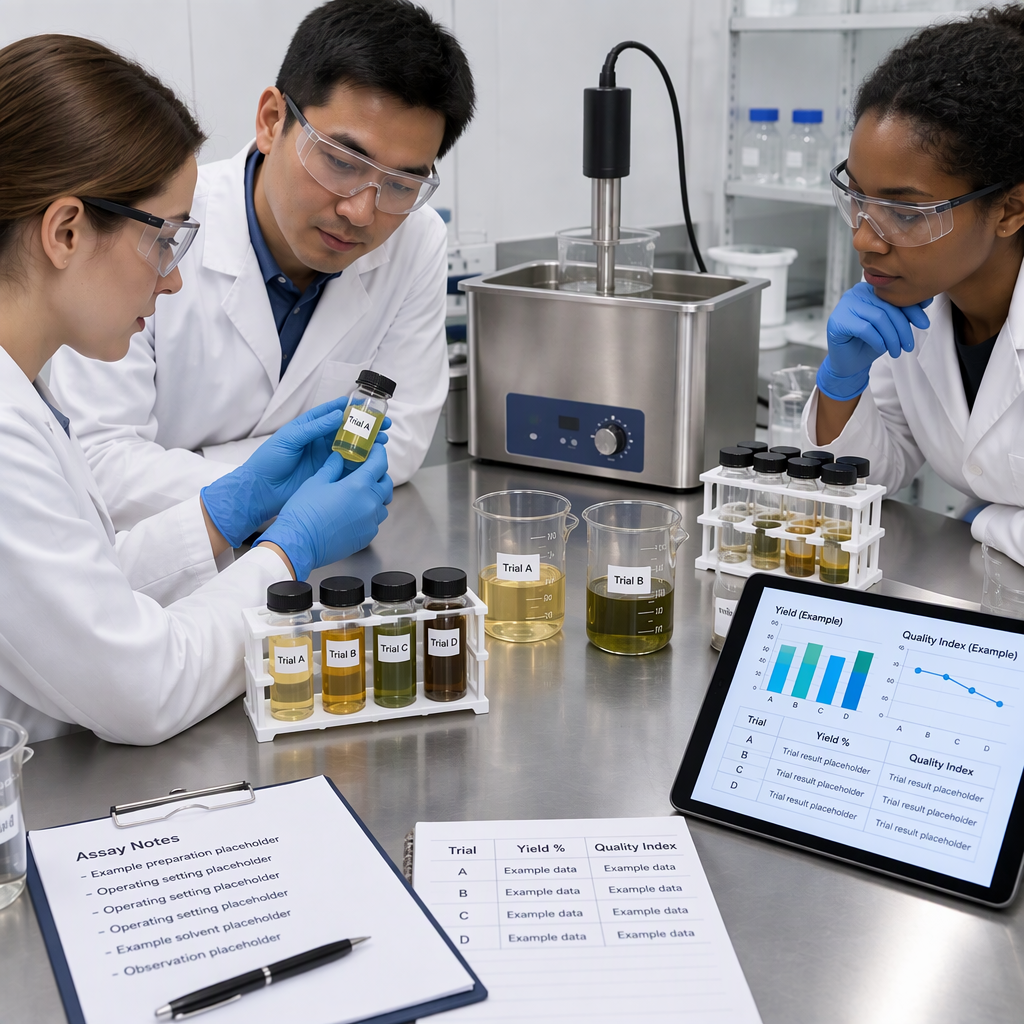
The trial should treat yield and product quality as linked responses, because a higher extract mass is not useful if the extract misses the target chemistry, activity, or specification.
A peer-reviewed ultrasonic-assisted extraction study on Clinacanthus nutans evaluated ultrasonic frequency and solvent ratio against total phenolic content, DPPH activity, and FRAP antioxidant capacity, showing how one trial can pair extraction output with quality-related assays in a defined botanical system.
| Response type | What it answers | How to use it in the trial |
|---|---|---|
| Yield or recovered extract | Whether the process extracts enough material to justify further work. | Report it alongside quality assays, not as the only success measure. |
| Target compounds, such as phenolic content where relevant | Whether the desired chemistry is actually present in the extract. | Make it a co-primary response when the product value depends on composition. |
| Functional assays, such as antioxidant measures in suitable botanical work | Whether the extract retains the function the product requires. | Use validated assay methods and keep the same method across all runs. |
| Process-response behavior over time | Whether longer extraction continues to help or begins to reduce performance. | Include time as a tested factor instead of assuming that longer exposure is always better. |
The PLOS One ultrasonic-assisted extraction study is a useful example of pairing extraction variables with phenolic and antioxidant responses. Treat it as a trial-design example for a botanical system, not as a universal performance promise for every feedstock.
Screen the variables most likely to change yield or quality before optimization, then narrow the ranges to settings that are feasible, measurable, and safe for the material.
For botanical ultrasonic extraction, published work identifies temperature, extraction duration, solid-to-liquid ratio, and solvent type as factors that can affect yield and bioactivity within the studied system.
Another ultrasonic-assisted extraction study used single-factor tests before a Box-Behnken response surface design, evaluating liquid-to-solid ratio, ethanol concentration, extraction time, and temperature for total flavonoids from Zanthoxylum bungeanum residue.
| Factor | Why include it | Boundary for the first trial |
|---|---|---|
| Solvent system or concentration | Solvent choice can affect the compounds recovered and the product-quality profile. | Use only solvent systems that fit the product, lab controls, and downstream requirements. |
| Liquid-to-solid ratio | It changes mass transfer conditions and can influence flavonoid yield in the tested biomass context. | Set a range the lab can reproduce accurately and that can be discussed later for scale-up. |
| Extraction time | Time helps define extraction kinetics and whether the process has reached a useful plateau. | Include enough time points to see direction, but avoid assuming maximum time is best. |
| Temperature | Temperature can materially affect yield in the tested system. | Keep the range compatible with product stability and solvent handling requirements. |
| Ultrasonic frequency, when adjustable | The PLOS One study evaluated ultrasonic frequency as part of its trial design. | Record the actual setting and equipment configuration so results are interpretable. |
Do not copy a published optimum into a new material. Use literature to select candidate factors, then run a feedstock-specific screen because the cited studies support their own botanical systems rather than universal ultrasonic extraction settings.
Move from screening to DOE or response surface methodology when the team has defined responses, practical factor ranges, and a reason to model interactions or curvature rather than changing one variable at a time.
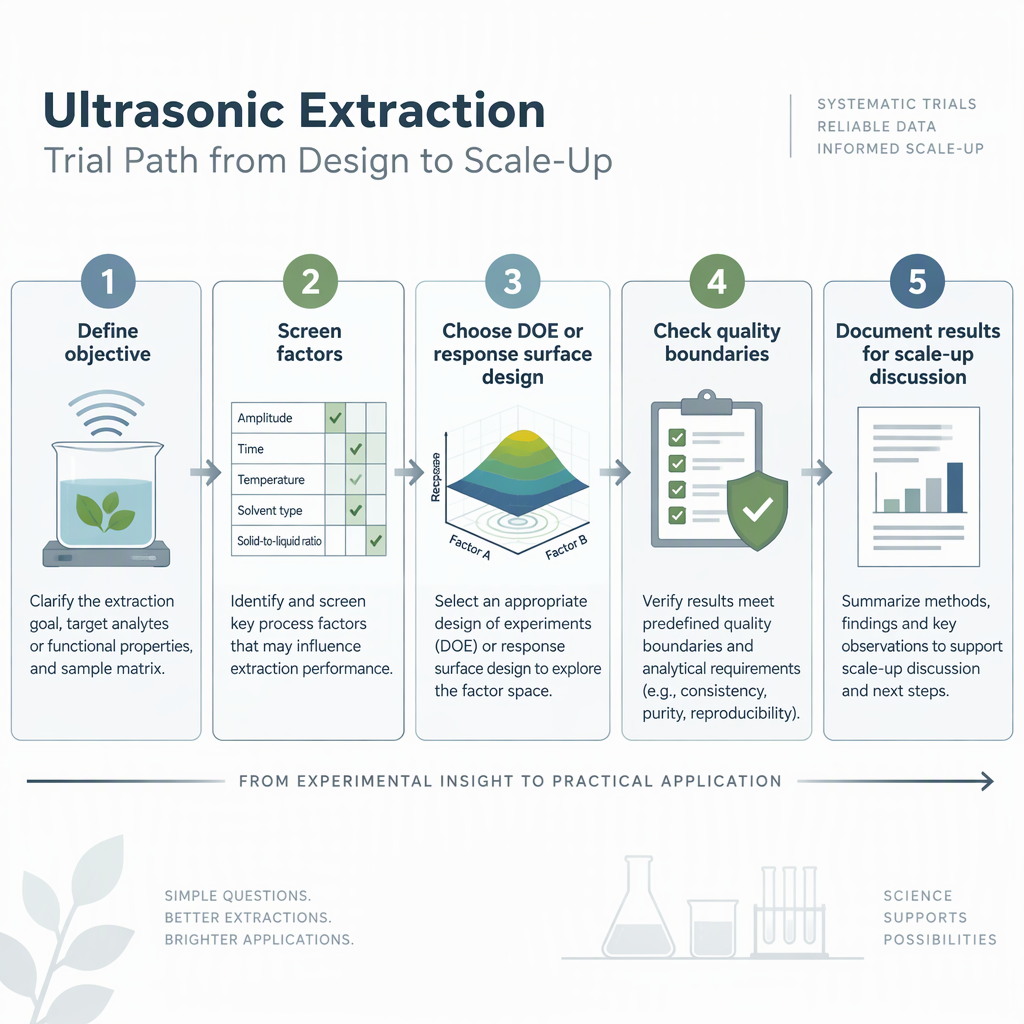
The NIST/SEMATECH Engineering Statistics Handbook section on response surface designs explains that response surface designs model main effects, interactions, and curvature, while classical options such as central composite and Box-Behnken designs are used for fitting response surfaces.
Set quality boundaries before optimization, because the best extraction condition is the one that meets the product objective, not necessarily the condition that gives the largest single yield number.
A yield-led trial may identify conditions that recover more material, but it can miss changes in composition or function if quality assays are treated as secondary notes.
A quality-bounded trial defines target chemistry or activity measures beside yield, so a candidate setting must satisfy both recovery and product-relevant performance.
In the Frontiers study context, extraction time could show an increase-then-decrease behavior, which is a practical reminder that longer or more intensive processing should be tested rather than assumed to improve every response.
If the extract will be used in a regulated food, cosmetic, pharmaceutical, or medical application, the trial plan should be reviewed against the current requirements for that product and jurisdiction. This planning guide does not replace regulatory, medical, or legal review.
A useful ultrasonic extraction trial record connects every result to the feedstock, factor settings, response methods, and DOE structure so equipment and scale-up discussions are based on comparable evidence.
The trial should make one decision possible: which factor window deserves the next engineering step because it balances yield, quality responses, and practical operating limits.
Most trial questions come back to the same point: make the extraction condition prove both recovery and product fitness for the specific feedstock.
The first decision is the response set: define the yield measure and the product-quality measure that will decide whether the trial condition is useful.
Yield can be a primary response, but it should be paired with composition or function measures when product value depends on chemistry or activity.
Common screening candidates include liquid-to-solid ratio, solvent concentration or type, extraction time, and temperature, with ultrasonic settings recorded when adjustable.
Response surface methodology is appropriate after the team has chosen factor ranges and needs to model interactions or curvature rather than only compare isolated settings.
Longer time is not automatically better; in one tested system, extraction time showed an increase-then-decrease behavior, so time should be tested against quality boundaries.
No. Published studies can guide factor selection, but each feedstock and product objective needs its own trial because the evidence applies to the studied system.
Ask for the DOE matrix, response methods, factor ranges, raw results, and the quality limits used to accept or reject the operating window.