

Define the application boundary: material, part, joint, and acceptance target
Describe the parts before describing the machine: ultrasonic welding outcomes depend on the thermoplastic, part geometry, joint design, and whether the weld is treated as near-field or far-field.
- Name the material family and grade when known, and state whether samples, drawings, and molded parts can be supplied for evaluation.
- Attach joint drawings that show the intended contact surfaces, because projection-style and shear-style joint concepts create different RFQ questions.
- Identify whether the weld zone is close to or distant from the horn contact area, since near-field and far-field welding considerations affect feasibility discussions.
- Define the acceptance target in buyer language: strength, leak tightness, appearance, dimensional stability, cycle objective, or another inspection criterion.
- Ask the supplier to state which part-design details must change before process trials, rather than accepting a machine quote that assumes the present design is already weldable.
Ask for parameter logic, not unsupported universal settings
Your RFQ should ask the supplier to explain how amplitude, welding mode, downspeed, trigger pressure, weld time, and hold time will be selected or validated for the specific application.
- Start with the application data package: material, part drawing, joint concept, sample availability, and the inspection method that will decide pass or fail.
- Ask the supplier to identify the process variables that need trials, including amplitude, weld mode, downspeed, trigger pressure, weld time, and hold time.
- Request the proposed validation route: sample welds, parameter window development, destructive or functional testing, visual checks, and final acceptance reporting.
- Require the response to separate fixed equipment configuration from adjustable process settings, so your team can see what is engineered into the system and what remains process-development work.
For ultrasonic plastic welding, the RFQ should not treat one parameter value as universal. The relevant process questions include amplitude and welding mode as well as pressure, timing, and hold conditions; those questions only become meaningful when tied to the actual material and joint.
Separate purchaser inputs from supplier engineering responses
A clear RFQ separates what your team must provide from what the supplier must confirm, so the quote can be evaluated as an engineering proposal rather than a generic equipment offer.
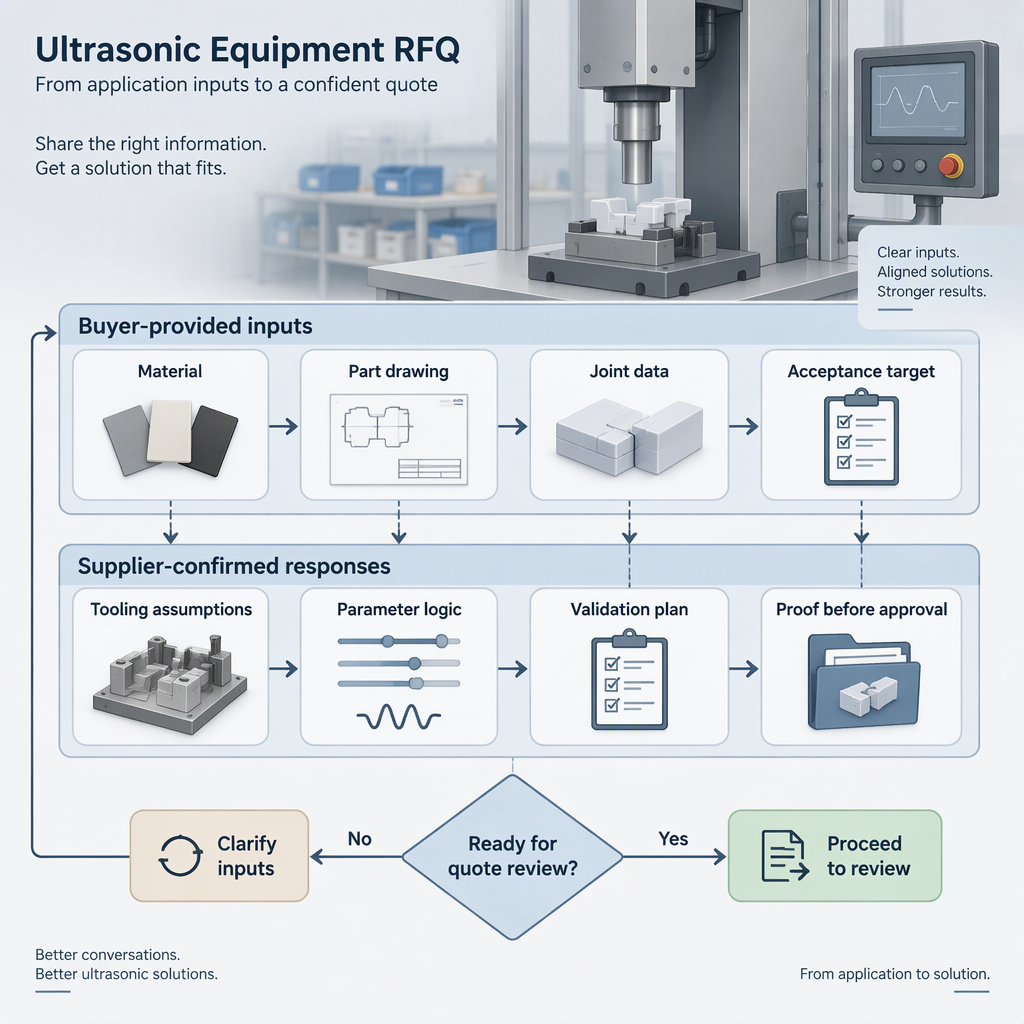
| RFQ area | Buyer supplies | Supplier confirms |
|---|---|---|
| Material and molded part data | Resin details, part drawings, sample quantity, and known molding constraints | Whether the material and part condition are suitable for trials and what information is missing |
| Joint and tooling concept | Joint drawings, contact surfaces, cosmetic limits, and allowed design changes | Recommended joint approach, horn-contact assumptions, and tooling questions before manufacture |
| Process development | Acceptance targets and test method | Parameter-development plan covering amplitude, weld mode, pressure, timing, and hold conditions |
| Purchase decision | Required documentation format and approval gates | Which results will be delivered before order placement and which will require later commissioning or trials |
Include safety, noise, and site-readiness questions
Include noise and site-readiness questions in the RFQ because workplace exposure needs measurement and controls, not assumptions based on equipment category alone.
- Ask what sound measurement information the supplier can provide for the proposed equipment, tooling, enclosure, and expected operating condition.
- Plan for on-site confirmation using appropriate measurement methods after installation, because actual exposure depends on the workplace layout and operating pattern.
- Ask whether sound level meters, dosimetry, or noise mapping are appropriate for your approval process; NIOSH noise guidance describes these measurement approaches for workplace exposure planning.
- Require the supplier response to identify noise-control options or enclosure assumptions when the process may contribute to operator exposure.
- Coordinate hearing-loss prevention planning with your environmental, health, and safety team before final acceptance.
NIOSH identifies repeated workplace noise exposure at 85 dBA or higher as hazardous and states a recommended exposure limit of 85 dBA over an eight-hour shift. Use that as a planning trigger for measurement and prevention discussions, while confirming the legal and site-specific requirements that apply to your facility.
Mark assumptions that require evidence before purchase approval
Do not let an RFQ convert assumptions into purchase facts; mark every unsupported setting, compliance statement, noise expectation, and performance outcome as something the supplier must verify or document.
| Do not assume | Ask for instead | Why it matters |
|---|---|---|
| A generic machine quote proves weldability | Application review, sample plan, and acceptance criteria | Material, joint design, and process settings affect ultrasonic weld outcomes. |
| Exact parameters can be specified before trials | Parameter-development logic and trial documentation | Amplitude, mode, pressure, timing, and hold conditions are application-specific RFQ topics. |
| Noise risk is resolved by the equipment name | Measurement plan, expected controls, and site verification | Workplace exposure depends on measured levels, duration, layout, and prevention controls. |
| Certifications, delivery dates, prices, and service coverage are implied | Supplier documents that state the exact scope offered | Procurement approval should rely on written, current supplier commitments rather than assumptions. |
Final ultrasonic equipment RFQ checklist
Before sending the RFQ, check that it lets suppliers respond with application-specific engineering evidence, not only a model name and price.
- Part drawings, material details, molded sample status, and joint-design information are included.
- Acceptance targets are written in measurable terms, such as strength, leak performance, appearance, dimension, or inspection method.
- The RFQ asks for parameter logic covering amplitude, welding mode, downspeed, trigger pressure, weld time, and hold time.
- The response template separates buyer-supplied data from supplier-confirmed tooling, trial, and validation responsibilities.
- The site-readiness section asks how noise exposure will be measured, mapped, controlled, and reviewed with the facility safety team.
- The commercial section asks for current written evidence of any certifications, service scope, warranty terms, delivery dates, and exclusions before purchase approval.
Conclusion
A strong ultrasonic equipment RFQ is an engineering filter: it defines the application, requests parameter-development logic, and reserves purchase approval for claims that are documented for the exact project.
For process engineers, R&D teams, and equipment integrators, the most useful RFQ does not ask for a universal ultrasonic solution. It asks the supplier to connect material, joint, tooling, and process choices to the buyer’s acceptance target.
It also treats site readiness, especially noise exposure, as part of procurement verification rather than a late installation issue.
FAQs about ultrasonic equipment RFQs
Use these questions to pressure-test the RFQ before it goes to suppliers or internal approval.
Can an RFQ state exact amplitude, frequency, pressure, weld-time, or power settings for all custom ultrasonic applications?
No. The RFQ can ask the supplier to define and validate parameter logic, but universal settings are not supported for every material, joint, and acceptance target.
What should be attached to the RFQ if prototype parts are available?
Attach drawings, material information, sample quantities, inspection targets, and any known molding or dimensional constraints that could affect welding trials.
Should the RFQ ask for joint-design feedback?
Yes. Joint design is central to ultrasonic plastic welding discussions, so the supplier should identify whether the proposed joint concept supports the acceptance target or needs revision.
How can buyers compare responses from different suppliers?
Compare whether each response explains the same engineering items: application assumptions, tooling concept, parameter-development method, validation plan, and unresolved risks.
Is workplace noise only an installation issue?
No. Noise exposure planning belongs in the RFQ because measurement methods, noise mapping, dosimetry, and prevention controls may affect site readiness and acceptance.
Can certification or compliance claims be accepted if they are implied by the supplier?
No. Ask for current written documents that identify the exact equipment, scope, market, and standard or regulation claimed.
What should integrators clarify when the ultrasonic unit is part of a larger automated cell?
Clarify which party owns part presentation, tooling interfaces, process settings, validation samples, and acceptance documentation, because weld performance depends on the application conditions as well as the ultrasonic equipment.