

Define the Repeatability Boundary Before the First Trial
A repeatable ultrasonic trial record should define what is being repeated, which measurement conditions are being held the same, and which changed conditions would move the comparison toward reproducibility rather than repeatability.
NIST TN 1297 terminology defines repeatability as agreement between successive measurements of the same measurand under the same measurement conditions, including the same procedure, observer, measuring instrument, location, and a short time period.
The same terminology distinguishes reproducibility as agreement when conditions change, and it says the changed conditions should be specified.
For ultrasonic process trials, that means the record should not stop at amplitude, time, or energy fields; it should also preserve the measurement setup, operator context, run grouping, and conditions that affect whether later results can be pooled or compared.
Do not label a comparison as repeatable unless the record shows which conditions stayed the same. If a fixture, instrument, operator, measurement method, or timing window changed, name that change before interpreting the result.
Record the Ultrasonic Parameters That Can Change the Trial
Capture the ultrasonic parameters that define the weld cycle and actuator behavior, then add a field for the exact mode used so engineers do not compare unlike trials.
| Parameter field | What to record | Why it matters in the trial sheet |
|---|---|---|
| Vibration amplitude | The amplitude setting or program value used for the trial | Amplitude is identified as an ultrasonic welding parameter, so it belongs in the controlled-setting portion of the record. |
| Welding mode | The selected mode, such as time mode or energy mode | Mode changes how the weld cycle is controlled and how results should be interpreted. |
| Downspeed and trigger pressure | The actuator approach condition and the trigger pressure used to start the weld event | These fields describe how the process is initiated and applied to the part during the trial. |
| Weld time and hold time | The programmed weld duration and post-weld hold duration | Both are named process parameters and should be available when comparing cycle records. |
Use these parameter categories as a recording framework, not as recommended setpoints. Exact amplitude, pressure, time, or energy values depend on the material, joint, tooling, equipment, and application being tested.
Build a Trial Sheet Around Factors, Responses, and Context
A useful trial sheet separates deliberate process factors from measured response variables and from uncontrolled or contextual conditions that may explain variation.
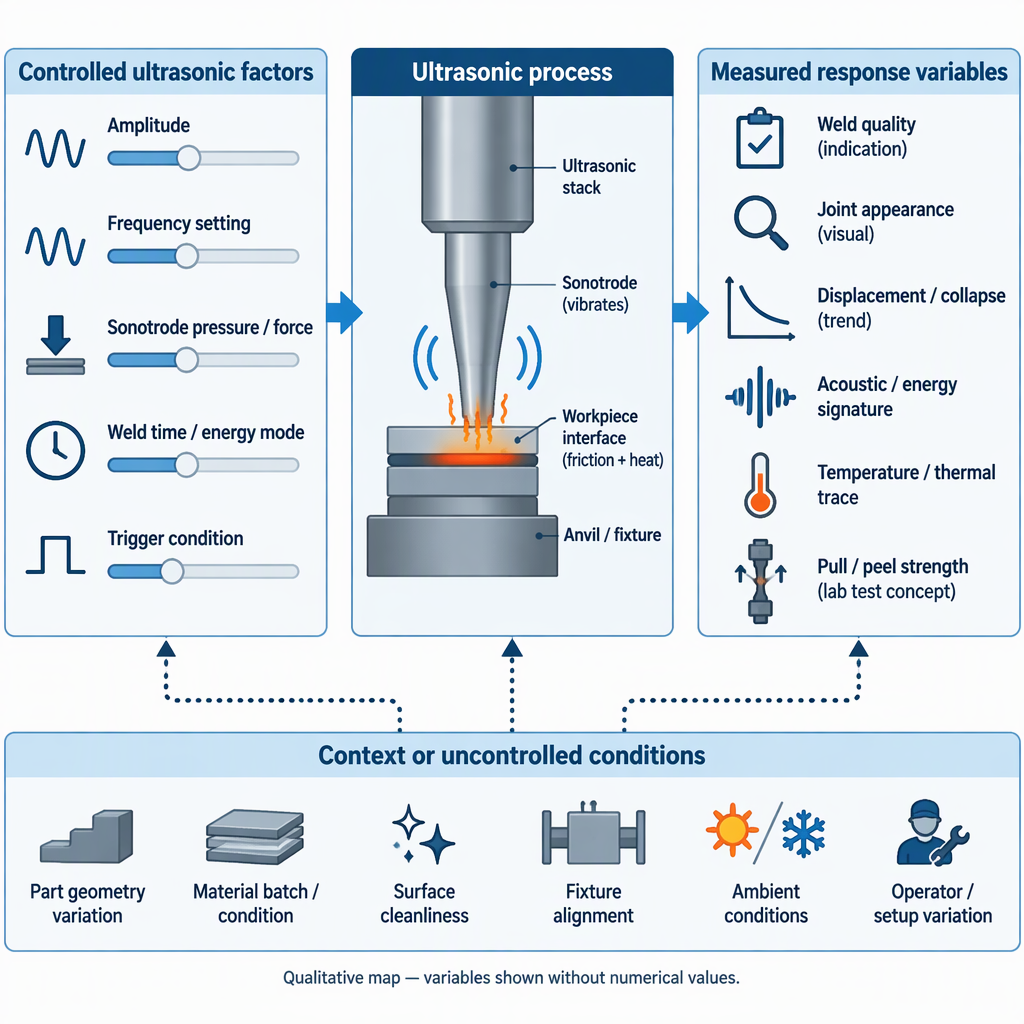
Experimental design begins with objectives, selected process factors, and response variables, then considers controlled and uncontrolled factors such as machines, operators, ambient temperature, and humidity.
- State the trial objective in one sentence, such as screening a parameter window, comparing tooling conditions, or checking whether a changed factor affects a measured response.
- List the controlled ultrasonic process parameters that the team intends to set deliberately for each run.
- Define the response variables before testing, so every run records the same output measures rather than selectively reporting convenient results.
- Create context fields for machine, operator, environment, material batch, part version, fixture, tooling condition, and other uncontrolled factors relevant to the application.
- Assign a run identifier and sequence number so later analysis can separate planned changes from order effects or day-to-day context changes.
- Controlled factors are fields the team intentionally changes or holds constant.
- Response variables are measured outcomes used to judge the trial.
- Context fields capture conditions that may not be controlled but should be visible during comparison.
Add Measurement-System Fields, Not Just Machine Settings
Record the measurement system behind each result because repeatability analysis can depend on gauges, operators, runs, days, and check standards, not only on the ultrasonic machine settings.
- Record the measuring instrument or gauge used for each response variable.
- Record the observer or operator when human reading, placement, or judgement affects the measurement.
- Record the run, day, or time grouping so repeated measurements are not mixed without context.
- Record any check standard, reference part, or verification condition used to judge whether the measurement process was stable enough for comparison.
The NIST Engineering Statistics Handbook section on analysis of repeatability explains that repeatability standard deviations can depend on gauge, operator, runs, days, and check standards.
It also explains that pooling repeatability estimates can be appropriate only when the conditions justify that treatment.
For an ultrasonic trial record, this reinforces a practical rule: preserve enough measurement-condition detail to show whether repeated results were collected under the same measurement conditions.
Document Weld Mode So Trial Results Are Interpreted Correctly
Time mode and energy mode should be documented differently because one records a programmed time basis while the other depends on feedback to reach an energy target.
| Weld mode | Record these fields | Interpretation caution |
|---|---|---|
| Time mode | Programmed weld time, amplitude, trigger pressure, downspeed, hold time, and measured responses | Time mode is described as open-loop, so the same programmed time does not by itself prove the same delivered effect in every weld. |
| Energy mode | Energy target, amplitude, trigger pressure, downspeed, hold time, actual cycle data, and measured responses | Energy mode is described as closed-loop feedback, but delivered energy and losses still require interpretation between welds. |
Avoid comparing a time-mode trial directly with an energy-mode trial unless the record clearly identifies the mode, the controlled settings, and the response measures used to judge the outcome.
Review the Record Before Drawing Process Conclusions
Before choosing a parameter direction, check that the record separates planned factor changes from measurement variation and uncontrolled context changes.
- Confirm that repeated measurements were made under the same stated measurement conditions before calling the comparison repeatable.
- If conditions changed, describe them as changed conditions rather than hiding them inside a single repeatability claim.
- Check whether gauge, operator, day, run, or check-standard differences could affect the repeatability estimate.
- Confirm that each planned process factor and each response variable appears in every relevant run record.
- Use the NIST Engineering Statistics Handbook overview of experimental design as a reminder to separate controlled factors from uncontrolled conditions when planning comparisons.
- Repeatability is a boundary around same-condition measurement, not a general promise that a process will always behave the same.
- A trial sheet is stronger when it records factors, responses, and context in separate fields.
- Ultrasonic mode selection affects how process records should be interpreted.
Conclusion
The next step is to convert the trial sheet into a controlled team habit: define the objective, record the ultrasonic settings, capture measured responses, and keep the measurement and context fields complete for every run.
When the same-condition boundary is visible, process engineers, R&D teams, and equipment integrators can compare repeated ultrasonic trials with fewer hidden assumptions.
When the mode and parameter fields are visible, later reviewers can tell whether they are comparing similar weld cycles or different control approaches.
FAQs About Recording Ultrasonic Process Parameters
These questions help teams turn ultrasonic process parameter recording into a practical selection and trial-comparison method.
What ultrasonic process parameters should be on the trial sheet?
Include the ultrasonic welding parameters that define the cycle, such as vibration amplitude, welding mode, downspeed, trigger pressure, weld time, and hold time.
What is the difference between repeatability and reproducibility in trial records?
Repeatability applies to successive measurements under the same measurement conditions, while reproducibility applies when changed conditions are involved and those changed conditions need to be specified.
Why record the weld mode separately from the setpoint values?
Mode affects interpretation because time mode is described as open-loop, while energy mode is described as closed-loop feedback with delivered energy and losses still requiring interpretation.
Which context fields are useful for process engineers and R&D teams?
Useful context fields include machine, operator, ambient temperature, humidity, material batch, fixture, tooling condition, and other uncontrolled factors that may affect the response variables.
Why does the measurement system belong in an ultrasonic trial record?
Repeatability analysis can depend on gauge, operator, runs, days, and check standards, so the measurement system must be visible before results are pooled or compared.
Can one recording template recommend exact amplitude, pressure, time, or energy values?
No. A template can ensure the right categories are recorded, but exact values must be selected for the material, joint, tooling, equipment, and application being tested.
What should be checked before comparing two ultrasonic trials?
Check that the same-condition boundary is clear; if procedure, observer, instrument, location, timing, or other measurement conditions changed, record those changes before drawing a process conclusion.