Tooling contact
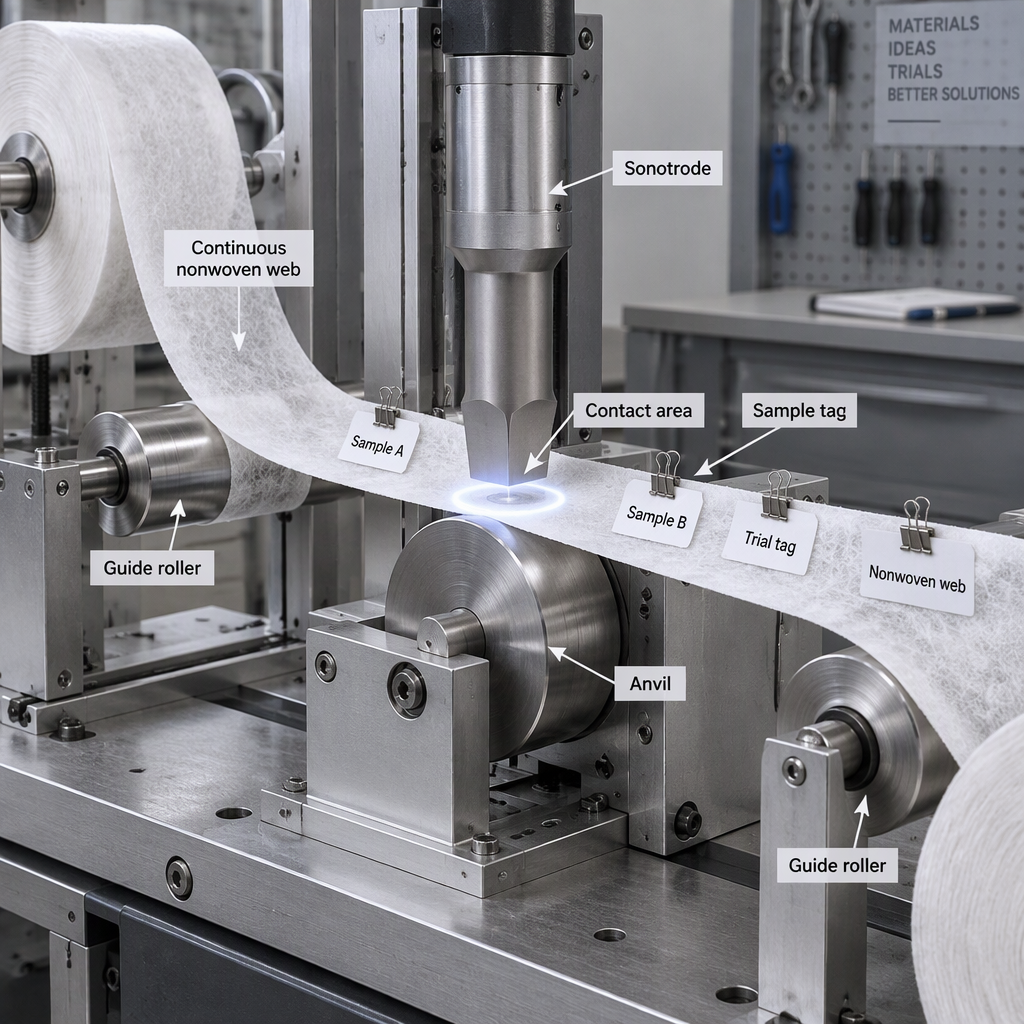
Continuous systems are commonly described around the sonotrode, rotating anvil drum, and tooling gap.
Ask how the trial setup will represent the intended web path, contact width, and allowable compression.

Views: 0 Author: Site Editor Publish Time: 2026-11-18 Origin: Site
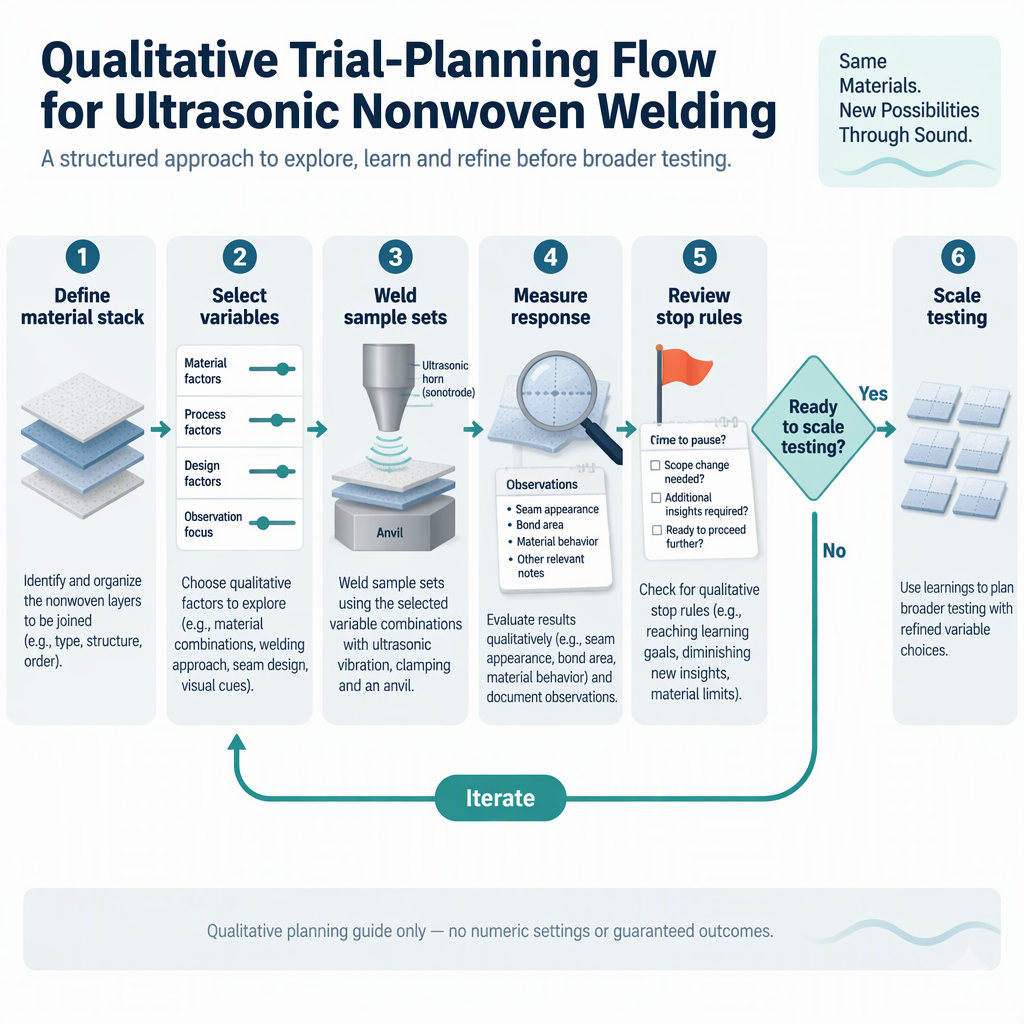
Plan continuous ultrasonic nonwoven welding as a controlled material trial before equipment selection: define the material stack, choose a small set of process variables, measure the bond response, and use stop rules before scaling the process.
A material stack is a practical candidate for ultrasonic nonwoven welding trials only when the team can test how the actual layers respond under controlled weld settings instead of assuming a universal machine recipe.
In a polypropylene nonwoven welding study, welding time, welding pressure, and weld-zone shape were treated as variables affecting breaking strength, which makes those factors useful starting points for structured trials.
Start by holding the material stack constant and varying a short list of process factors, because uncontrolled material and process changes make weld results hard to interpret.
| Trial variable | Why it matters | How to use it in early trials |
|---|---|---|
| Welding time | The polypropylene nonwoven study evaluated welding time as a factor affecting breaking strength. | Screen a limited range agreed by the lab or supplier rather than chasing a single setting on the first pass. |
| Welding pressure | The same study evaluated welding pressure as a process variable. | Change pressure independently from time so the team can see whether bond strength, damage, or appearance shifts. |
| Weld-zone shape | The study included weld-zone shape when assessing breaking-strength response. | Compare candidate seam or pattern geometries only after the basic material response is understood. |
A useful trial matrix changes one planned factor at a time where possible, records the material response, and keeps enough samples to explain both acceptable and failed welds.
| Trial stage | Buyer decision | Do not over-interpret |
|---|---|---|
| Screening | Can the stack form a repeatable bond window? | Do not claim production readiness from a few attractive samples. |
| Refinement | Which variable range looks stable enough for more testing? | Do not treat one material lot as proof for all future lots. |
| Pre-integration | Which tooling and handling questions must be answered on a continuous line? | Do not specify final speed, width, or tooling life without project data. |
Record measurements that match the product’s job: breaking strength may be central for structural seams, while appearance, leakage, permeability, elasticity, or softness may matter for other nonwoven applications.
Select current test methods with your quality team, customer, or notified laboratory. If a nonwoven standard is required for the project, confirm the exact edition, scope, specimen preparation, and reporting format before trials begin.
| Measurement area | When to include it | Planning note |
|---|---|---|
| Breaking strength | Include it when seam strength or bond durability is a primary requirement. | Keep specimen preparation and pull direction consistent across conditions. |
| Visual and tactile review | Include it when the product cannot tolerate holes, hard spots, visible marking, or edge distortion. | Photograph retained samples under the same lighting and label them clearly. |
| Application-specific checks | Include them when the welded zone affects filtration, hygiene, liquid handling, stretch, or comfort. | Use criteria supplied by the product owner or customer rather than generic pass/fail language. |
Continuous ultrasonic nonwoven bonding requires trial results to be translated into web handling, tooling contact, and application-mode decisions before line selection.
Continuous systems are commonly described around the sonotrode, rotating anvil drum, and tooling gap.
Ask how the trial setup will represent the intended web path, contact width, and allowable compression.
Nonwoven ultrasonic bonding may be discussed for longitudinal sealing, cross sealing, laminating, embossing, perforating, cut-and-seal, and elastic-thread anchoring.
Match the trial pattern to the real product function instead of testing a convenient pattern that will not be used later.
Stop rules protect the project from scaling a weld that only works in a narrow or poorly understood condition.
If a trial requires threading, sample retrieval, jam clearing, or any manual access near powered ultrasonic equipment, switch off and disconnect the relevant power source before manual access, then follow the model manual’s permitted access points and guarding instructions.
A good trial brief turns an open-ended welding question into a controlled test plan with materials, variables, measurements, and decision rules.
Continuous ultrasonic welding for nonwovens should move from material fit, to controlled variables, to measured response, and only then to integration choices.
Engineers usually need answers about material fit, variables, measurement, integration, and when to stop a trial before selecting equipment.
Treat suitability as a trial result, not an assumption. Test the actual stack and record how it responds to controlled welding variables.
Welding time, welding pressure, and weld-zone shape are practical first variables because they were evaluated as factors affecting breaking strength in polypropylene nonwoven ultrasonic welding research.
Discuss it once early coupons show a plausible bond response, because the sonotrode, anvil drum, tooling gap, and application mode influence how a trial translates to a web process.
No. Breaking strength is important when seam strength is the target, but many nonwoven products also need application-specific checks such as appearance, softness, stretch, leakage, or filtration-related performance.
No. A trial brief can state target production needs, but final speed, width, tooling life, and production limits require project-specific equipment and material data.
Redesign the trial if repeated samples are inconsistent, if the material is damaged, if the measurement method is unclear, or if the coupon pattern does not represent the intended product function.
Send labelled material samples, layer order, target bond function, planned variables, measurement criteria, quality limits, and the questions that must be answered before equipment selection.