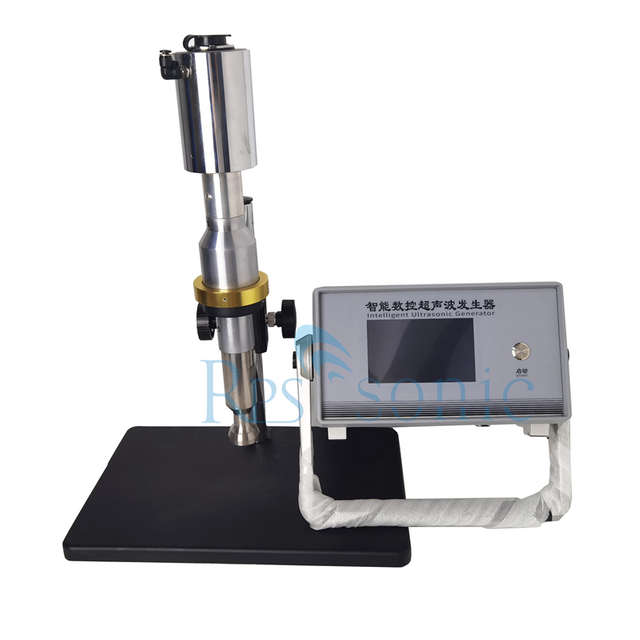
What Is Ultrasonic plant extraction?
Ultrasonic plant extraction is a green technology that utilizes the cavitation effect and other physical properties of ultrasound to efficiently extract active ingredients from plants. It is considered an advanced alternative to traditional thermal extraction methods (such as decoction and reflux), especially excelling in extracting heat-sensitive components.
Working Principle: The Physical Force of Cavitation Effect
The core of this technology lies in the ultrasonic cavitation effect. When ultrasound propagates in a liquid, it generates millions of tiny bubbles. These bubbles violently collapse instantaneously, releasing enormous energy and producing the following effects:
Cell Wall Breakage: The powerful shock waves and localized high temperatures (up to 5000K) and pressures (approximately 2000 atmospheres) generated by bubble collapse effectively disrupt plant cell walls.
Enhanced Solvent Penetration: With cell walls broken, solvents can more easily penetrate the cells, dissolving and releasing the target active ingredients.
Accelerated Mass Transfer: The mechanical vibration of ultrasound promotes the mixing and diffusion of the solvent and released components, significantly accelerating the extraction speed.
This process is typically carried out at room temperature or low temperature and is a purely physical process, effectively protecting heat-sensitive components from damage, which is one of the sources of its "green" designation.
Compared to traditional methods (such as Soxhlet extraction and steam distillation), ultrasound-assisted extraction has the following significant advantages:
characteristic | Ultrasound extraction performance |
High extraction efficiency | Compared with traditional methods, the extraction rate can be increased by 50% - 500% , and the extraction time is usually shortened by 50% - 80%. |
The time has been significantly reduced. | The optimal extraction rate can usually be achieved within 24 to 40 minutes. |
Temperature requirements are low. | The optimal extraction temperature is usually between 40 and 60 degrees Celsius, which is suitable for heat-sensitive components. |
wide range of application | Suitable for a wide range of plants and various active ingredients (such as flavonoids, polyphenols, essential oils, etc.). |
environmental protection and energy saving | Reducing the amount of organic solvents (typically by 30% to 50%) and energy consumption complies with the principles of green chemistry. |
easy and simple to handle | The equipment is relatively simple and easy to operate as well as to be controlled automatically. |
Application Areas
This technology is widely used in multiple industries for extracting various valuable plant active ingredients:
Natural Products and Traditional Chinese Medicine: Highly efficient extraction of flavonoids, polyphenols, saponins, alkaloids, polysaccharides, and other active ingredients for pharmaceutical and health product development.
Food Industry: Used for extracting tea polyphenols, natural pigments, fragrances, and functional food ingredients.
Cosmetics: Extraction of plant essential oils, antioxidants, etc., for the research and development of high-end skincare and cosmetic products.
⚙️ Ultrasonic Extraction Equipment
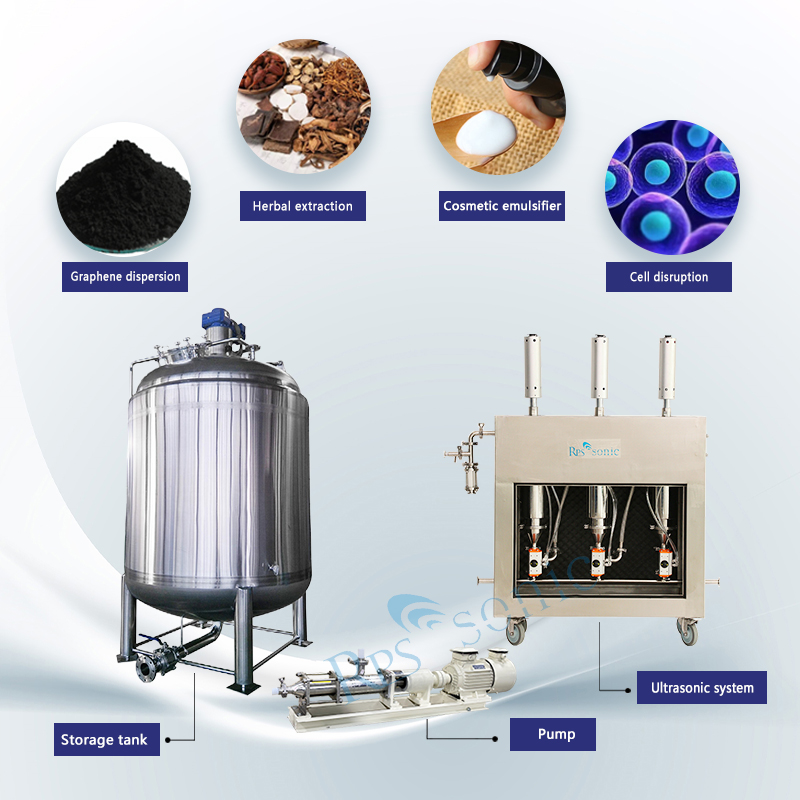
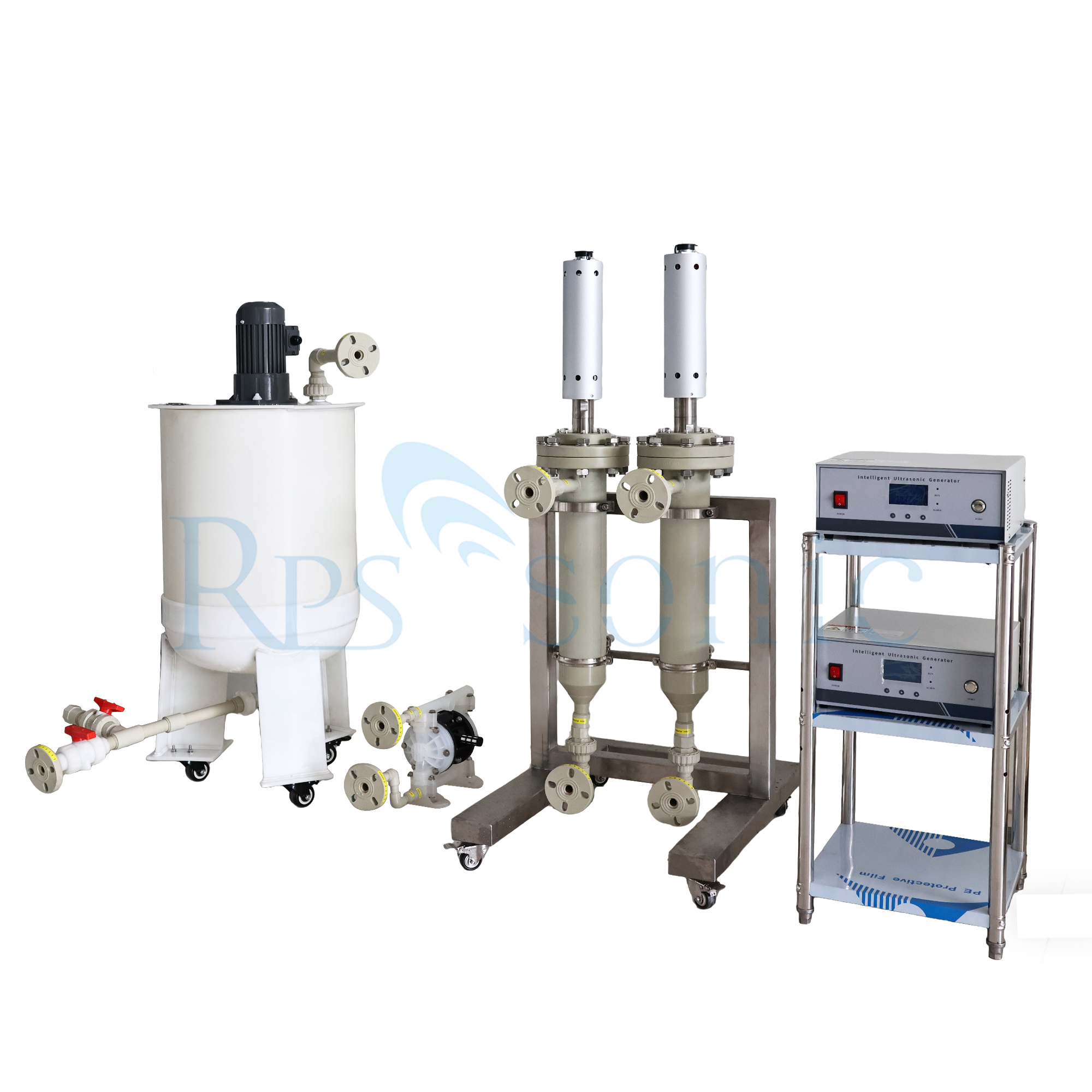
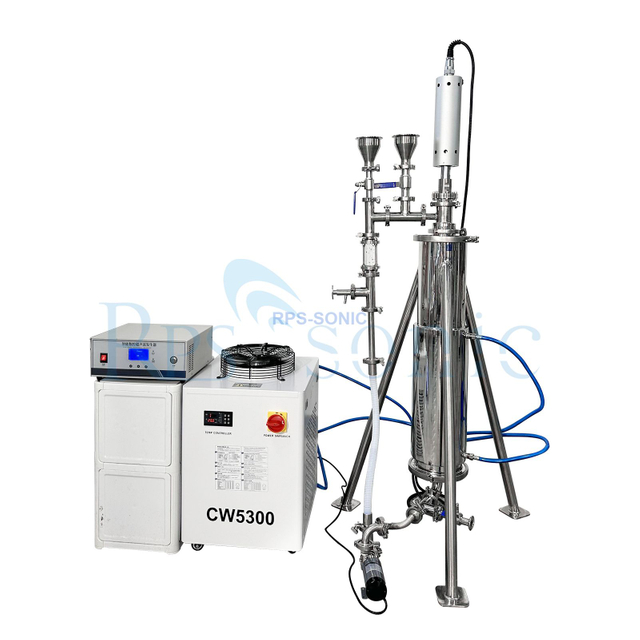
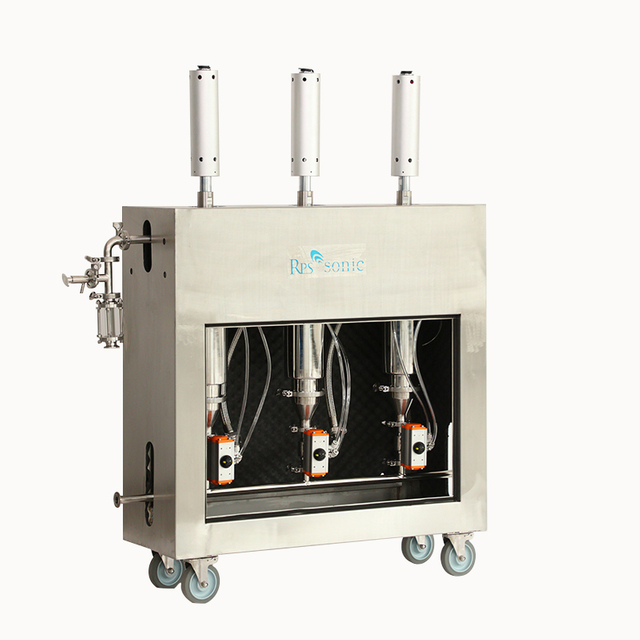
Currently, there are two main types of common ultrasonic equipment:
Probe-type (Focused) Ultrasonic Extractor: The ultrasonic probe is directly inserted into the extraction liquid, resulting in highly concentrated energy and extremely high power density (up to 20,000 W/L). Advantages include high efficiency, good repeatability, and suitability for processing small-volume samples; disadvantages include limited single-batch processing capacity (typically 5–500 mL), making large-scale scaling difficult.
Tank-type (Dispersion) Ultrasonic Cleaner: The extraction container is placed in an ultrasonic cleaning tank filled with water or a cleaning medium. While the energy distribution is uniform, the intensity is relatively low (typically 20–40 W/L). Advantages include simple equipment and suitability for processing large-volume samples; disadvantages include relatively low efficiency and potential variations in extraction results at different locations.
Challenges and Limitations
Despite its significant advantages, ultrasonic extraction technology faces several challenges in application:
Scaling up challenges: Maintaining consistent extraction results when scaling from laboratory to industrial production is crucial. Studies indicate that industrial equipment may require 2.5 times the ultrasonic power density to achieve laboratory results, placing higher demands on equipment design and cost control.
Uneven energy distribution: In large-scale equipment, the ultrasonic energy distribution may be uneven, potentially leading to incomplete extraction of some materials.
Potential for localized high temperatures: Prolonged high-power ultrasound can generate localized high temperatures, requiring strict parameter control to prevent damage to heat-sensitive components.
Noise issues: The equipment generates noise during operation, necessitating sound insulation measures for large-scale production.
Summary
In conclusion, ultrasonic-assisted extraction technology, with its high efficiency, low temperature operation, environmental friendliness, and wide applicability, has become a powerful tool for extracting high-value active ingredients from plants. Although challenges remain in industrial scale-up and equipment design, it will play an increasingly important role in future green and efficient plant extraction processes as research deepens and technology matures.