
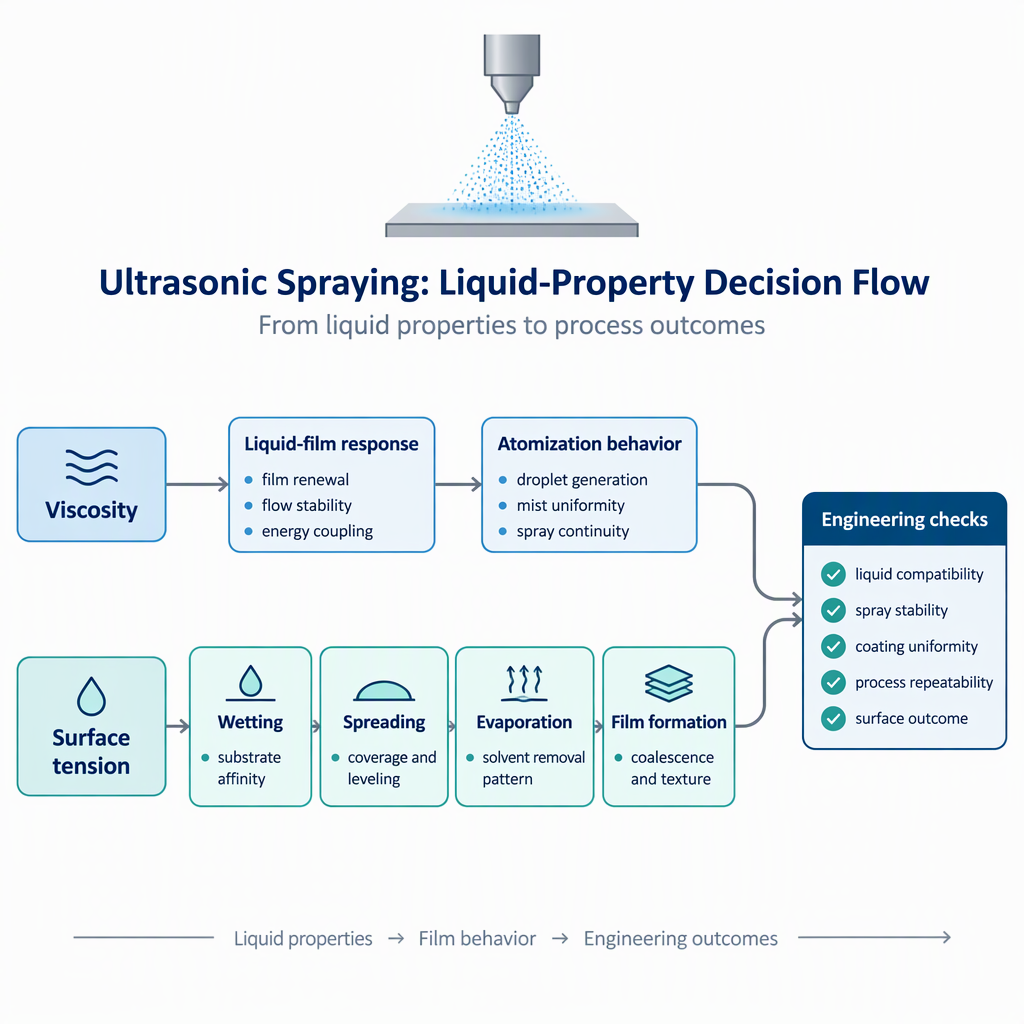
In ultrasonic spraying, viscosity and surface tension matter because liquid properties help determine how the liquid film responds to ultrasonic vibration and breaks into droplets, while surface tension and wettability also shape wetting, spreading, evaporation behavior, and film smoothness after deposition.
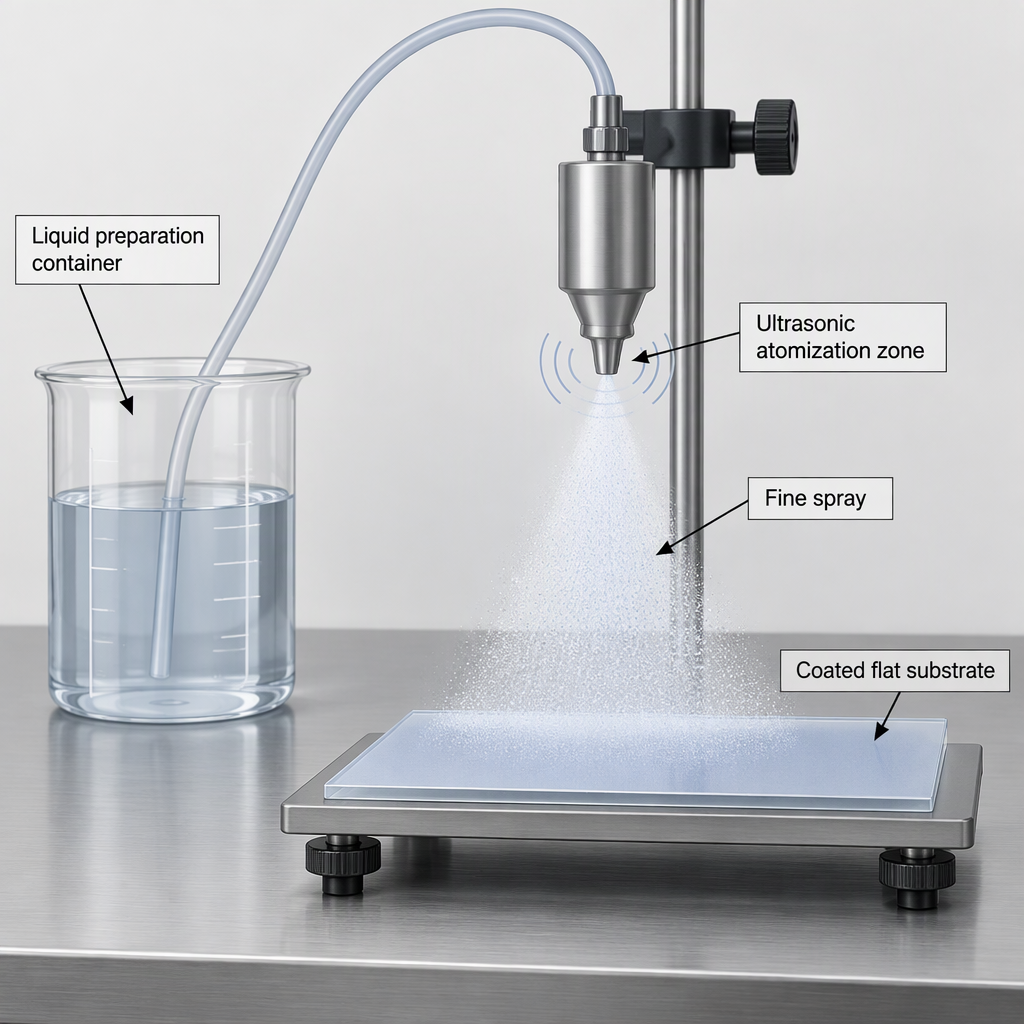
How liquid properties enter ultrasonic atomization
Liquid properties enter the process at the vibrating liquid film, where ultrasonic atomization depends on liquid film behavior, vibration amplitude, and capillary-wave-based droplet formation.
For engineers, this means ultrasonic spraying is not only a nozzle or generator setting problem. The same hardware setup can behave differently when the liquid formulation changes, because the liquid must form a stable film, respond to the acoustic excitation, and separate into droplets within the actual operating window.
A directly relevant ultrasonic atomization study hosted by the Eindhoven University of Technology research portal describes droplet formation in terms of liquid film thickness, vibration amplitude, and liquid-property effects.
Do not convert this mechanism into a universal numeric limit for every coating liquid. The study scope is ultrasonic atomization under its tested conditions, so process qualification still needs the actual formulation, substrate, flow condition, and target film requirement.
Why viscosity matters
Viscosity matters because it changes how the liquid resists deformation as the ultrasonic surface motion forms and sheds droplets.
In a practical ultrasonic spraying trial, viscosity should be treated as a formulation variable, not as an afterthought. A liquid with a different solvent ratio, polymer concentration, solids loading, or temperature may resist the film motion differently, which can alter the atomization behavior observed at the nozzle.
The ultrasonic atomization research record reports that viscosity affected droplet size distribution within the experimental scope. Use that finding to include viscosity in process screening, but set acceptance limits only after testing the specific liquid, nozzle configuration, and application requirement.
General atomization research outside ultrasonic spraying also treats viscosity as a variable that can influence atomized droplet size, but that evidence comes from a twin-fluid atomizer context rather than an ultrasonic nozzle.
Use non-ultrasonic atomization studies only as context. If the decision concerns an ultrasonic nozzle, confirm behavior by testing the exact liquid and setup rather than assuming that another atomizer type will predict the same response.
Why surface tension matters
Surface tension matters because it influences wetting-layer formation, spreading on the substrate, solvent evaporation behavior, and the smoothness of the resulting sprayed film.
For process engineers, surface tension connects the atomization step to the coating result. A spray that appears acceptable in the plume can still create poor coverage, edge effects, dewetting, or uneven film formation if the liquid does not wet the substrate appropriately.
In a peer-reviewed Scientific Reports study on ultrasonic spray coating for organic light-emitting-device films, low-surface-tension dilution and surface-tension control were used to support wetting-layer formation and smoother films in that material system.
Lower surface tension is not automatically better for every coating. The useful target depends on substrate energy, solvent system, drying path, solids or polymer behavior, and the film function being qualified.
Symptom-to-property map for process troubleshooting
When troubleshooting ultrasonic spraying, connect visible symptoms to both atomization behavior and post-deposition wetting before changing hardware settings.
| Observed issue | Liquid-property check | Reason to check it |
|---|---|---|
| Droplet distribution changes after a formulation adjustment | Review viscosity and the liquid film condition at the ultrasonic surface. | Ultrasonic droplet formation is affected by liquid film behavior and viscosity within the cited study scope. |
| Coating looks uneven although the spray plume appears stable | Review surface tension, wettability, and substrate preparation. | Surface tension and wettability can influence wetting-layer formation and final film smoothness. |
| Drying marks, roughness, or patchy coverage appear | Check solvent blend, evaporation path, and spreading behavior together. | The ultrasonic spray coating evidence links surface-tension control with wetting and evaporation behavior in film formation. |
| General atomization literature suggests a trend | Treat it as a hypothesis, then test with the ultrasonic setup. | Twin-fluid atomization evidence supports the importance of liquid properties, but it does not directly prove ultrasonic nozzle behavior. |
If troubleshooting requires manual access to powered spraying equipment, switch off and disconnect the applicable electrical power source before opening guards, touching the nozzle area, or clearing liquid-contact parts, and follow only the access steps allowed in the equipment manual.
Applicability boundaries: what the evidence can and cannot prove
The strongest evidence here supports the principle that liquid properties affect ultrasonic atomization, while application-specific limits still require testing with the actual liquid, substrate, and equipment configuration.
| Evidence type | Useful for | Do not use it for |
|---|---|---|
| Ultrasonic atomization research | Explaining why film thickness, vibration amplitude, and viscosity can affect droplet formation. | Claiming a universal viscosity range or guaranteed droplet distribution for every ultrasonic spraying liquid. |
| Ultrasonic spray coating film research | Explaining why surface tension, wettability, evaporation, and film smoothness should be evaluated together. | Claiming that one surface-tension adjustment will optimize all coatings and substrates. |
| Twin-fluid atomization research | Providing broader context that viscosity and surface tension can influence atomized droplet size. | Proving ultrasonic nozzle performance or replacing ultrasonic-specific qualification tests. |
When you use broader atomization literature, label it as context and validate the final decision on the ultrasonic process itself. A different atomizer mechanism can change how liquid-property trends appear in production.
Liquid screening checklist before process changes
Before blaming the ultrasonic nozzle, screen the liquid formulation, wetting behavior, and process setup as one system.
- Record the formulation state that affects viscosity, such as concentration, solvent ratio, solids loading, and temperature during the trial.
- Observe whether atomization changes coincide with changes in liquid film behavior at the ultrasonic surface.
- Check whether the liquid wets the target substrate consistently before judging film smoothness.
- Review solvent evaporation behavior together with surface tension and spreading, not as a separate coating defect.
- Use non-ultrasonic atomization studies only to form troubleshooting hypotheses, then confirm them on the ultrasonic setup.
- Hold the hardware setup stable while comparing liquid formulations, so viscosity-related changes are easier to isolate.
- Run substrate wetting checks before optimizing film appearance, because wetting-layer behavior can shape the final coating.
- Change one formulation or process variable at a time and record the observed atomization and film response.
- Confirm the selected liquid condition against the application’s film requirement instead of relying on a generic surface-tension target.
Conclusion
Use viscosity and surface tension as first-line screening variables whenever ultrasonic spraying results change after a formulation, substrate, or drying adjustment.
- Viscosity belongs in atomization troubleshooting because it affects how the liquid responds to ultrasonic droplet formation.
- Surface tension belongs in coating troubleshooting because it affects wetting, evaporation behavior, and film smoothness.
- Broader atomization studies are useful context, but they should not replace ultrasonic-specific process qualification.
For process engineers, R&D teams, and equipment integrators, the practical move is to qualify the liquid and substrate together, document the operating condition, and avoid universal limits unless the exact liquid, nozzle configuration, and film requirement have been tested.
FAQs about ultrasonic spraying liquid properties
The most useful questions focus on separating liquid behavior from hardware assumptions.
Does lower surface tension always mean better coating quality?
No. Lower surface tension helped in a specific ultrasonic spray coating study for OLED-related films, but coating quality depends on the liquid, substrate, wetting layer, evaporation behavior, and final film requirement.
Does higher viscosity always make droplets larger in ultrasonic spraying?
Not as a universal rule. The ultrasonic atomization evidence shows viscosity affected droplet size distribution within its experimental scope, so the safer engineering approach is to test the actual liquid rather than assume one trend applies everywhere.
Should viscosity be checked before changing nozzle settings?
Yes, especially when the formulation, concentration, solvent blend, or temperature has changed. Viscosity can alter how the liquid film responds during ultrasonic droplet formation.
Why can a stable spray still produce a poor coating?
A stable-looking spray does not guarantee good wetting or film formation. Surface tension and wettability can affect how the deposited liquid spreads, evaporates, and forms the final film.
Can twin-fluid atomization data be used for ultrasonic spraying?
Use it only as context. Twin-fluid atomization evidence supports the broader importance of viscosity and surface tension, but it does not directly prove ultrasonic nozzle behavior.
What should be documented during liquid qualification?
Document formulation state, temperature, observed atomization behavior, substrate wetting, drying behavior, and final film result so liquid-property effects can be separated from equipment setup changes.
What if troubleshooting requires access to the nozzle area?
Switch off and disconnect the applicable power source before manual access, then follow the equipment manual’s permitted access and cleaning steps. Do not bypass guards or improvise disassembly.