
Plan an ultrasonic application trial as a structured engineering experiment before choosing machine settings: define whether the purpose is comparison, screening, modeling, or optimization, then use representative samples and controlled variables to decide what the trial can responsibly prove. The NIST/SEMATECH design-of-experiments guidance frames DOE as a systematic approach to collecting data for defensible engineering conclusions while reducing unnecessary runs, time, and cost.

Build a representative sample set
Representative samples should reflect the actual material, geometry, joint or contact design, fixture support, and production variation that may affect ultrasonic welding behavior.
For ultrasonic welding of thermoplastic components, outcome depends on more than a nominal material name. Component design, joint design, thermoplastic type, distance from horn contact to the joint, fixture support, and welding parameters can all affect the result.
- Send parts made from the intended material grade and molded or formed condition whenever possible, because thermoplastic type is one of the factors that can influence welding behavior.
- Include the real joint, seal, cut, or contact geometry rather than only flat coupons when the application depends on energy direction, horn contact, or part support.
- Represent expected dimensional and surface variation, including samples near known production limits, because component and joint design affect ultrasonic welding outcomes.
- Provide parts that show the intended horn-contact area and the distance from horn contact to the joint, since that distance is a relevant welding factor.
- Identify how the part will be supported during the process, because fixture support can influence the trial result.
A trial built from convenient samples can answer only a convenient-sample question. If the sample set omits actual material condition, joint geometry, horn access, or fixture support, treat a positive result as early screening evidence rather than as a production-ready process decision.
Map samples to the variables that may affect the result
The trial plan should record both sample attributes and ultrasonic process variables, because welding outcomes may depend on material, component design, joint design, fixture support, and parameters such as amplitude, welding mode, downspeed, trigger pressure, weld time, and hold time.
| Trial item | What to record | Why it matters |
|---|---|---|
| Material and part condition | Thermoplastic type, molded condition, surface state, and known variation | Thermoplastic type and component design are factors in ultrasonic welding outcomes. |
| Joint or contact design | Joint shape, energy-director or contact features, contact area, and distance from horn contact to the joint | Joint design and horn-to-joint distance can affect the result. |
| Support condition | Fixture concept, nesting, clamping approach, and unsupported features | Fixture support is a named influence on ultrasonic welding behavior. |
| Process settings | Amplitude, welding mode, downspeed, trigger pressure, weld time, and hold time | These welding parameters are among the variables that can affect ultrasonic welding results. |
For application selection, the practical goal is traceability: each tested sample should be linked to the settings, tooling support, and observations used during its trial run.
Choose a trial matrix that fits the decision
Use the smallest trial matrix that can answer the engineering decision: compare alternatives, screen important factors, characterize a process window, model a response, or optimize selected conditions. Designed experiments may be analyzed as full factorial, fractional factorial, or response-surface experiments, depending on the objective and analysis plan described in the NIST/SEMATECH DOE examples.
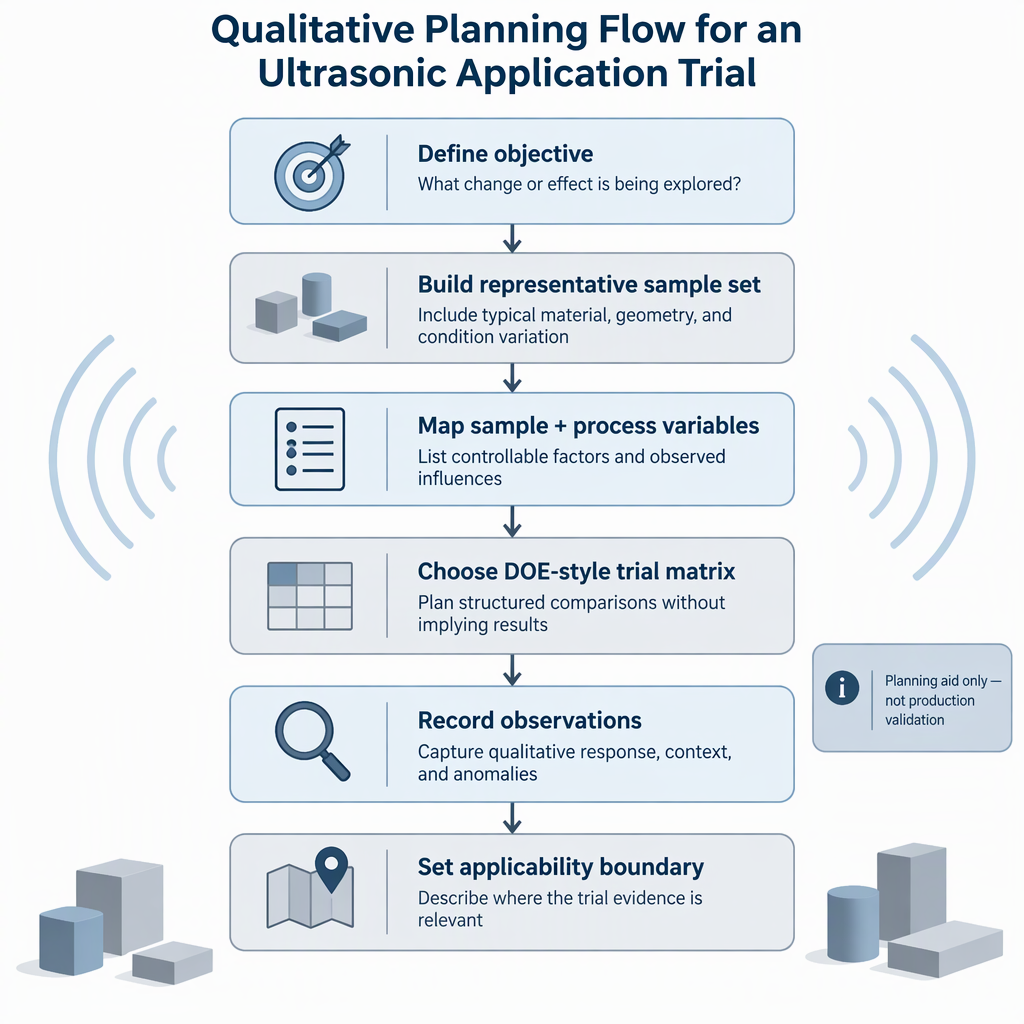
- State the decision first: comparison, screening, modeling, or optimization.
- List the sample factors that must be held constant or deliberately varied, including material, geometry, joint design, horn-contact location, and fixture support.
- List the process settings to record for every run, including amplitude, welding mode, downspeed, trigger pressure, weld time, and hold time.
- Choose a data-collection structure that can support the conclusion you need without adding runs that do not answer the decision.
- Select an analysis approach that matches the matrix, such as graphical review, model fitting, or assumption checks when those are appropriate for the experiment type.
| Decision need | Suitable matrix direction | Boundary to keep clear |
|---|---|---|
| Compare two or more feasible options | Use a comparative design that keeps sample and fixture conditions controlled. | A comparison does not automatically model the full process window. |
| Screen which factors matter most | Consider a screening structure such as a fractional factorial approach when the factor count is high. | Screening identifies influential factors; it is not the same as final optimization. |
| Characterize or optimize a narrowed process area | Use a modeling or response-surface direction when the objective is response behavior across selected settings. | Model-based conclusions depend on the experiment design and assumption checks used. |
Set applicability boundaries before interpreting results
A successful ultrasonic application trial can support the next engineering decision, but it should not be treated as validated production performance unless the sample set, matrix, measurements, and acceptance criteria were designed for that production claim.
Ultrasonic welding outcomes may be affected by component design, joint design, material, horn-contact distance, fixture support, and welding parameters. If any of those factors changes after the trial, the original result may no longer apply to the changed condition.
DOE planning is useful because it ties the data-collection plan to the conclusion the team intends to make. The NIST/SEMATECH handbook describes DOE as a systematic approach intended to support valid and defensible engineering conclusions while reducing unnecessary engineering runs, time, and money.
For more complex matrices, the analysis plan should be chosen before testing begins, because designed experiments may involve graphical displays, model fitting, and assumption checks depending on the objective.
Before acting on a favorable trial, separate three decisions: whether the application appears feasible, which factors deserve tighter study, and what additional validation is required before equipment, tooling, or production acceptance is selected.
Prepare the sample submission package
Send enough context for the trial team to connect samples, variables, observations, and the engineering decision, rather than treating the test as a search for one unexplained setting.
- Trial objective: comparison, screening, characterization, modeling, or optimization.
- Part description: material type, molded or formed condition, geometry, and known production variation.
- Joint or process area: intended weld, seal, cut, or contact location and the distance from horn contact to the joint when welding is involved.
- Support information: fixture concept, nesting constraints, delicate features, and surfaces that must not be marked.
- Parameter log needs: amplitude, welding mode, downspeed, trigger pressure, weld time, hold time, and any project-specific settings that must be recorded.
- Decision criteria: what the team will do if the trial is positive, inconclusive, or negative.
- Validation boundary: which later production, quality, or acceptance checks are outside the screening trial and must be handled by the project team.
Conclusion: turn the trial into a next engineering decision
The best outcome of an ultrasonic application trial is not a universal setting; it is a documented decision about feasibility, influential variables, remaining risks, and the next experiment or validation step.
- Start with the decision the trial must support, then choose the experiment structure.
- Make samples representative of material, geometry, joint or contact design, horn access, and fixture support.
- Record the process settings and support conditions that could affect the result.
- Treat screening results as screening evidence unless the trial was designed for a stronger conclusion.
FAQs about ultrasonic application trials
The main follow-up questions should clarify representativeness, variables, trial design, interpretation, and the next engineering decision.
How many representative samples should be prepared?
Set the sample quantity from the trial objective and matrix rather than from a universal rule. Comparative, screening, modeling, and optimization objectives place different demands on the number of runs and observations.
Can one material grade represent another grade?
Do not assume that it can. Thermoplastic type is one of the factors that can affect ultrasonic welding behavior, so a material change should be treated as a change in trial applicability.
Why does fixture information matter before testing?
Fixture support can influence ultrasonic welding outcomes, so the support concept should be recorded with the sample and settings instead of added as an afterthought.
Which settings should be logged during an ultrasonic welding trial?
Log the settings that are part of the planned process window, including amplitude, welding mode, downspeed, trigger pressure, weld time, and hold time when those variables apply to the welding trial.
When is a fractional factorial or response-surface approach useful?
A fractional factorial direction can help when many factors must be screened, while a response-surface direction is more suitable when the team is ready to model response behavior across selected conditions.
Does a positive application trial prove production performance?
Not by itself. A positive trial supports the conclusion it was designed to support; production performance requires acceptance criteria and validation evidence matched to the production application.
What should the team do with an inconclusive trial?
Use the result to refine the decision: adjust the sample set, reduce uncontrolled variation, narrow the variables, or choose a more suitable experiment structure for the next trial.