What's The Difference between An Ultrasonic Homogenizer And A High-shear Homogenizer?
Views: 89 Author: Site Editor Publish Time: 2026-07-21 Origin: Site
What's The Difference between An Ultrasonic Homogenizer And A High-shear Homogenizer?
High-shear homogenizers and ultrasonic homogenizers are both commonly used refinement and mixing equipment, but their core principles and applicable scenarios are very different.
To put it simply: the high-shear homogenizer relies on "powerful cutting" and is suitable for large-scale processing; the ultrasonic homogenizer relies on "oscillating blasting" and is suitable for precision processing.
The following table can help you quickly grasp their core differences:
Item
high-shear homogenizer
ultrasonic homogenizer
Core Principles:
High Shearing: Particles are broken down through intense shearing, impact, and turbulence generated between a high-speed rotating rotor and a stationary stator.
Ultrasonic Cavitation: Microbubbles are generated in a liquid using high-frequency sound waves; the violent collapse of these bubbles. releases enormous energy to pulverize particles.
Homogenization effect
can reach the micrometer level (approximately 2-5 µm)
reach to nanometer level (<100 nm), exhibiting excellent effects in disrupting fragile structures such as cells.
Processing capacity
It has a large processing capacity and is suitable for continuous industrial production.
With its small processing capacity, it is more suitable for laboratory or small-batch production.
Suitable materials:
Particularly suitable for fibrous, highly resilient materials, as well as materials with medium to low viscosity.
Suitable for cell disruption and nanomaterial preparation, but there are certain limitations on material viscosity (approximately 4,000 cP).
Energy consumption and cost
It has relatively low energy consumption and is cost-effective.
Energy consumption is relatively high and equipment costs may also be higher.
High-shear homogenizer: The "crusher" of mass production
Its advantages lie in its large processing capacity and high speed, making it ideal for industrial production. In processing some fibrous materials, its effect is even superior to ultrasonic homogenizers. Therefore, it is widely used in large-scale production lines in the food (e.g., dairy products, juices), chemical (e.g., paints, coatings), and pharmaceutical industries.
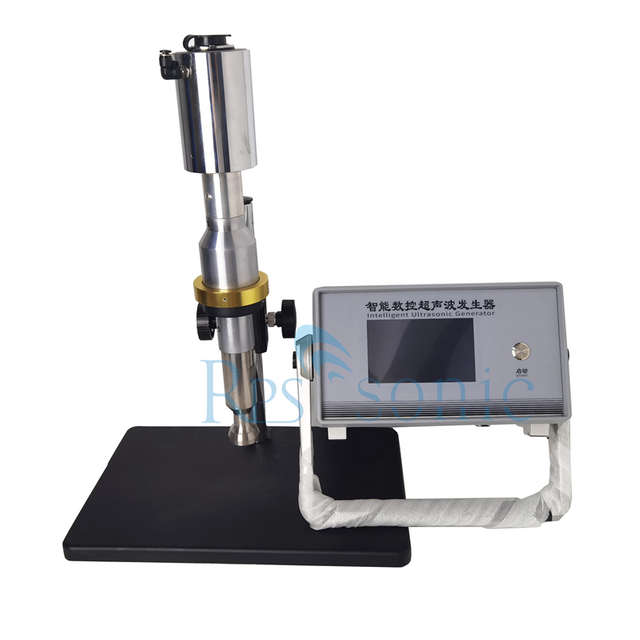
Ultrasonic homogenizer: The "precision instrument" of the laboratory
Its advantage lies in its high precision, achieving nanoscale homogenization effects. It is ideal for delicate operations such as cell disruption and extraction of intracellular substances (e.g., DNA, proteins). At the same time, its operation is relatively simple, making it very suitable for research laboratories and the production of small-batch, high-value-added products.
Summary and Selection Recommendations
In general, the choice of equipment depends on your specific needs:
For large-scale, high-efficiency processing of fibrous materials: A high-shear homogenizer is a more economical and efficient choice.
For nanoscale precision processing of fragile biological samples and small-batch experiments: An ultrasonic homogenizer is more suitable.
In actual industrial production, the two methods are sometimes combined: a high-shear homogenizer is used for coarse processing, followed by an ultrasonic homogenizer for fine homogenization, in order to achieve the best results.