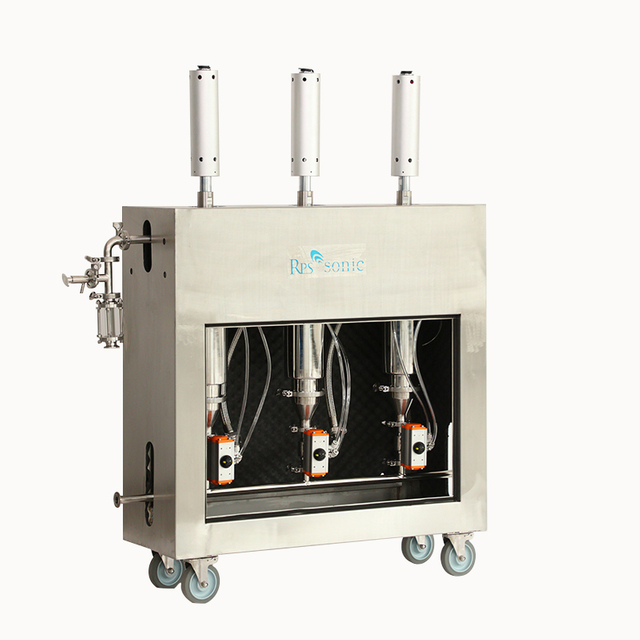
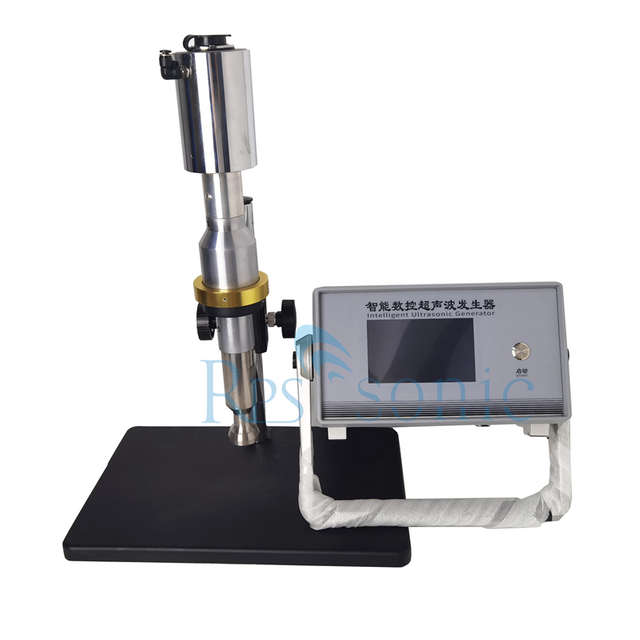
What Is Ultrasonic Extraction Technology?
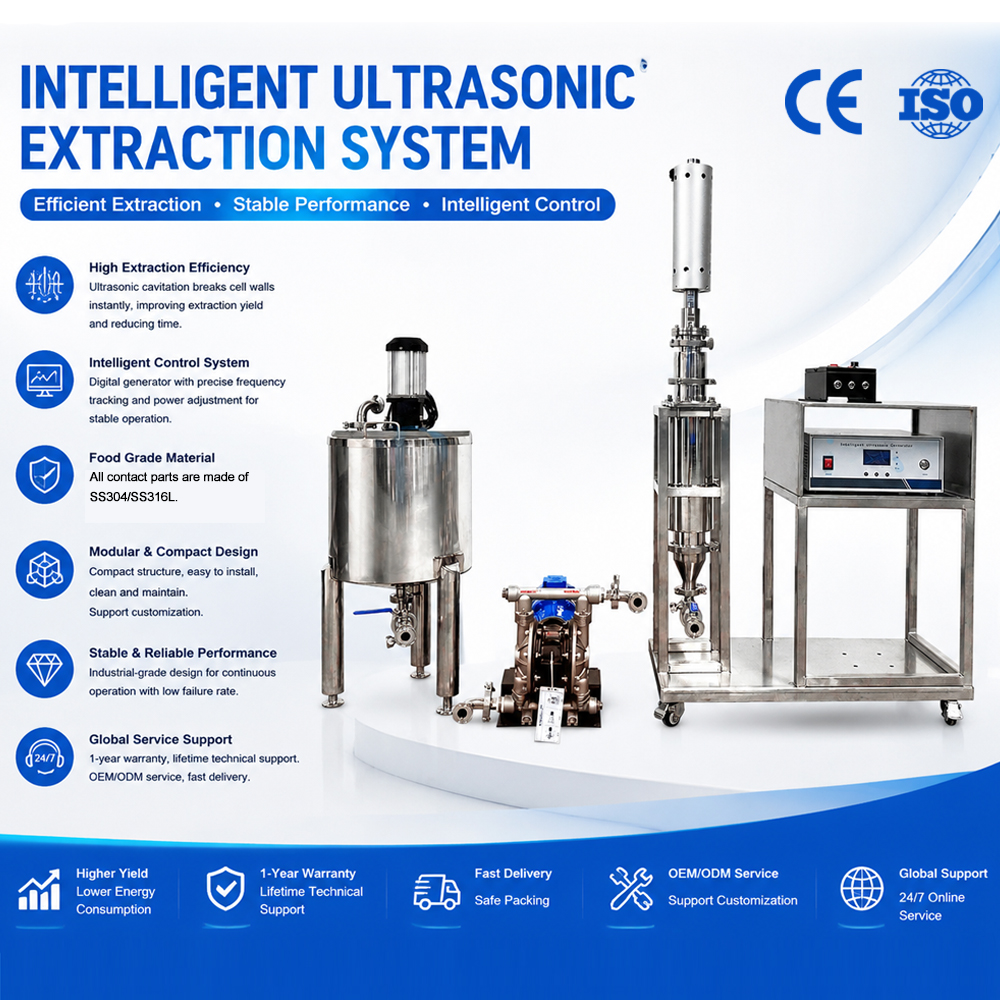
Ultrasonic extraction technology, also known as ultrasound-assisted extraction, is a green and efficient technology that utilizes ultrasonic energy to enhance the extraction process. Simply put, it uses the cavitation, mechanical, and thermal effects generated by ultrasound in a liquid to create instantaneous high temperature and pressure and generate a powerful impact force. This opens the cell walls of plants, allowing the active ingredients to dissolve more easily and quickly into the solvent, significantly shortening the extraction time.
Its applications are very wide-ranging, with diverse core technical parameters, and a complete process flow is crucial.
Process Flow: Key Steps to High-Efficiency Extraction
A standard ultrasonic extraction process typically includes the following steps:
* Raw Material Pretreatment: The solid raw material to be extracted (such as plants or medicinal herbs) is cleaned, dried, and pulverized.
* Mixing and Solvent Addition: The pretreated raw material is mixed with the selected extraction solvent (such as ethanol or water) in an extraction tank.
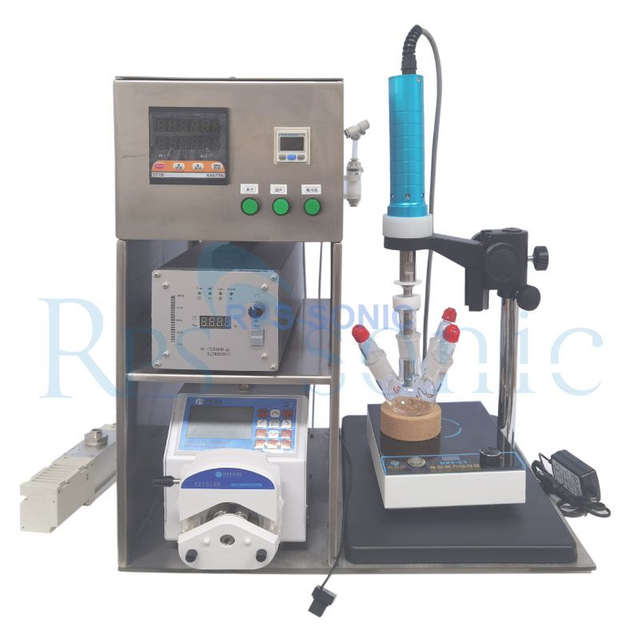
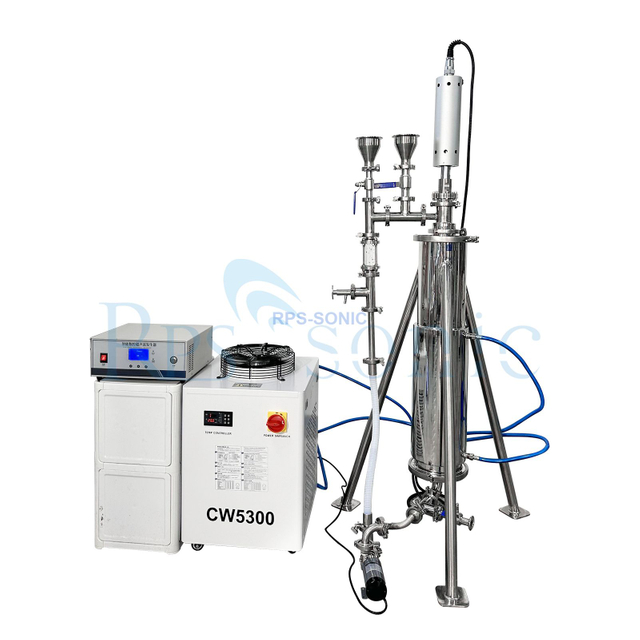
* Ultrasonic Enhanced Extraction: The ultrasonic system is activated, and the mixture is irradiated under the set parameters.
* Separation and Purification: The extracted mixture is subjected to solid-liquid separation, and the liquid containing the target components is further concentrated or dried to obtain the final product.
Core Technical Parameters: How to Optimize Extraction Effect
To improve extraction efficiency and product quality, the key lies in precisely controlling the following core parameters:
Ultrasonic Frequency: Determines the intensity of the cavitation effect, commonly ranging from 16kHz to 500kHz. Low frequencies (20-40kHz) have strong cell-wall breaking ability, suitable for disrupting cells; high frequencies facilitate the diffusion of small molecules.
Power Density: Refers to the ultrasonic energy received per unit volume of solution, directly affecting the number of cavitation bubbles.
Extraction Temperature: Although ultrasound can generate heat, it is usually maintained at room temperature or low temperature (40-60℃) to protect heat-sensitive components from damage.
Extraction Time: This reflects the efficiency advantage, typically requiring only 10-60 minutes, much faster than traditional methods.
Solvent Type and Concentration: Various solvents such as water, ethanol, and methanol, as well as their mixtures, can be selected, flexibly adapting to target substances of different polarities.
Main Advantages and Limitations Overview
High Efficiency: Compared to traditional methods, extraction time can be shortened by 50%-80%, and the yield of target components is significantly improved.
Pure and Safe: The extraction process is typically conducted at low or room temperature, effectively protecting the activity and natural structure of heat-sensitive components.
Green and Environmentally Friendly:Solvent usage can be reduced by 30%-50%, resulting in lower energy consumption and fewer pollutants.
Wide Applicability:Equipment investment and operating costs are relatively low, and process scale-up is relatively easy.
Easy to Operate: The entire system is highly automated, greatly simplifying the operation process and ensuring process reproducibility.
Higher Cost: The manufacturing and maintenance costs of specialized equipment are relatively high.
Uniformity Issues: Ensuring uniform distribution of ultrasonic energy within the reactor is a challenge in large-scale production.
Over-processing Risk: Improper parameter control may lead to localized overheating, damaging heat-sensitive components or triggering side reactions.
Noise Pollution: The equipment generates significant noise during operation, requiring additional sound insulation measures for large-scale production.
This technology has already penetrated many fields closely related to our lives.
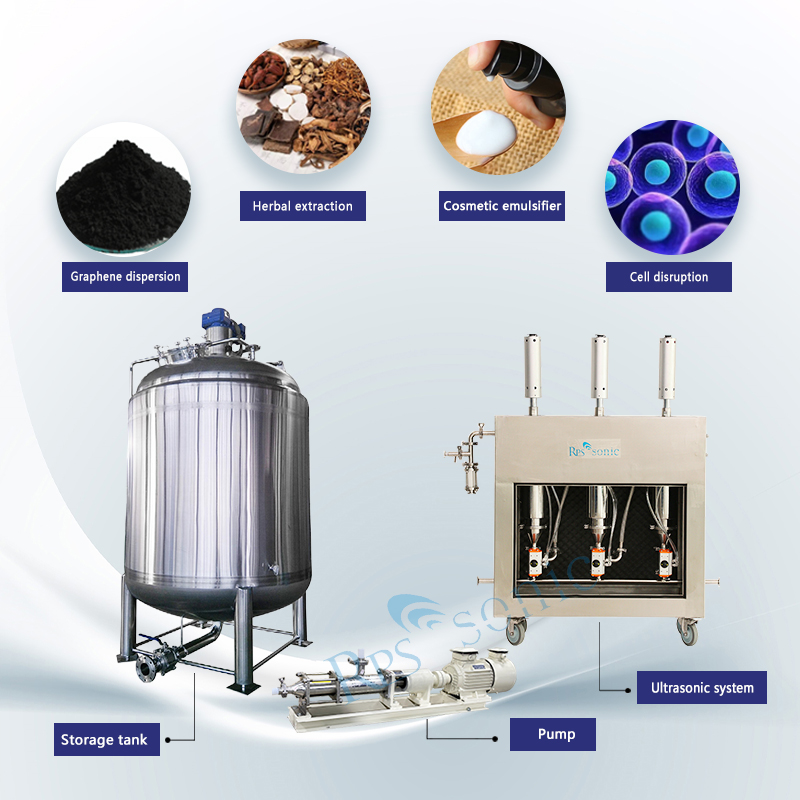
Natural Product Extraction: In the traditional Chinese medicine, food, health product, and cosmetic industries, it is used to efficiently extract active ingredients such as polysaccharides, flavonoids, saponins, and essential oils from plants. The process is gentle and maximizes the preservation of their natural efficacy.
Environmental Monitoring: In the environmental protection field, it is used to extract trace organic pollutants such as polycyclic aromatic hydrocarbons and pesticide residues from soil and water samples as a pretreatment step for detection and analysis.
Biology and Medicine: In biotechnology, it is used to disrupt cells to extract biomolecules such as proteins and nucleic acids; in forensic identification, it can also rapidly extract toxins from blood and tissues.
Materials and Chemical Engineering:In materials science, it is used for the dispersion of nanomaterials to prevent aggregation and for catalyst preparation; in the chemical industry, it is also commonly used for emulsification, dispersion, and accelerating chemical reactions.
Summary:Ultrasonic extraction technology is a mature, efficient, and environmentally friendly extraction solution. With relatively low equipment investment and operating costs, it achieves high extraction efficiency and wide applicability, demonstrating irreplaceable value in numerous fields.
In the future, the development trend of this technology will be the combined use of multiple technologies. For example, combining it with cutting-edge technologies such as enzymatic hydrolysis, supercritical fluids, and ionic liquids is expected to achieve a double leap in both efficiency and quality