Ultrasonic Dispersion Technology for Soy Milk: Improving Protein Dispersion, Emulsion Stability and Product Quality
1. Introduction: The Application of Ultrasonic Technology in Soy Milk Processing
Soy milk is a popular plant-based beverage made from soybeans. It is rich in plant proteins, oils, carbohydrates, and other nutrients, making it an important alternative to traditional dairy products.
However, during soy milk production, manufacturers may encounter several processing challenges, including uneven particle distribution, protein aggregation, oil separation, sedimentation, and inconsistent product texture.
Traditional mechanical stirring and homogenization methods can improve mixing performance, but they may not always provide sufficient dispersion efficiency, particularly when dealing with concentrated soy protein solutions or fine suspended particles.
Ultrasonic dispersion technology offers an effective solution for improving the physical stability and uniformity of soy milk.
By utilizing high-frequency ultrasonic vibrations, typically at 20kHz, ultrasonic equipment generates acoustic cavitation in liquid media. The formation and collapse of microscopic bubbles create localized shear forces, microjets, and turbulence, helping break down particle agglomerates and improve the distribution of proteins, oils, and other suspended components.
This technology can be applied during soy milk preparation, protein dispersion, emulsification, and post-homogenization processing.
2. How Does Ultrasonic Dispersion Work in Soy Milk?
The working principle of ultrasonic dispersion is based on acoustic cavitation.
When high-frequency ultrasonic waves enter the soy milk solution, alternating compression and expansion cycles generate microscopic cavitation bubbles.
These bubbles grow and subsequently collapse, producing localized mechanical effects that contribute to:
· Breaking down protein aggregates.
· Reducing the size of suspended particle agglomerates.
· Improving the dispersion of soybean oil droplets.
· Enhancing the uniform distribution of solid components.
· Promoting interactions between proteins and other liquid components.
Through these physical effects, ultrasonic treatment can improve the uniformity of soy milk and help optimize its colloidal structure.
The actual results depend on ultrasonic power, treatment time, amplitude, temperature, soybean concentration, and initial particle size.
3. Key Advantages of Ultrasonic Dispersion for Soy Milk
1. Improved Protein Dispersion
Soy milk contains various plant proteins, which may form aggregates during processing.
Ultrasonic cavitation generates strong localized shear forces that help break down protein aggregates and improve protein distribution throughout the liquid.
This contributes to a more uniform soy milk solution.
2. Reduced Particle Agglomeration
During soybean processing, fine particles may cluster together and form larger aggregates.
Ultrasonic dispersion helps separate these agglomerates, improving particle distribution and reducing unevenness in the final product.
3. Improved Emulsion Stability
Soy milk naturally contains proteins and oils. Uneven oil droplet distribution can contribute to creaming and phase separation.
Ultrasonic treatment can help reduce oil droplet size and improve emulsion uniformity, potentially enhancing physical stability during storage.
4. More Uniform Product Texture
By improving the dispersion of proteins, oils, and suspended solids, ultrasonic treatment can help create a smoother and more consistent soy milk texture.
This is particularly useful for manufacturers producing premium plant-based beverages.
5. Enhanced Processing Efficiency
Ultrasonic treatment can be integrated into existing mixing and homogenization processes to improve dispersion efficiency and reduce the need for prolonged mechanical processing.
6. Continuous Industrial Processing
With an ultrasonic flow cell system, soy milk can be processed continuously through a pipeline.
This configuration is suitable for medium- and large-scale beverage production, allowing manufacturers to integrate ultrasonic treatment into existing production lines.
4. Ultrasonic Equipment Solutions for Soy Milk Production
Different production capacities and processing requirements call for different ultrasonic equipment configurations.
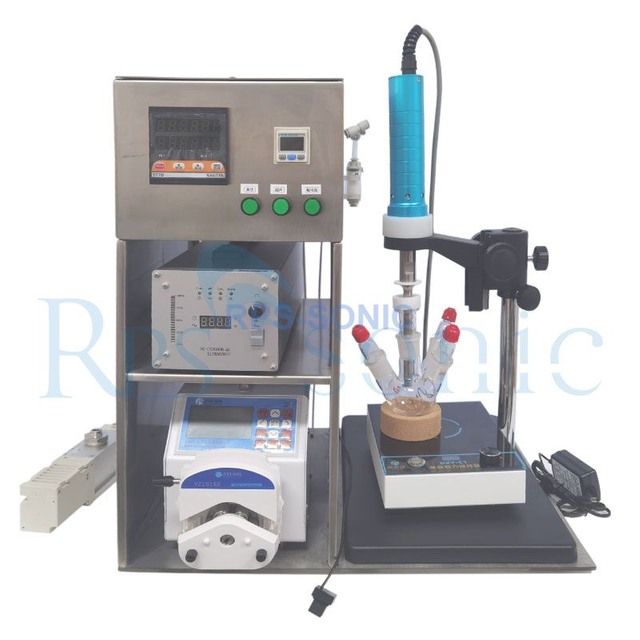
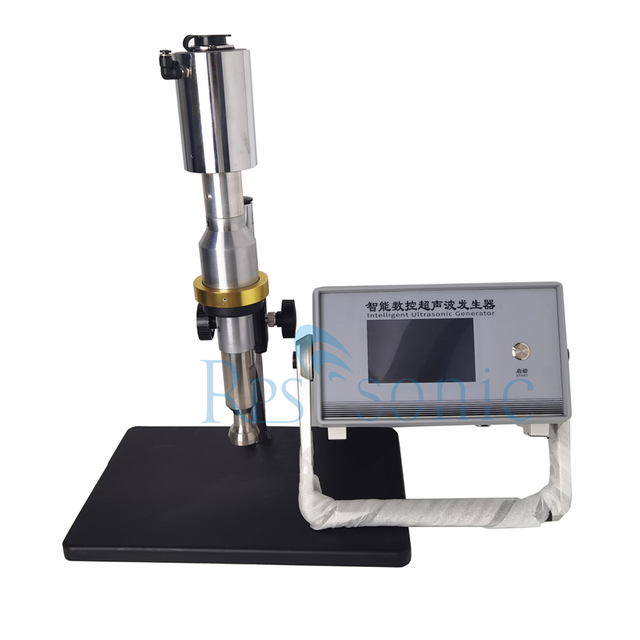
A. Probe-Type Ultrasonic Homogenizer
A probe-type ultrasonic homogenizer is suitable for laboratory research, formulation development, and small-batch soy milk processing.
The ultrasonic probe is directly immersed in the soy milk solution, transferring acoustic energy into the liquid.
Main features:
· Direct ultrasonic energy transfer.
· Adjustable ultrasonic amplitude and power.
· Suitable for laboratory and pilot-scale experiments.
· Useful for evaluating protein dispersion and emulsion stability.
· Supports process parameter optimization before industrial scale-up.
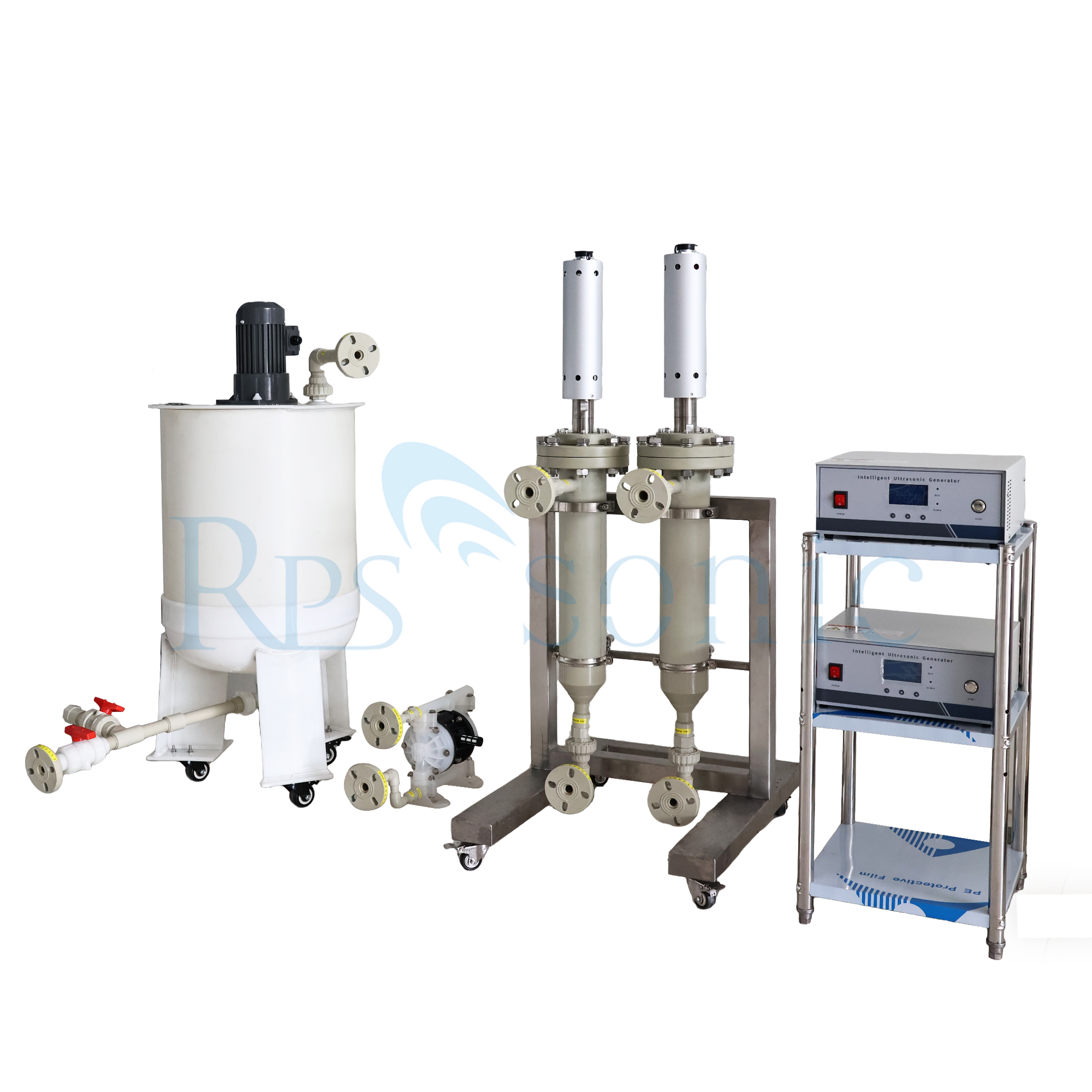
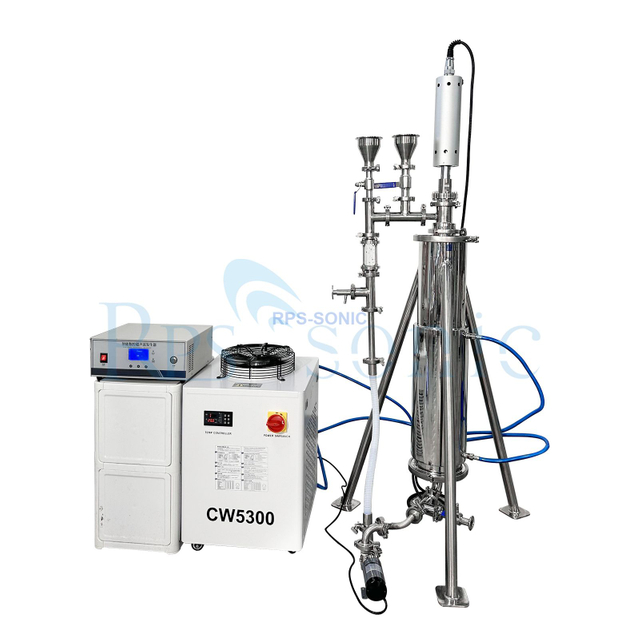
B. Industrial Ultrasonic Flow Cell System
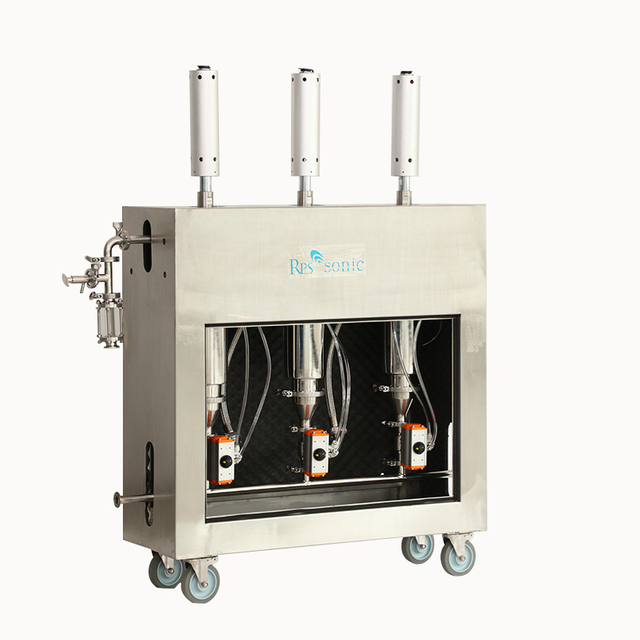
An ultrasonic flow cell system is designed for continuous soy milk processing.
The soy milk solution is transported through a specially designed ultrasonic reaction chamber by a sanitary pump. Ultrasonic energy is applied during liquid flow, helping improve particle dispersion and emulsion uniformity.
Main features:
· Continuous inline ultrasonic processing.
· Suitable for industrial beverage production.
· Customizable ultrasonic power and chamber dimensions.
· Can be integrated with sanitary pipelines and storage tanks.
· Suitable for processing larger volumes of soy milk.
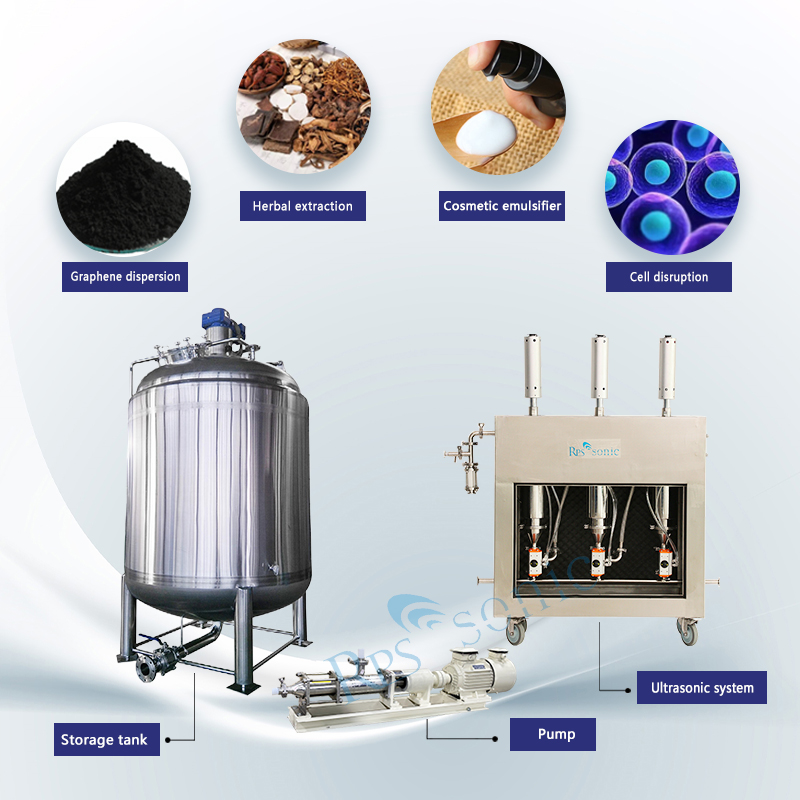
C. Ultrasonic Homogenization with Mixing Tank
An integrated ultrasonic homogenization system combines a stainless steel mixing tank, mechanical agitator, ultrasonic transducer system, and temperature control.
The mechanical agitator provides bulk mixing, while ultrasonic cavitation helps break down particle agglomerates and improve dispersion.
This combination is particularly useful for concentrated soy milk solutions and plant-based beverage formulations.
Conclusion: Ultrasonic Technology for Modern Plant-Based Beverage Production
Ultrasonic dispersion technology provides a promising solution for improving the processing of soy milk and other plant-based beverages.
Through acoustic cavitation, ultrasonic equipment helps break down particle aggregates, improve protein dispersion, reduce oil droplet size, and enhance the uniformity of liquid formulations.
For manufacturers seeking better product consistency, improved emulsion stability, and flexible production configurations, ultrasonic probe homogenizers and industrial ultrasonic flow cell systems offer practical options for laboratory testing, pilot production, and industrial-scale processing.
With customized ultrasonic power, sanitary contact materials, temperature control, and continuous processing capabilities, ultrasonic technology can become a valuable addition to modern soy milk production lines.