Ultrasonic Dispersion Technology for Beverage Processing Improving Mixing, Homogenization and Product Stability
1. Introduction: The Application of Ultrasonic Technology in Beverage Processing
In the modern food and beverage industry, manufacturers are constantly looking for more efficient technologies to improve product quality, processing efficiency, and formulation stability.
During beverage production, many ingredients need to be uniformly dispersed in liquid systems, including fruit powders, plant proteins, functional ingredients, vitamins, minerals, natural pigments, flavoring agents, and other food additives.
However, conventional mechanical mixing sometimes struggles to achieve fine and uniform dispersion, especially when dealing with poorly soluble powders, high-concentration formulations, or ingredients that tend to form agglomerates.
Ultrasonic dispersion technology provides an advanced solution for beverage processing.
By utilizing high-frequency ultrasonic vibrations, typically at 20kHz, ultrasonic equipment generates acoustic cavitation in liquids. The formation and collapse of microscopic bubbles produce intense localized shear forces, microjets, and turbulence, helping break down particle agglomerates and improve the distribution of ingredients throughout the beverage.
Ultrasonic homogenization can be applied to various beverage formulations, helping manufacturers improve dispersion uniformity, optimize emulsification, and develop more consistent products.
2. How Does Ultrasonic Dispersion Work in Beverage Solutions?
The working principle of ultrasonic dispersion is based on acoustic cavitation.
When ultrasonic waves propagate through a liquid, alternating compression and expansion cycles cause microscopic cavitation bubbles to form, grow, and collapse.
The collapse of these bubbles generates localized mechanical effects, including:
· Strong localized shear forces.
· Microjets and liquid turbulence.
· Breakdown of particle agglomerates.
· Improved wetting and dispersion of powder ingredients.
· Reduction of oil droplet and particle agglomerate sizes under suitable conditions.
These effects help improve the uniformity of beverage formulations and reduce the formation of large aggregates.
For example, when dispersing plant protein powder, fruit powder, cocoa powder, or functional food ingredients into water, ultrasonic cavitation can help separate agglomerated particles and promote a more homogeneous suspension.
The final results depend on the formulation, particle characteristics, ultrasonic power, amplitude, processing time, temperature, and liquid viscosity.
3. Key Applications of Ultrasonic Dispersion in the Beverage Industry
1. Plant-Based Beverage Processing
Ultrasonic dispersion is suitable for processing various plant-based beverages, including:
· Soy milk.
· Oat milk.
· Almond milk.
· Coconut milk.
· Rice milk.
· Pea protein beverages.
Ultrasonic treatment can help disperse plant proteins, oils, and suspended particles, improving formulation uniformity and potentially enhancing physical stability.
2. Fruit Juice and Fruit Beverage Processing
Fruit beverages often contain suspended fruit pulp, fruit powders, natural pigments, and other ingredients.
Ultrasonic cavitation can help break down particle agglomerates, improve ingredient distribution, and support the development of more uniform beverage textures.
3. Protein Beverage Dispersion
Protein powders, including whey protein, soy protein, pea protein, and other plant proteins, are widely used in functional beverages.
During conventional mixing, protein powders may form lumps due to insufficient wetting or rapid surface hydration.
Ultrasonic dispersion helps break down these aggregates and improve the distribution of protein particles throughout the liquid.
4. Functional and Nutritional Beverage Production
Functional beverages may contain vitamins, minerals, botanical extracts, amino acids, and other nutritional ingredients.
Ultrasonic technology can assist in dispersing these ingredients into liquid formulations, particularly when the ingredients have a tendency to agglomerate.
For sensitive ingredients, ultrasonic energy and processing temperature must be carefully controlled to avoid unwanted degradation.
5. Emulsification of Oil-Based Ingredients
Some beverages contain essential oils, flavor oils, plant oils, or other hydrophobic ingredients.
Ultrasonic emulsification can generate fine oil droplets and improve their distribution in the aqueous phase when suitable emulsifiers or stabilizers are present.
This is particularly useful for developing flavored drinks, plant-based beverages, and functional emulsified beverages.
4. Main Advantages of Ultrasonic Beverage Dispersion
1. Improved Powder Dispersion
Ultrasonic cavitation helps break down powder agglomerates and improve the distribution of solid ingredients in liquid beverages.
This is useful for protein powders, fruit powders, cocoa, and other functional ingredients.
2. More Uniform Mixing
Ultrasonic processing generates intense localized fluid movement, helping improve the uniformity of beverage formulations.
3. Improved Emulsification
Ultrasonic treatment can reduce oil droplet sizes and help create more uniform emulsions, potentially improving physical stability.
4. Reduced Particle Agglomeration
Ultrasonic shear forces help separate particles that tend to cluster together, reducing the formation of large aggregates.
5. Flexible Processing Configuration
Ultrasonic equipment can be designed for batch processing or continuous inline processing, depending on production requirements.
6. Integration with Existing Production Lines
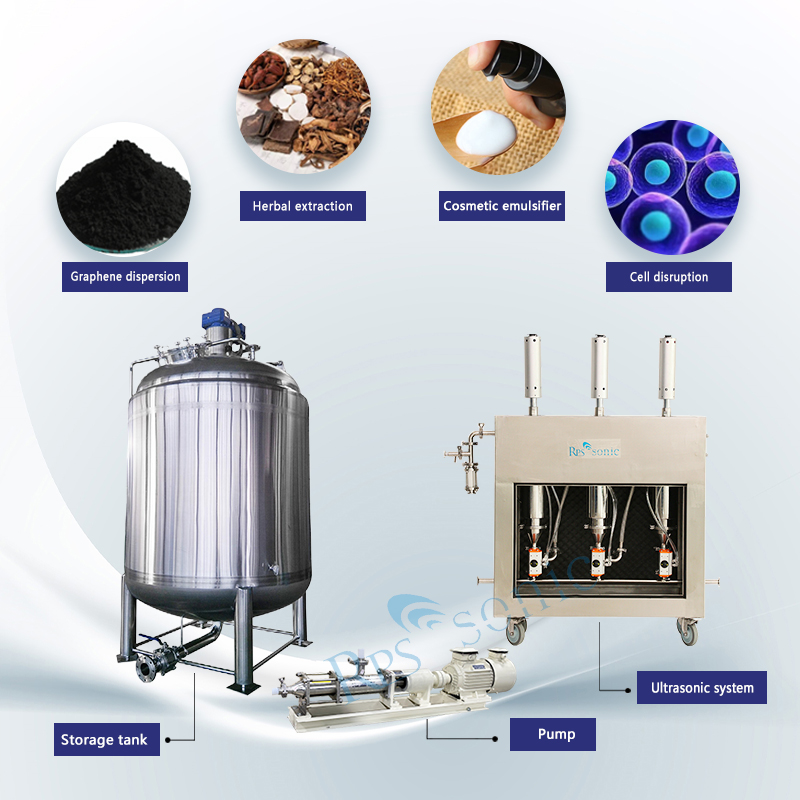
Industrial ultrasonic systems can be connected to mixing tanks, sanitary pumps, pipelines, and heat-exchange systems to support existing beverage manufacturing processes.
5. Ultrasonic Equipment Solutions for Beverage Production
Different beverage formulations and production capacities require different ultrasonic equipment configurations.
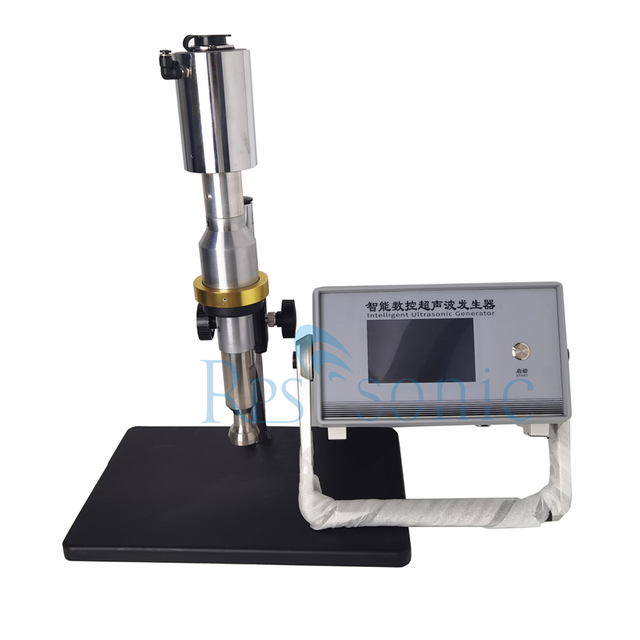
A. Probe-Type Ultrasonic Homogenizer
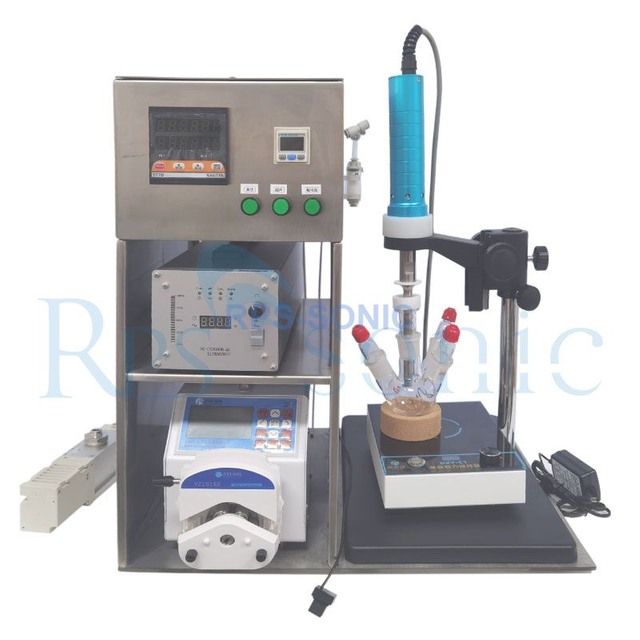
A probe-type ultrasonic homogenizer is suitable for laboratory testing, formulation development, and small-batch beverage processing.
The ultrasonic probe is directly immersed in the liquid, transferring acoustic energy into the beverage.
Main features:
· Direct ultrasonic energy transfer.
· Adjustable ultrasonic amplitude and power.
· Suitable for laboratory and pilot-scale testing.
· Effective for evaluating powder dispersion and emulsification.
· Useful for optimizing processing parameters before industrial scale-up.
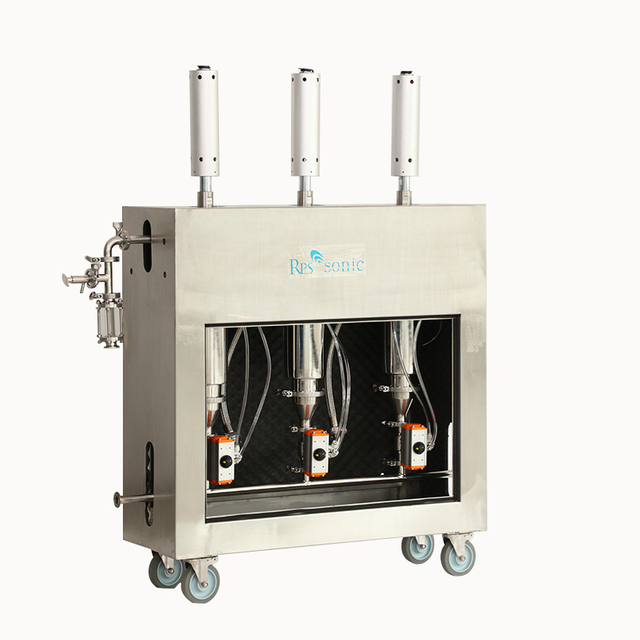
B. Industrial Ultrasonic Flow Cell System
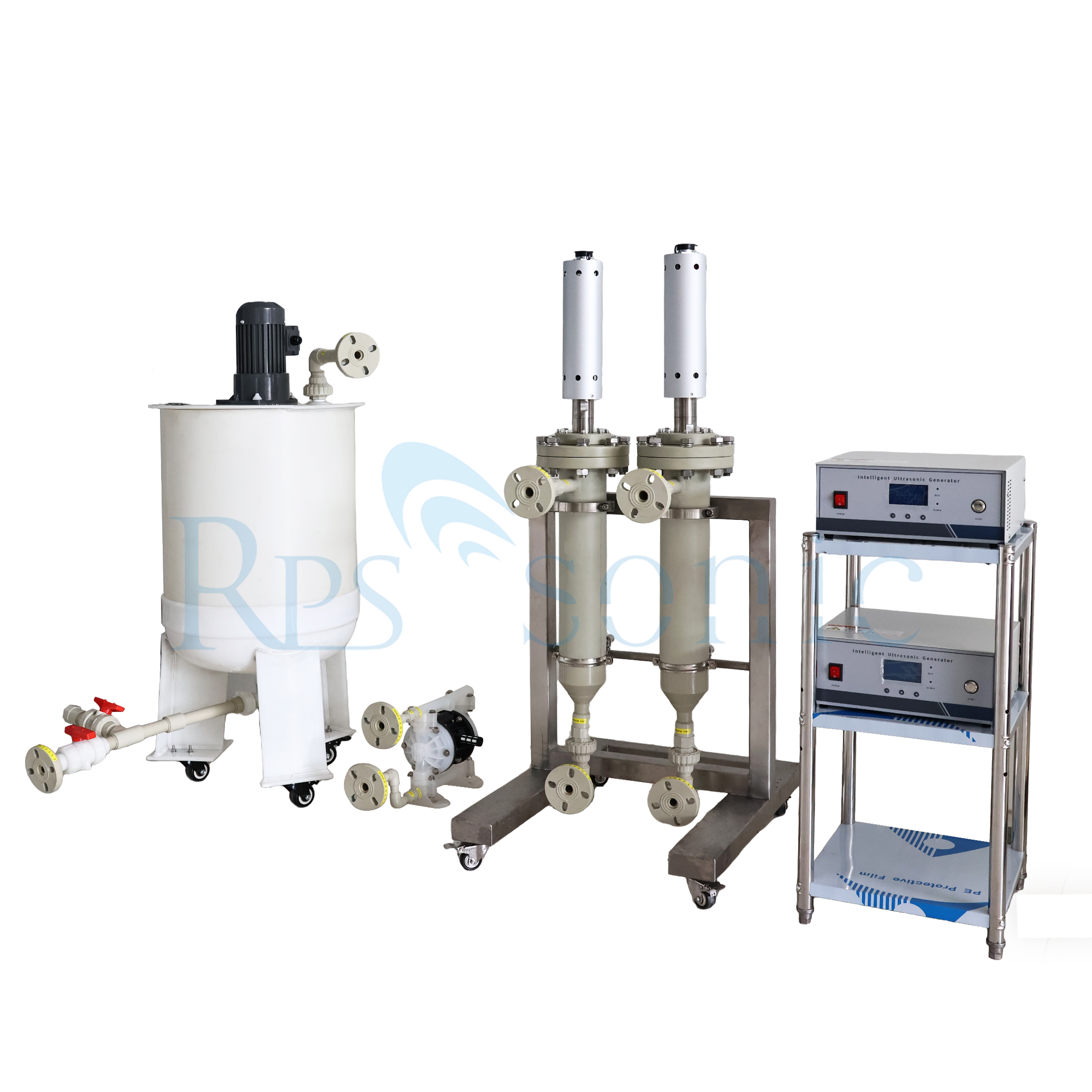
An ultrasonic flow cell system is designed for continuous beverage processing.
The beverage solution is transported through an ultrasonic reaction chamber by a sanitary pump. Ultrasonic energy is introduced directly into the flowing liquid to improve dispersion and homogenization.
Main features:
· Continuous inline ultrasonic processing.
· Suitable for medium- and large-scale production.
· Customizable ultrasonic power and chamber design.
· Stainless steel sanitary contact components.
· Easy integration into existing beverage pipelines.
· Suitable for continuous processing and recirculation systems.
C. Integrated Ultrasonic Mixing Tank System
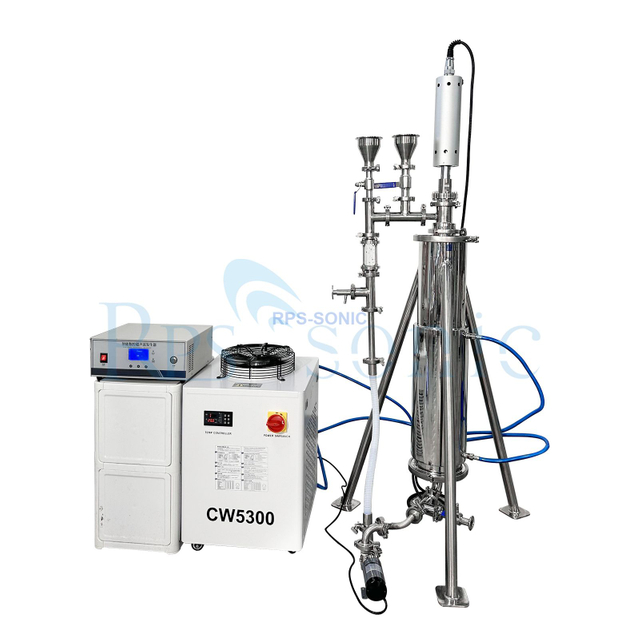
An integrated ultrasonic mixing system combines a stainless steel tank, mechanical agitator, ultrasonic transducer, and temperature control system.
The mechanical agitator provides bulk circulation and mixing, while ultrasonic cavitation helps break down particle agglomerates and improve fine dispersion.
This configuration is suitable for concentrated beverage formulations, protein drinks, plant-based milk, and functional beverage production.
6. Typical Industrial Ultrasonic Beverage Processing Workflow
A typical ultrasonic beverage dispersion process may include the following stages:
Step 1: Liquid Preparation
Prepare the base liquid, such as purified water, fruit juice, plant milk, or another beverage formulation.
Step 2: Ingredient Feeding
Add powder ingredients, proteins, functional additives, pigments, or emulsifying components into the liquid under controlled mixing conditions.
Step 3: Preliminary Mechanical Mixing
Use a mechanical agitator to create circulation and wet the ingredients, reducing the formation of large dry powder clusters.
Step 4: Ultrasonic Dispersion
Pass the mixture through an ultrasonic flow cell or apply ultrasonic treatment directly inside the mixing tank.
Acoustic cavitation helps break down agglomerates and improve the dispersion of particles and droplets.
Step 5: Temperature Control
Monitor the processing temperature and use a cooling system if necessary to prevent excessive heat accumulation.
Step 6: Final Homogenization and Beverage Treatment
Depending on the product, additional homogenization, filtration, pasteurization, or sterilization may be required.
Step 7: Filling and Packaging
The finished beverage is transferred to the filling and packaging system.
Ultrasonic dispersion is a physical processing method and should not replace validated thermal or other microbiological safety treatments.
Conclusion: Ultrasonic Technology for the Future of Beverage Manufacturing
Ultrasonic dispersion technology offers an effective approach to improving the processing of modern beverages.
Through acoustic cavitation, ultrasonic equipment helps break down particle agglomerates, improve powder dispersion, enhance emulsification, and promote uniform distribution of ingredients.
From plant-based milk and protein drinks to fruit beverages and functional nutritional drinks, ultrasonic homogenizers and continuous ultrasonic flow cell systems provide flexible solutions for laboratory development, pilot testing, and industrial beverage production.
With customized ultrasonic power, sanitary stainless steel construction, temperature control, and continuous processing capabilities, ultrasonic technology can help beverage manufacturers optimize their production processes and improve product consistency.