Solving the problem of air leakage in vacuum glass: A new ultrasonic vacuum glass tin-plating and edge-sealing process
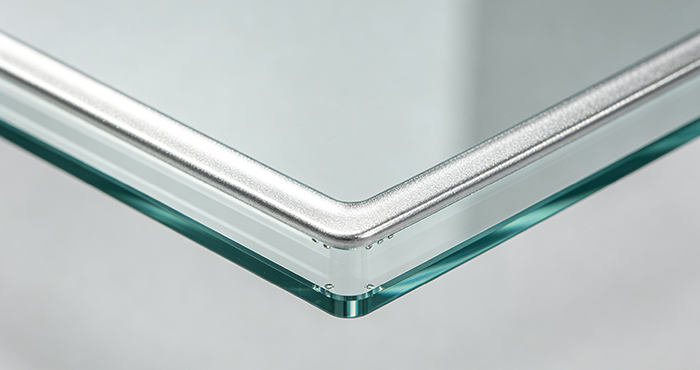
Ultrasonic vacuum glass tin plating = ultrasonic-assisted tin plating of glass edges, used for metal edge sealing of vacuum glass; it is not tin plating inside the vacuum chamber, which is easily confused by many. Principle: Ultrasonic cavitation effect, without flux, generates a dense tin layer at the glass edge, serving as the gas-tight sealing substrate for vacuum glass.
In the fields of building energy conservation and high-end door and window deep processing, vacuum glass has long been a core material for ultra-low energy consumption buildings, high-end villas, and passive houses. With its superior heat insulation, sound insulation, and anti-condensation performance compared to insulated glass, vacuum glass is gradually replacing traditional glass products, becoming the mainstream direction for industry upgrading. However, many door and window manufacturers and glass deep processing companies face the same pain point: products meet performance standards when they first leave the factory, but after one or two years of use, vacuum degradation, deterioration of heat insulation, and glass fogging and leakage occur, ultimately leading to after-sales complaints and damage to brand reputation.
Fundamentally, the lifespan of vacuum glass depends not on the glass substrate, but on the edge sealing process. As a key process in vacuum glass production, the sealing performance, stability, and durability of the edge sealing directly determine the product's lifespan and user experience. The drawbacks of traditional high-temperature glass powder sealing and flux-plated tin sealing processes are becoming increasingly apparent. The application of ultrasonic vacuum glass tin plating technology has completely broken through the bottlenecks of traditional processes, becoming one of the optimal solutions for high-quality mass production of vacuum glass.
Many industry professionals wonder: What exactly is the advantage of ultrasonic technology in edge sealing and tin plating? Why are more and more leading glass companies replacing traditional processes? Today, we will delve into this revolutionary glass metallization edge sealing technology.
I. Shortcomings of Traditional Edge Sealing Processes
For a long time, domestic vacuum glass edge sealing has mainly adopted two processes, but both have unavoidable defects and cannot meet the needs of high-end, long-term use.
The first is the high-temperature fusion sealing process using glass powder. This process requires sintering at temperatures above 380℃. The high-temperature environment easily causes stress release in tempered glass, resulting in slight annealing and deformation. This not only reduces the flatness of the glass but also significantly increases the risk of spontaneous breakage. At the same time, the glass powder sealing material is brittle and easily develops micro-cracks when exposed to temperature changes or slight vibrations. Over time, the expansion of these cracks can lead to vacuum leakage, significantly reducing the product's lifespan.
The second is traditional flux-plated tin sealing. This was the mainstream process for early metal edge sealing, relying on flux to achieve adhesion between the tin and the glass. However, flux residue is a fatal flaw. Residual organic matter will continuously and slowly release gas within the vacuum layer, causing a decrease in vacuum level over time, leading to glass fogging and heat insulation failure. Furthermore, the traditional tin plating layer is loose and has poor adhesion, easily peeling off and cracking after thermal cycling, resulting in extremely poor sealing stability. With the advancement of dual-carbon policies and the upgrading of building energy efficiency standards, the market's demands for the durability, stability, and environmental friendliness of vacuum glass are continuously increasing. Traditional processes can no longer meet the needs of high-end projects and long-term home decoration, necessitating a new iteration of edge-sealing technology.
II. Ultrasonic Tin Plating Principle: Flux-Free Tin Plating for Ultimate Sealing
Ultrasonic vacuum glass tin plating is a flux-free, high-precision glass surface metallization pretreatment process, perfectly suited for edge-sealing production of tempered vacuum glass and Low-E vacuum glass, fundamentally solving various drawbacks of traditional processes.
Its core principle relies on the ultrasonic cavitation effect: high-frequency ultrasonic vibration causes liquid tin to generate intense cavitation impact, instantly shattering the oxide layer, dust, and microscopic impurities on the glass edge surface, while simultaneously activating the molecular structure of the glass surface. Without any flux, the molten tin can uniformly and densely wet and adhere to the glass edge, forming a uniformly thick and highly bonded metallic coating.
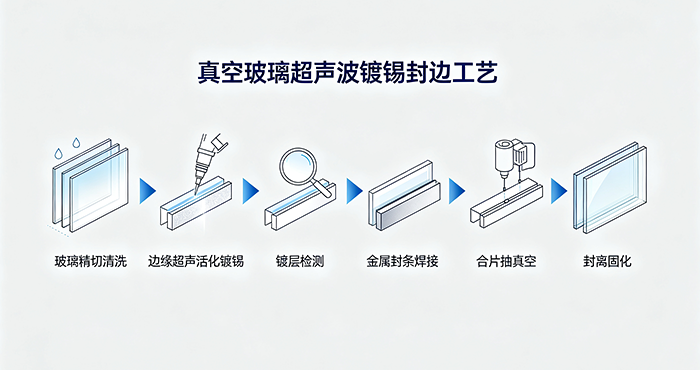
The entire production process is simple and efficient, with standardized procedures: glass precision cutting and cleaning → ultrasonic tin plating of edges → plating inspection → metal sealing welding → lamination and vacuuming → sealing and curing. The processing temperature is controlled below 180℃ throughout the process, preventing damage to the pre-stress of the tempered glass and avoiding problems such as glass annealing, deformation, and spontaneous breakage.
III. Four Core Advantages of Ultrasonic Vacuum Glass Tin Plating
Compared to traditional processes, ultrasonic vacuum glass tin plating offers advantages throughout the entire production, finished product, and usage cycle, precisely addressing pain points for both manufacturers and users.
First, zero residue, high airtightness, and doubled service life. No flux is required throughout the process, eliminating the problem of residual organic matter releasing gas. The tin layer is dense, without pinholes or gaps, resulting in excellent airtightness after sealing. After cold and hot cycling and damp heat aging tests, the plating does not crack or peel off, and the vacuum level remains stable, extending the service life of vacuum glass to over 20 years and completely solving the problems of later leakage and fogging.
Second, low-temperature processing significantly improves yield. Unlike high-temperature glass powder sealing, ultrasonic tin plating at low temperatures does not damage the stress structure of tempered glass. It is perfectly compatible with various substrates such as Low-E coated glass, custom-shaped glass, and ultra-clear glass, without scratching the coating or damaging the glass substrate. The product yield rate can reach over 99%, significantly reducing enterprise waste costs.
Third, it is green and efficient, suitable for mass production needs. The process produces no waste gas, no waste residue, and no chemical residue, eliminating the need for subsequent cleaning and impurity removal processes. This simplifies the production process while fully complying with environmental protection standards. It supports both flexible handheld customization and automated production line mass production, meeting both small-batch custom orders and large-scale engineering projects, significantly improving production efficiency.
Fourth, it offers controllable costs and outstanding cost-effectiveness. Although the initial equipment investment is higher than traditional processes, it eliminates the costs of flux and cleaning consumables. The extremely low defect rate and maintenance-free characteristics significantly reduce overall production costs, making its long-term cost-effectiveness far superior to traditional edge-sealing processes.
IV. Industrialization and Implementation: A New Trend in Industry Upgrading
Currently, ultrasonic vacuum glass tin-plating technology has been applied in various fields, including high-end home decoration windows and doors, photovoltaic vacuum glass, and automotive soundproof vacuum glass. With the continuous upgrading of building energy efficiency standards, the market's quality requirements for vacuum glass are becoming increasingly stringent, and low-end, easily aging traditional edge-sealing processes are being rapidly phased out.
For glass deep-processing enterprises, iterating on ultrasonic tin-plating technology is not only a core means to improve product quality and reduce after-sales disputes, but also a key breakthrough for seizing the high-end vacuum glass market and achieving product differentiation.
In the future, with the popularization of automated and intelligent ultrasonic tin-plating equipment and the gradual improvement of industry process standards, flux-free ultrasonic metal edge sealing will inevitably become the mainstream standard process in vacuum glass production, driving the entire energy-saving glass industry towards a new height of high quality, long-lasting performance, and green technology.